
Country of Origin


The word ken primarily means a person's range of knowledge, understanding or mental perception. As a title, it's also a somewhat laboured nod at Gurdjieff's Meetings with Remarkable Men, a book which like Yogananda's Autobiography of a Yogi is a mainstay of spiritual libraries. But this Year's End page is all about materialistic hedonism; about augmenting our ken on how to 'get some'. Unlike a retrospective on awards, these entries weren't accompanied by a Blue Moon. Here we revisit them for reasons explained. To start with, just how much can ~€250 buy us today?
 Exhibit N°1: the Aiyima B07 Pro. It's a modern chip amp; in class D. It's tiny but very well formed. It packages two TI TPA3255 ~450kHz chips for 200w/4Ω speaker drive and separate mono sub terminals. It adds 30-200Hz continuously adjustable lo/hi-pass filters, the latter with bypass; an RCA sub out; a separate sub attenuator; defeatable treble/bass controls. Also, BT, twin RCA and single balanced TRS inputs all via physical controls sans display, menu or remote. Then think bolt-free sandblasted aluminium enclosure not plastic; power from an included external 48V/5A laptop-style switching brick. A 10A version is optional. In one chassis, for less than most of us nutters spend on an entry-level aftermarket power cord, this device enables a compact stereo 2.1 system with passive or active sub. It sports ideal integration features to unload smaller monitors and perform better whilst segueing in our sub on a phase-aligned amplitude-mirrored slope. As with everything, it's all about right tool for the job. The shocker here is how well this bonsai amp does its job when mated correctly; what by implication then quickly becomes overkill so wasted coin. Alas, real men don't drive opamps. Real men go discrete. So this notice flies far below their radar like the gainclones¹ did of many moons ago. They too dared to couple speakers to lowly opamps with absolutely minimalist circuits. They simply did it in respectable class AB not uncouth D. Clearly there's no real money to be made here, no credibility to be minted. All true. And yet, in one of my systems this slick affront to seriousness displaced €2'000 worth of amps and a €3'850 active crossover—not temporarily but permanently. The defence rests its case. Next.
____________________________
¹ Another obvious connection is Tripath, the silicon-level digital algorithm modulation approach of Adya Tripathi which at its time was coined 'class T' and gave rise to the $30 Sonic Impact amp. After its 2007 bankrupcy, Cirrus Logic eventually acquired the IP. But Tripath was low power whereas TI's current tech with its analog input and advanced integrated feedback loop is very high.
 Exhibit N°2: this year China's aune left their own ±€500 headfi reservation two ways—with the new €1'490 AR9000 dynamic over-ear flagship; and through the €239 AR3000 backdoor. One parks 430g on our noggin, the other 300g. The far cheaper one gets loud on less signal voltage. Grill excepted, both look most similar. The weight savings substitute metal elements with identical-looking hard plastic. Comfort wins, luxury looses. Tunings diverge; a bit. Essentially it's more sub vs upper bass; a more energetic vs smoother treble. Each triggers preferences. Vanilla pods from Madagascar, Tahiti, Mexico or India. Connoisseurs care. The point is, both trade from the same upscale sales counter. The real difference? One has the till ring six times louder. It's not for the brand's luxury division like Lexus by Toyota either. It's for the same branding. In trade, only the zippered hard case gets lost. So does the presentation box. The cables change, too. Using 3.5mm cup plugs, that's easily remedied with posh aftermarket wire guaranteed to cost more than the entire headphone but which we may happen to have in a drawer. Air-flow control aka venting is exceptional. That undercuts common chamber resonances as well as on-ear pressure. Resolution is high, wear ace, drive friendly. Already the AR9000 competed head-on against my €3K Final D-8000 planar. The AR3000 arm-wrestled its elder brother. Depending on who watched, it even won. You do the math. Like with Aiyima, wearing aune doesn't say cred—yet. aune's ascent into the bright lights should still happen though. Driving dynamic not ever-popular planarmagnetic also could seem so 20th century. Where such things matter, the AR3000 doesn't; exactly why it belonged on this page.
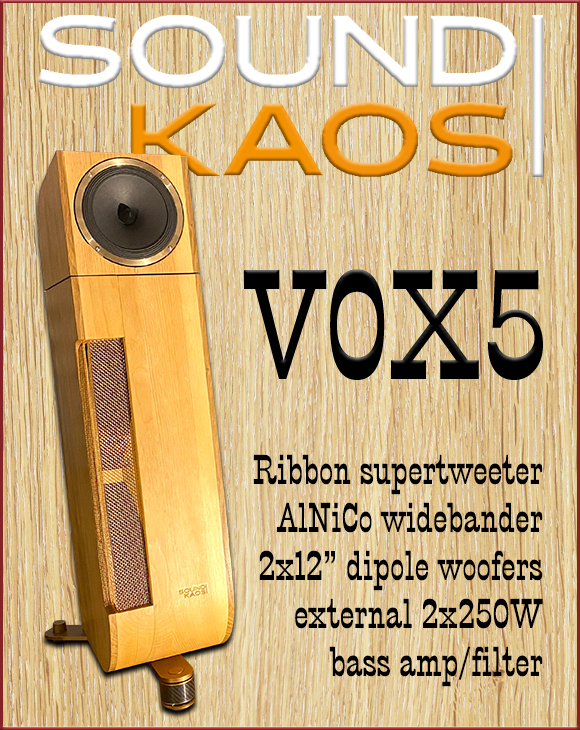
 daudio's M1 true dipole monitor—2×10" force-cancelling sub, tall Mundorf AMT, premium AudioTechnoloy 6" mid, passive 2-way crossover plus ~120Hz active xover to the sub—is an ideal realization of turnkey 2.1 stereo. The open-backed monitor concept creates superlative soundstaging of great airiness with no box-talk reminders. What those are the vast listening majority doesn't know. Like fish in water, they're used to so imprinted by them. Only their sudden absence outs them. Full-range dipoles like Virtual Hifi's ultra-ambitious Supernova must woof big. Hence the Poles stack two mega 15" bass pumps per side. The compact Dutch hybrid solution goes more places. Its adjustable LF balance adds to it. With integration guaranteed—the phase-coherent analog sub/sat filter is fixed and suffers zero DSP latency—this 3-piece fits perfectly off the rack. Merely twirl the sub's pot to taste. Bass to 25Hz, treble to 35kHz or better, midrange championed by Goldmund of extremist Swiss pedigree, the M1 execution is very smart. It's also as décor friendly as it is acoustically easy due to dipole propagation's reduced room interactions. The point-source head works well in the nearfield. Serious bass weaponry also has the number of bigger rooms where the electronically unloaded mids are happy to scale. This just is no large-volume enterprise you call today to ship tomorrow. It's a small boutique which only now is expanding to sales beyond its domestic borders. Baby steps for very grown-up returns.
 Back in the instant web shoppe biz we are with smsl's PL200T. I bought mine from audiophonics.fr. €575. Delivered. CD is dead. Long live CD. A disc on endless repeat. You just can't keep a good format down. For not much money, this is another Sino wonder of perfect machining and sleek industrial design. It's a top loader with a plexi not glass lid. That should better survive an accidental drop. Yet this bonsai deck even works au nature. Just park the small puck on your disc, then hold the play button for two seconds. Voilà. Those four hard chassis controls conceal elite mechanical keyboard switches. That promises very long life indeed. There's a plastic remote, dimmable display and audiophile catnip of I²S/HDMI, AES/EBU and 10MHz 50Ω clock input. TOC read-in is lickety-split. So is commencement of play. Only posh kit takes forever. I run my budgeteer into a 1st-gen LAiV discrete R2R DAC. Splendiferous! I've had zero functional hiccups. I love this minimalist yet full-featured spinner. I adore how nicely it is styled and built. There's even a 5VDC input should we want to skip its built-in SMPS. I haven't bothered. Do disc transports sound different? Been there, done that, smoked the cigarillo. For my compact upstairs tabletop system, naught bigger would have worked. That made the smsl perfect by default. Should its transport mech give up its ghost one day, I never spent the long green. There's no flimsy drawer or suck-in slot to go all verklemmt on me, either. My kinda math.

The ARP-S from Polish designer Arek Kallas is a quite esoteric passive-magnetic linestage. He executes it with four silver-coil autoformers. Their relay-switched taps invoke precisely 1dB-stepped attenuation and voltage/current conversion; under full-function remote control. A plethora of RCA/XLR i/o supports complex installs. The display has 5-stage adjustable brightness including off, shows chosen input and left/right signal cut. Being dual mono, we enjoy balance control. Once dialled in, our offset tracks through all level changes and simply displays like 15:17, showing the left speaker down by 2dB—or however we set our channel balance. In an autoformer attenuation scheme, each additional 10dB of signal cut incurs a logarithmic reduction of output Ω. That increases current flow. This mechanism is believed to be behind a common observation—that AVC/TVC so autoformer/transformer volume controls excel at whisper levels. Translated, they forestall that inevitable sonic bleaching and leaning out which occurs in hifi systems as we ramp down their SPL. Such passive non-resistive preamps are thus at their best when we invoke high signal cut. In my main system, the ARP-S tends to run 30-40dB below unity gain. My bigger upstairs system runs an equivalent solution from Lifesaver Audio's Pàl Nagy. AVC and I have excellent form going back to the Bent Audio TAP-X. Given Arek's skills, I just commissioned him for a custom project. If it turns out, it could be a welcome problem solver not just for yours truly.
 A final para, another Sino punch to the hara. Hands-down, the Gustard U26 is the best USB bridge I've yet run; and I've had my share of various Audiobyte, Singxer and Soundaware. Whilst I can't tap Gustard's Amanero-customed DSD2'048 ceiling—over USB, my Win11/64 Audirvana Studio resampler maxes at DSD512 or PCM768—I listen to much DSD 22.5M off my trusty Qobuz Sublime subscription. I²S outputs to the companion R26II discrete R2R DAC with native DSD. Both sync to the same external LHY crystal oscillator. This chicane is all about chasing nth-degree res. It's on ambient and overtone recovery—recorded data very close to a system's noise floor. There's something to leveraging a modern PC's high processing power for sophisticated sample-rate conversion, then running our D/A converter in NOS mode. There's something else to inserting a top-quality 'buffer' between a generic workstation optimized for intense parallel processing; and an audio-only music processor. Combine such hardware with cracking real-time software code. In a revealing system, compound gains of soundstage depth, image focus, contrast ratio and timbre finesse can become quite hard to miss. At €999 again from French e-tailer audiophonics.fr, this was another non-crazy spend for my office system which as punter by proxy, I can wholeheartedly vouch for to fellow pilgrims on the hear-more trail. With my customary six entries, that now concludes my brief walk down Memory Lane 2026: one each physical and streaming digital transport; one preamp; one integrated amp; one speaker set; one headphone.