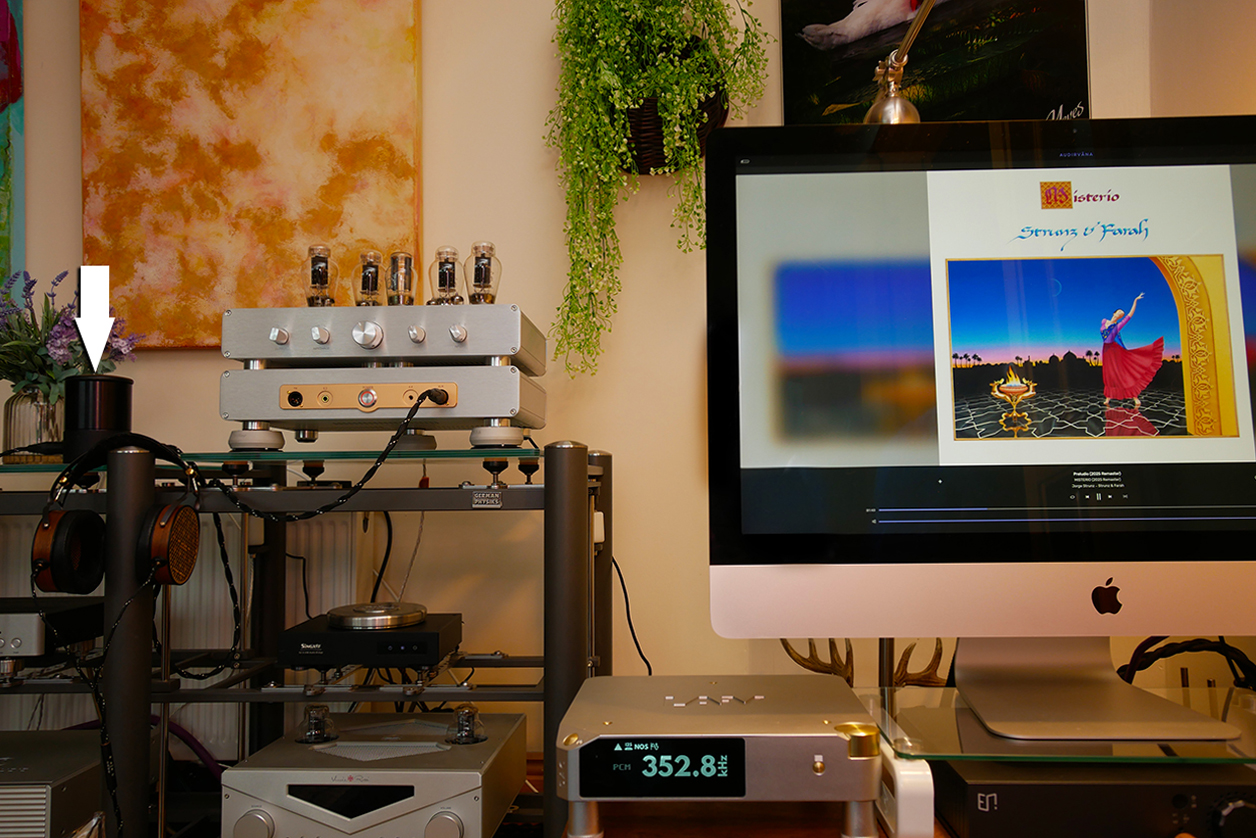
The white arrow points at the 32Ω Raal 1995 interface barrel. I've not heard the newer all-silver version but Simone already reviewed it. These comparisons meant three very quick things: unplug ribbon headphones from their stock barrel connected to Woo's standard XLR4 and plug them into the ribbon XL4; switch output selector; slightly adjust master volume. One of the albums I used was the 2025 remaster of the early Strunz & Farah Misterio release which combines inspired playing with uncomplicated arrangements and quality production values. This difference was very slight; too narrow to lose even one hair over especially when supply is short. Despite well-reading 'direct' propaganda, the only real upside I saw was that we eliminate the external barrel with its separate cable. However, don't pursue the WA33 because of it. Pursue it because it's great, period—and works equally well either way. The rare customer who buys it for Immanis or Magna prior to their acquisition simply saves the cost of the Raal barrel. That's a legitimate advantage. Onto general sonics regardless of load or port including HifiMan OG Susvara and FiiO FT7. The 33's headstage feels unusually wide. Unlike circuits which focus more densely in the centre then bleach the outer quadrants, here the virtual stage's outsides have equal weight. There's no central precedence. Whilst this won't actually broaden the stage as though the distance between our ears grew, it seems so because the outermost images retain equal image density. For headfi that gets quite enormous. This expansive impression is furthered by the amp's supremely airy, lucid and fleet-footed demeanour. It's the anti-clump brand of audiophile cat litter. It's superb at maintaining separation even in the thick of interlocking melodic, harmonic and rhythmic threads. If you foresaw bits or blobs of stickiness from high even-order THD, hawk elsewhere. This fully balanced Woo isn't buying what you're selling. Despite treating its transients gentler than Enleum's lateral Exicon Mosfets, the 33 is bona-fide high res. Forget all about fireside romance, dimmed lights and heightened half shadows. This presentation is fully and thoroughly illuminated inside out. That's its first pillar.
 The next is unfettered speed. It registers as absence of let-go reluctance. This is critical for string tremolo or greased arpeggios where highly clipped sounds follow each other in rapid succession to mandate crisp stoppages for clean spacing. This type precision isn't typically associated with tube circuits since many lengthen their decays. Whilst this is very seductive on simple dreamy material, it gets counterproductive on brisk 32nd-note affairs. Those can feel transplanted into a small church whose reverb then stacks follow-on sounds into quasi chords rather than maintain apartheid. If we define speed as timely stoppages whereby things don't linger past their sell-by date, the Woo WA33 2nd gen is very adroit and exacting. This follows the same observation as slow bass being slow because it stops late when the majority of it snookers around the room before arriving at our ears. Here speed doesn't imply playing a 4"05' track in 3"52". It means avoidance of time blur. Things stop when they should—on time, not behind. When in place, music's forward momentum doesn't impede. Rhythmic tension asserts itself. Nothing wades through water or quicksand. Again, the very real compromises to low-Ω current drive exhibited by many tube amps tasked with speaker drive don't apply with 20 to 600Ω headphones of small drivers, especially planars with very linear impedance.
 Ditto valve preamps looking at the fixed very high input Ω of an amplifier. Tube perceptions tend to be about speaker amps. Their observations don't auto transfer to headfi. When unloaded from nominal 8Ω speakers traversing from 2.5Ω to 25Ω—or higher when ported—depending on frequency, tubes can step out of the transistor shadows to display real equivalence. Today's amp is a beautiful example that's as fast, precise, transparent and resolved as a premium solid-stater. Where it carves out distinctiveness is all about the feel of its soundstage. It's more bloomy, fluffy, billowy and breathy. That's back at my DSD² comment. On that score my Enleum plays it more unwavering or rigid; supremely sorted but with less inner motility. It'd be popular reflex to invoke the old watercolour vs oil-paint simile. I simply heard no runny gradual transitions, no humidity from decays lingering extra. Those would undermine clarity, timing and separation. The 33's soundstage difference didn't. Yet something was looser and freer. Compare the structural feel of the two embedded tracks from the wider Flamenco milieu. The Cortés is mostly staccato like a horse's clipped canter. The Dorantes is legato and sostenuto like a gliding falcon lazily flapping an occasional wing riding the updrafts. Distil that presentational offset. Apply it to Woo's soundstaging gestalt. That'll get you at my intended meaning. It's not soundstages that march or soar. They depict space. Still, the important differentiator lives somewhere in these examples. Ebbing 'n' flowing or crystallized. Gushing or locomotive. Poetic or prosaic. The WA33 2nd-gen essence. From low-power DHT it borrows 45-type airiness and sparkle, a sensation of flow and expansiveness plus subtle softness. From premium solid-state it inherits speed, precision, drive and control. On sheer quantity the male transistor virtues win out over the flowering female attributes of the glowing glass. As in a good conventional marriage, that strikes me as the proper division between hard elbow grease and ephemeral beauty.







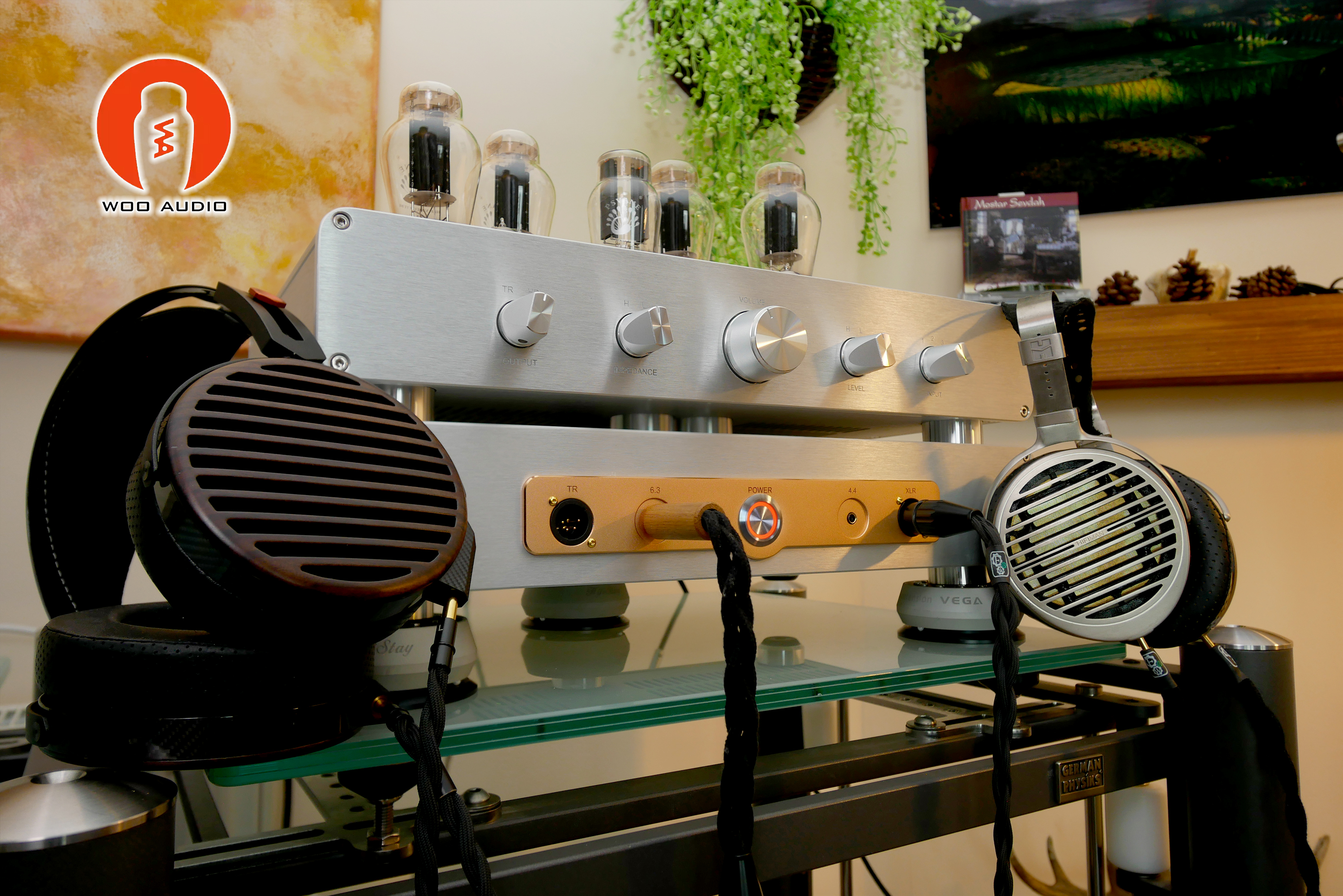
Tubular tolerance is required for occasional mechanical effects. One of the right channel's small tubes very occasionally emitted a single steady tone that continued into the gap between tracks. Tapping it with a fingernail instantly silenced it. I'd not encountered this particular fixed-tone singing with any valve before but never used 6C45PI. Regardless, living with tubes is a bit different than outa-sight outa-mind transistors. That's par for this course. Those shopping here already know or ought to catch up quick that just like occasionally flickering or suddenly dying lightbulbs, tubes are a bit fussier. One wants to keep some spares around just in case one develops the hiccups. Now the smart money wants to know whether feeding the Enleum native DSD via a true 1-bit converter could equal the Woo's peculiar pliancy. Not. The Enleum remains container, DSD its content. Whilst that content behaves a bit different like going from plain to carbonated water, the container shapes it. With the Woo, we change the container and its imprint on the content. That action is more primary so dominant. Whilst the DSD path + premium transistors can act as a quasi preview or mental pointer, the Woo raises its actual potency even with PCM. If one really wants this special suppleness with its sensation of spatial scale and is happy to accommodate its practical demands, these direct-heated triodes—liberated as they are to be at their best into earphones not speakers—are the means. They operate far beyond the coarse differences of tonal balance aberrations, high THD effects, bandwidth limitations, noise and colourations which lesser valve circuits may suffer. On all the basics, they already mirror excellent solid state. But otherness of gestalt remains. That now steps forward or crystallizes out because all lesser distractions or complaints are banished.
Woo'ts up? I'd given the matter no thought. Then Jack Wu's surprise email revived it. I'm honoured that he entrusted me with his creation then embraced the cross-Atlantic travails involved. It reminded me of something I'd forgotten. Just because my headspace no longer accommodates the demands of tube-gear ownership doesn't imply that I can no longer recognize and appreciate the allure of direct-heated triodes when harnessed this smartly. I really hadn't given this any thought; done 'n' dusted like. Having now heard very clearly how close my transistor amp gets whilst also seeing where and how it still diverges, I can think to myself that solid state is 'plenty good enough' with a silent heart of happiness. At the same time I fully appreciate and get why someone else would joyfully embrace the tube maintenance and associated cost issues to bag in this Woo their decisive difference maker. To them I'll say, "good on you. Congrats for identifying then securing yourself a rare masterpiece."
Postscript: When it came time to affix a UPS shipping label to the WA33 2nd gen's carton, It said Lieven on it so the publisher of Headfonia in Belgium. Now you know where to look for its next review. Also, I subsequently became aware that Allnic Audio of Korea too offer ribbon-direct inputs on some of their tube headphone amplifiers. The tyranny of choice…