Crackle'n'pop; not! With instant proof of life, there also was unconditional silence as in, zero self noise. Granted, I didn't have a 115dB IEM insanity plugged into a 10-watt direct-heated triode amp. Just because I had them spare by usually floating my Denafrips CD transport which relinquished its spot here, the same trio of HifiStay rubber-band suspension footers held the amp aloft. With headphone amps, airborne attacks roaming a room as playback SPL don't figure. That type of potentially microphonic interaction is reserved for speaker amps. If you lived in a high rise adjacent to a busy road with plenty of lorry haulers shaking your building, structure-carried resonances could still mandate isolating direct-heated triodes even in headphone mode. In this instance I was merely gilding the lily. I'm in a very rural standalone house's ground floor. For industrial traffic only the occasional tractor and liquid-manure lorry drive by.
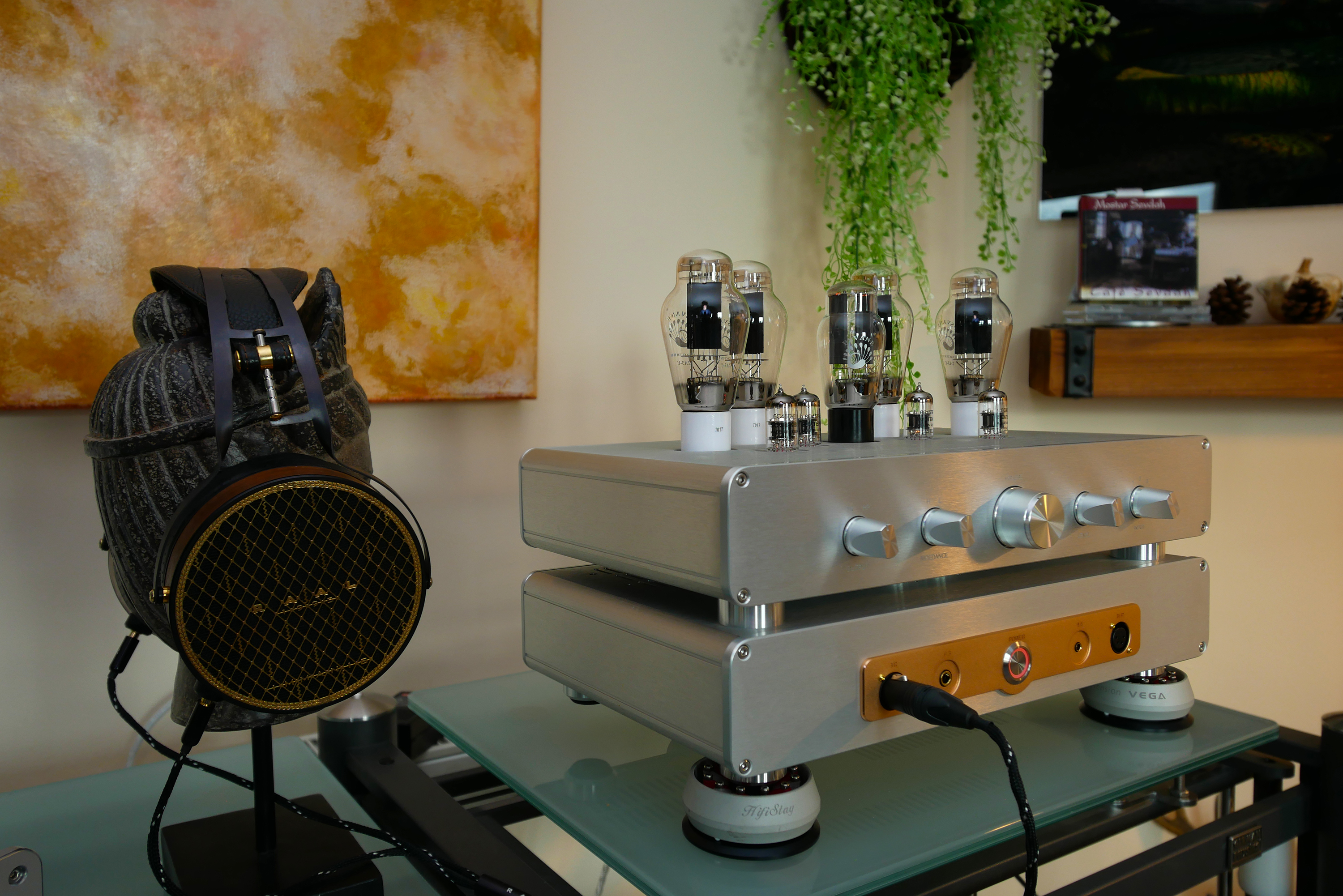
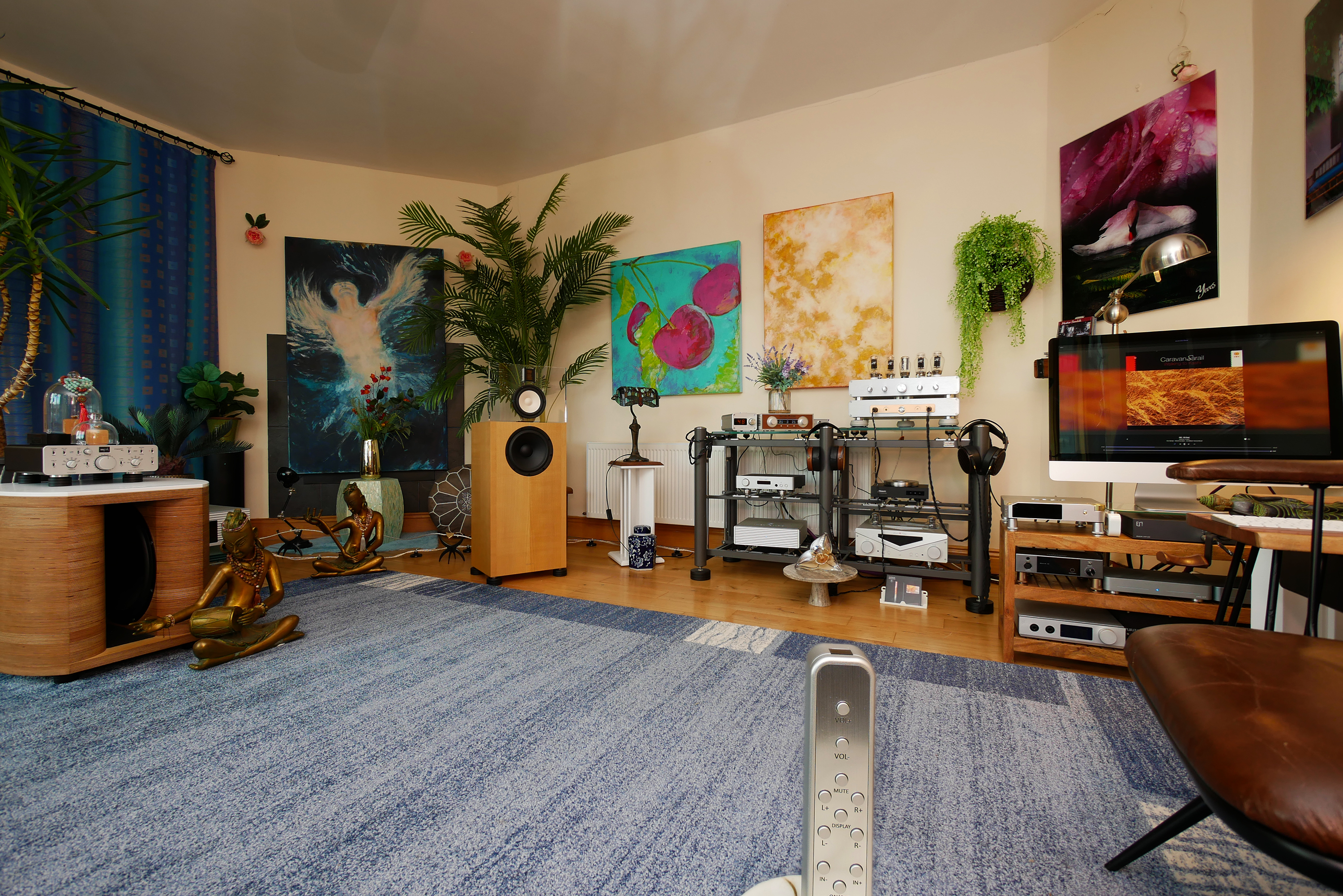
Below the break we see the complete setup: music-dedicated iMac with 40GB RAM and Audirvana Studio preceded by twin-slaved LHY network distributors for cloud files inbound over 20m CAT8a copper. Local files live on a 4TB SSD. Signal exits USB to hit a Singxer SU-6 ultra-cap powered USB bridge. I²S over HDMI returns to Laiv Audio's Harmony DAC in NOS mode to let the r8brain algorithm embedded in Audirvana handle upsampling to 352.8/384kHz. That DAC's fixed 4Vrms XLR output fed the Woo, its 2Vrms RCA an Enleum AMP-23R beneath the iMac. My HeadFi Olympics were open for business.




As I wrote in a recent industry feature entitled Magnetic magick—on the benefits of passive-magnetic volume controllers—"the young Turks on the YouTube review channels of our sector love the term 'technical'. When a component aces all basic specs of low distortion, low noise, high linearity and drive, they call it technical. The ASR site simply measures components to focus exclusively on this technical side without doing any listening. By that metric, perfect measurements equal perfect sound. And that's available for a few hundred bucks from the likes of Topping and smsl. On the opposite end of that dogma flourishes an underground of direct-heated triodes and horns or widebanders plus single-ended static-induction transistors. Their admirers revel in the condemnation which technical measurements might assign to their choices." Being so unabashedly tubular, one could suspect that 'technical' and WA33 2nd gen won't see eye to eye. That presumption makes for an excellent entry into this review. Because if it weren't so and this amp instead fell beyond technical reproach—why bother with the expense and maintenance of valves? Surely a 22wpc/16Ω Topping A900 would be just as technically competent if not more so; and for pennies on the Woo pound. Stir that pot? Without having one on hand, someone else must tackle the Topping topic. I'll reference the AMP-23R as widely reviewed quantity. Not to beat around that bush, on technicalities the Woo proved Enleum's equal. Whatever justifies its use of nine bottles goes beyond thus stands apart from the foundation of neutrality we expect of well-measuring premium transistors. This valve amp is no libertine. It hides no sins of loose engineering behind a hollow façade of 'musicality'. Since an achievement of core equality with transistors seems a most difficult feat with microphonic power triodes and output transformers, one obviously hopes that the extra effort involved also produces something extra. Let's pass that around for closer inspection. It turned out to be very simple.
Take a software algorithm like the r8brain sample-rate converter Audirvana Studio embeds. Set a DAC capable of native DSD to NOS mode. Send it 16/44.1 Redbook as either upsampled 352.8/384 PCM or resampled DSD256. Bottle the difference. Put a dial on it. Crank it up by a few clicks. Affix a label to that brew. Write on it Woo factor. Imbibe at will. If you've never done the PCM⇒DSD deed with a DAC good at 1-bit decoding, we now need more. Here goes for PCM: deeper but narrower staging; crisper outlines; drier textures; brighter treble; higher tension; sharper focus; shinier colours. DSD: wider but shallower staging; softer outlines; wetter textures; gentler treble; a more relaxed feel; subtly diffuse focus; more saturated colours. Where PCM focuses more on the materialism of images here, DSD digs deeper into the billowy ambiance of elastic spaciousness there. Replace PCM with Enleum, DSD with Woo. Voilà, the essence of my juxtaposition. I did promise simplicity. Has DSD your vote, this Woo actor could turn serious wow factor. If you're of the PCM people, it's an alternate reality. You could easily live there but would redecorate a bit. What does this mean for returns on extra tubular effort? Once we reference a transistor amp of AMP-23R pedigree, we leave behind the domain of 'better'. We instead enter the sideways dimension of 'just different'. The 2nd-gen WA33 was undeniably different. By concentrating thus enlarging a general PCM⇒DSD shift beyond algorithmic trickery, it became a legitimate alternative. All peaches and cream? I didn't hear any next level which I'd personally need to justify transitioning from silicon to glass whilst increasing my outlay by a third whilst giving up speaker drive. That's the only shade I can throw at Jack Wu's double-decker. Having obeyed the dictates of keeping it honest, let's proceed to considering this machine on its own merits. First, the iron vs iron² question of ribbon-direct drive so Jack's output transformer with special secondary; vs ribbon Ω interface so Jack's output transformer with classic secondary plus Alex's external 32Ω transformer.