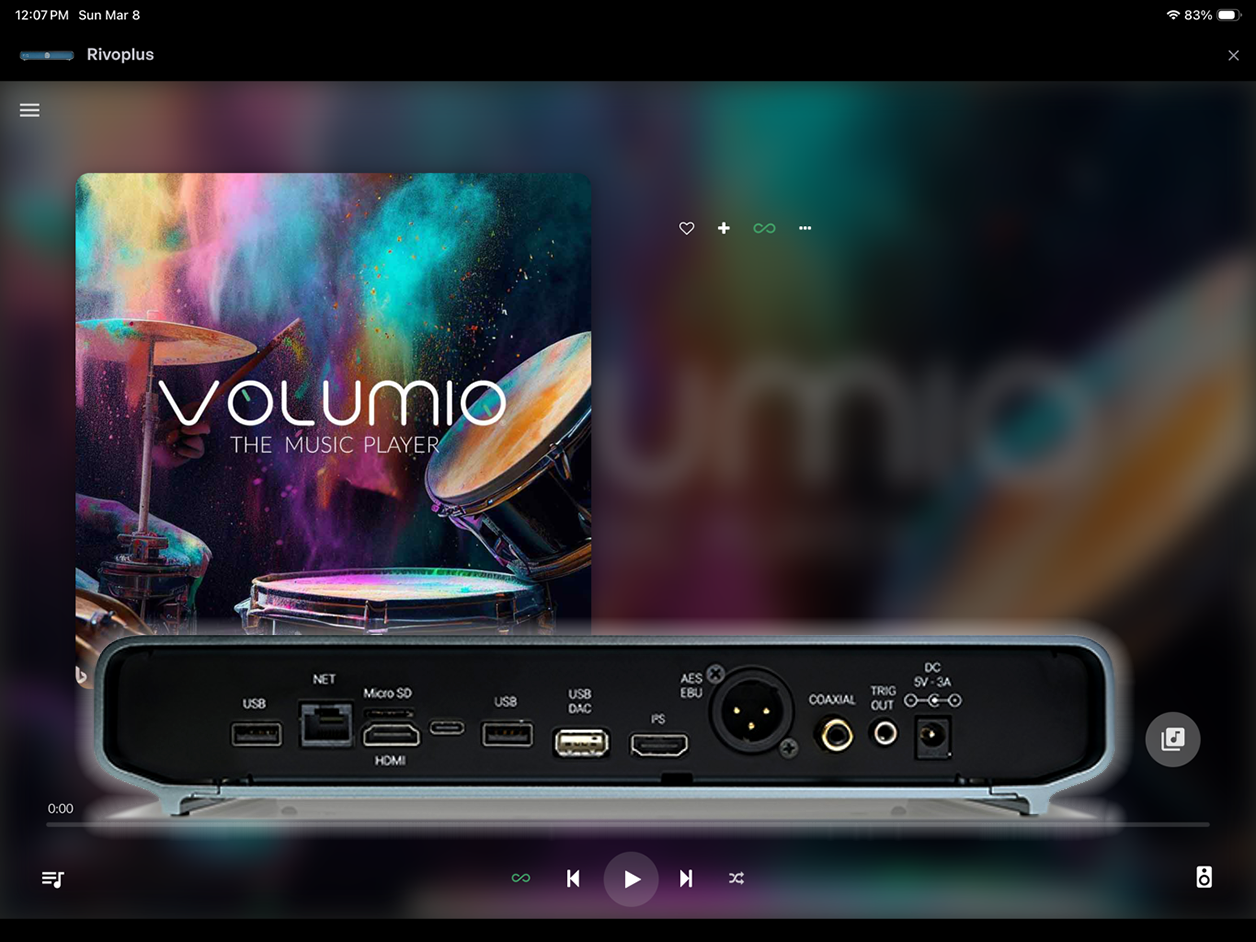
Unfortunately, Volumio can't do naught about the fact that Mola-Mola doesn't allow DSD via I²S into their Tambaqui for fear of retribution from Sony over SACD patents. Those risks don't apply to DSD streaming from legitimate sources but the Tambaqui's I²S input remains locked even when streaming DSD repackaged as PCM (known as DoP), a common work-around implemented by many brands. This is a very rare instance but something to be aware of if you have a large DSD collection and were planning on streaming from the Rivo+ into a DAC with restricted I²S. Since the Rivo+ cannot convert DSD to PCM, the only solution with such DACs is to use the USB connection, therefore shutting down all others. Fifth and final critical design choice impacting the sound of a streamer is the often overlooked dimension of software and operating system which impacts buffer management, network data packet handling and CPU load. Different operating systems can generate very different electrical noise profiles inside hardware. That's why Srajan for years has been utilizing dedicated music players on his Macs and where Volumio's Linux-based audio-optimized OS plays a major role. The platform manages playback buffers, streaming services and plugins while keeping the audio pipeline as streamlined and stable as possible. From a purely mathematical perspective, all streamers should sound identical yet in real hardware systems, we can hear profound differences as my experiments with the Rivo+ reconfirmed over the past weeks. Each of the five variables I described influences how the DAC reconstructs the analog waveform. This is why transports that appear similar on paper often produce different sonic signatures despite delivering the same bits. In the end, the audiophile streamer is less of a computer and more of a sophisticated timing instrument. Its mission is not merely to move data. Its mission is to move data quietly, precisely and without disturbing the fragile analog world waiting on the other side of the DAC. And with that little technical meandering out of the way, let's put our ears to work.
The first and for me maybe less intuitive conclusion was that the Rivo+, with its basic switching power supply already sounds extremely competent. Digital playback today often converges on a baseline of quiet backgrounds, stable imaging and good timing. The Rivo+ hit all of those marks. I would call it quite transparent overall but with a bit of emphasis on the upper midrange (violins and sopranos) and some hint of digital glare especially through its USB output when compared to pricier streamers. In all systems I tried, the Rivo+ showed strong emphasis on transient dynamics, maybe a bit over-emphasized at times but it certainly worked hard at preserving the pace and contrast of the music, with rhythm sections always taut and articulate. The stage is wide and extends well beyond speaker boundaries. Imaging is stable but slightly two-dimensional compared to top-tier transports. Overall the stock Rivo+ gives out a strong sense of digital correctness without ever sounding romanticized. I'd probably pair it with a more tonally forgiving DAC like a Denafrips or LTA Aero and my listening confirmed that one should stay away from the leaner Holo Cyan2 which does over-emphasize the already ultra-sharp transients especially over USB.









But then enters the optional Lineo5 power supply, a traditional linear sort delivering 5V/5A through a heavy transformer-based design intended to replace the stock switching adapter. As of this writing, the Lineo5 cannot ship to the US due to customs and regulatory limitations. For US clients, a good alternative is to order through Vinshine Audio, an approved Volumio distributor who can bundle the Rivo+ with one of the excellent LHY linear power supplies. With the Lineo5, the expected benefits of a lower noise floor are immediately audible, micro details emerge more clearly and quiet passages feel more resolved. But in the case of the Rivo+, the most beneficial improvement is that associated instrument textures feel fuller and more organic. The music sounds less 'digital', more continuous and goes a good way towards addressing the primary weakness of the stock Rivo+. Taken as a whole, the richer tones, deeper stage and more relaxed presentation push the Rivo+ into another tier. At this stage and as impressed as I was, I had to admit that my reference system was probably not ideal to fully do justice to the $2'000 Rivo+ and Lineo 5. Even if comparisons were insightful, they were probably not of great use to readers not used to $20K digital front-ends. So I made a few calls to fellow audiophiles whose systems are well put together and over a few weekends we lined up a comparison with the Eversolo T8 ($1'400) into the Denafrips Pontus II 12th anniversary ($1'800 when last available) and with the Aurender N150 ($3'850) into a Laiv Harmony DAC ($2'850), finishing with my own Lumin U2 ($5'000) and Mola Mola Tambaqui ($14'000), the only system using an optical LAN connection to decouple the streamer from network noise (the Eversolo T8 can also connect optically but it was using a regular wired LAN cable when we auditioned it).
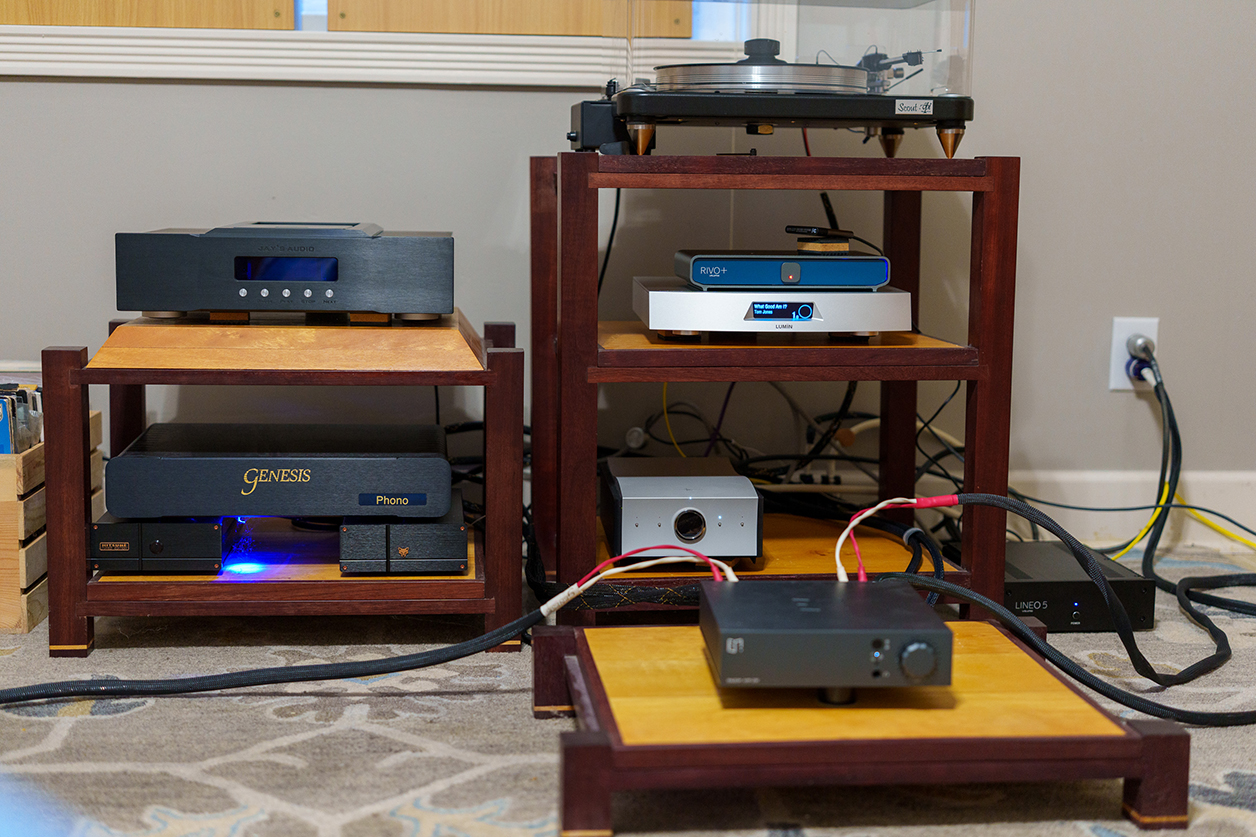
Starting with the Eversolo T8 and Pontus 12th Anniversary, the contrasts were quite extreme. The Eversolo T8 is a feature monster. It includes a large 6" touchscreen, internal memory and a full streaming interface with extensive connectivity including LAN over fiber optics. Where the Rivo+ plays up minimalism and sobriety, the T8 hits back with every feature ever found on a streamer for less than $1'400 even after tariffs. Sonically though the T8 fell well short of the Rivo+/Lineo5, to an extent that surprised me considering the high level of praise usually loaded upon that brand. The T8 didn't sound bad but was leaner, flatter and overall far less engaging regardless of connection used. I know that the price difference between the two is substantial but if it were me, I'd wait and save the extra $600 to jump from a feature-rich but sonically entry-level streamer to a true audiophile solution with the Rivo+/Lineo5. By the end of our afternoon, a used Eversolo T8 went up for sale and is now long gone.