Over the years I learnt that most footer designs follow a broadly similar sonic protocol. The differences between them rarely lie in what they do but rather, how much of it they do. There are levels to this hobby. When we pay premium green for resonance-control devices, it's only natural to expect premium results. On that note, my Vox monitors on Vibron and Auva 70 sounded broadly alike yet the magnitude of changes was not identical. Stack Audio did more for my Swiss speakers. It really was that simple. The gap wasn't night and day but sufficient to identify the footer that allowed the Vox boxes to dig deeper, gain extra heft and open the soundscape further while letting in more light and fine detail. The monitors atop the British isolators sounded still larger, beefier, more dynamically keen, investigative and radiant. I'm sure anyone ready to part with nearly €1'000 for two quads of these British particle-filled wonders will be very pleased to read this. Yet none of it takes away from Vibron. What they accomplish and how convincingly they do it is more than enough to justify their far more modest price. That's key.
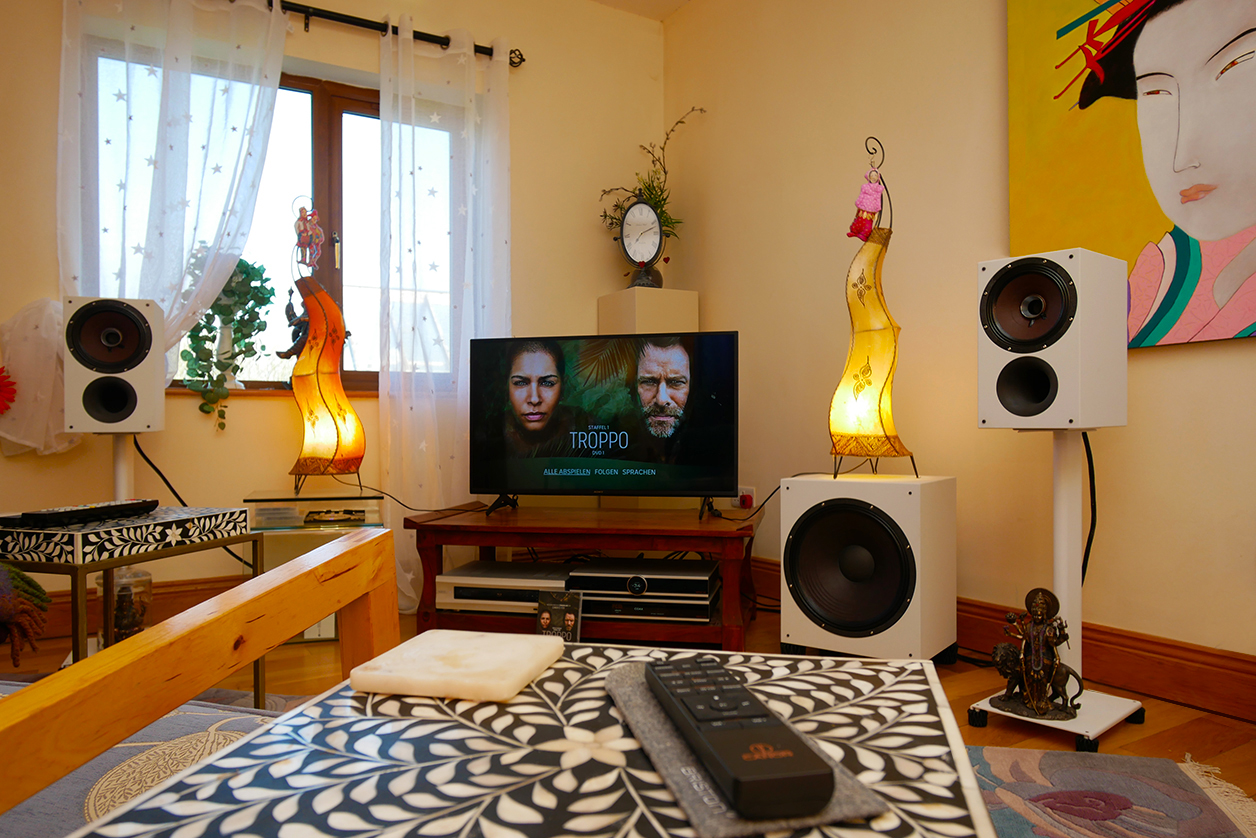 In casa 6moons, Vibron footers beneath Zu Method monitor stands and Zu Method subwoofer.
To raise the competitive ante further, three L-sized Vibron under my DAC traded blows with an altogether different league of resonance control. In the opposing corner sat three LessLoss GiantSteps atop fully kitted-out Carbide Base Micros, a stack that demands a cool €2'505/4 all in. To my ears this remains the most potent anti-vibration arsenal for electronics currently at my disposal. It covers all bases extremely effectively. One special trait of that setup is how much speedier, quicksilvery and plain raw my DAC sounds with it. There are mechanical reasons but that's beside the point. What matters is that while Vibron couldn't replicate the same ripped, spatially liberated, fully charged and overall bombastic aesthetic, it gave me a convincing taste of it. Against my daily driver its behaviour was simply softer, bloomier and more picturesque. Truth told, I didn't expect the 3D-printed team to match my reference stack where it matters nor did I anticipate securing anywhere near the same magic for a fraction of the cost. Yet from their service under the Horizon360, I gathered that whatever these Polish footers do, they do it remarkably well. For tubed digital hardware in particular, Vibron is the bee's knees. Besides, my comparison to far pricier counterparts was purely academic to begin with. I don't imagine anyone who already runs top-shelf isolators looking to downscale. That scenario is very unrealistic. The most important thing is what Vibron does against standard-issue footers by way of washers, spikes and their ilk. When put up against these, the local footers shine brightest and reveal their true strengths. Let's wrap.









At first glance it seems almost suspicious that Vibron manages to do so much for so little. Softening that assessment would be criminal, however. These small, cleverly executed very nicely packaged black buggers genuinely deliver an awful lot for their sticker. Truth told, I didn't expect this level of performance from an audio product priced roughly like a meal for two. As far as budget audio goes, Vibron sets the bar unreasonably high, quite the feat given that it's the most affordable hifi product I've ever sampled. High effectiveness, ease of use and sheer attainability make them ideal candidates for newcomers as well as naysayers who still hog the fence on anything tweaky. It really doesn't get cheaper than this to meaningfully improve our system and possibly become a convert in the process. Just do it. Thank me later. What we also learnt is that 3D printing now is very much a thing in our industry. Grzegorz Rulka simply happens to tread that path earlier than most and his Vibron are reminder that his is a very clever mind with its priorities firmly in place. Well played, sir. I couldn't have asked for more.