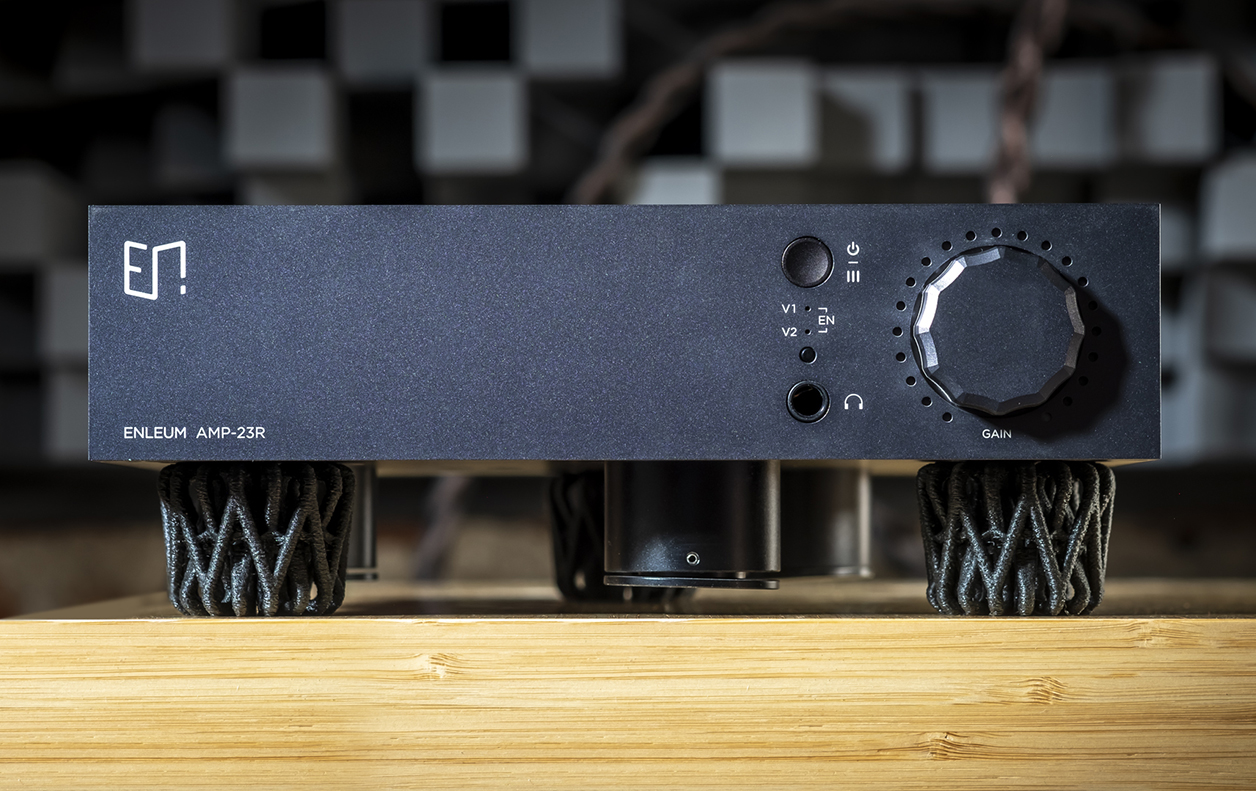
At its core Vibron is an anti-vibration footer designed to intake oscillations generated by the product atop it. That could be an amplifier, DAC, loudspeaker or pretty much anything that injects mechanical energy into whatever it sits on. Instead of allowing these resonances to travel further down the chain and excite racks, stands or floors, Vibron's job is to intercept them. The idea is simple enough. Vibrations enter the footer, travel through its elaborate structure, exhaust themselves and in the process convert to heat. Once that energy dissipates, it effectively disappears from the equation. That's the theory behind most isolators. Vibron simply approaches the task in its own distinctive way. Here structure is key. Vibron footers look unlike most counterparts because they result from fused filament deposition of thermoplastic polyurethane, i.e. 3D printing. This tech has matured to a point where it allows rather quick manufacturing of remarkably complex shapes that would be extremely difficult if not outright impossible with conventional subtractive machining methods. Instead of carving a footer from aluminium or moulding a rubber puck, one grows the desired geometry layer by layer one droplet at a time. Grzegorz Rulka has turned that capability into his daily bread. With an army of printers running pretty much around the clock, he manufactures these parts on a scale that makes sense for our industry. The process is efficient, flexible, cost-effective and particularly well suited to designs that rely on elaborate internal structures.
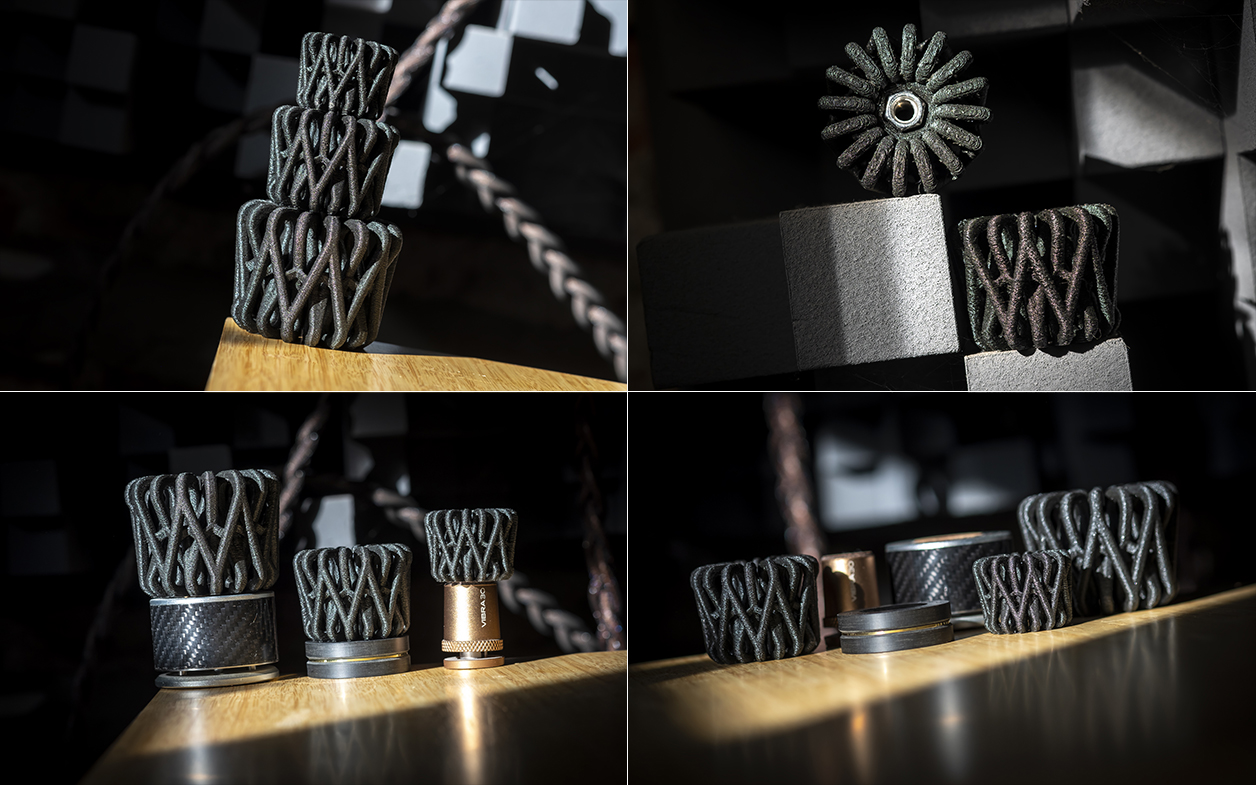
Vibron footers come in three sizes: M, L and XL. Their dimensions are 44×34mm, 58×45mm and 76×58mm WxH whilst load bearing limits for quads are 15kg, 40kg and 80kg. As far as audio gear goes, that covers just about anything one might realistically want to support. Smaller electronics and compact monitors fall comfortably within the M limits, heavier speakers or more substantial electronics move up the ladder. No stone is left unturned. Each footer embeds an internal hexagonal shaft that serves as retainer for threaded inserts. The supplied hardware varies with model. Vibron M ships with M6 and ¼" bolts, L adds M8, XL includes M8, M10 and ¼" bolts to cover the vast majority of speakers and components currently in circulation. An included Allen key takes care of installation and makes the process quick and painless. While Vibron footers certainly look unusual, they also behave somewhat different from the typical isolator. Pick one up and it doesn't take much to gently squeeze and feel individual ribs give slightly under pressure. The entire geometry exhibits some horizontal compliance due to the inherent plasticity of the printed TPU. Yet in the vertical axis—the one that actually matters once the footer is in service—the structure remains so robust that you can stand on one without crushing it. That peculiar combination of flexibility and strength is no accident. The lattice-like arrangement of ribs distributes the load efficiently while still allowing the material to respond to incoming vibrations.










Like all vibration dissipators, Vibron acts as directional sink for mechanical energy. Transferred resonance travels through the structure and dissipates instead of reflecting straight back into the load. Accessories of this type generally fall into two camps. Soft designs rely on springs, rubber elements or elastomers that allow visible movement. Hard solutions use rigid materials and avoid obvious springy reactions. Vibron initially appears to be of the latter category. First, its unibody structure is entirely 3D printed to contain no moving element apart from the steel insert to accommodate the mounting bolt. Second, in the vertical axis Vibron remains firm to show no meaningful compression under load. Yet the fact that the elaborate geometry yields slightly when squeezed suggests something more nuanced. The structure itself provides the compliance rather than a separate elastic element. For that reason Vibron behaves neither fully soft nor as hard as Ansuz, LessLoss or Stack Audio footers. Hybrid seems the most accurate description. As far as fit and finish go, Vibron proudly reveals its manufacturing method. Up close print lines clearly show with no attempt to disguise them. From a distance that becomes irrelevant. While the product in any of its three sizes holds no audiophile jewelry status, it looks interesting. Much of that visual appeal comes from how Grzegorz arranged his 32 miniature beams into a coherent load-bearing object. The result looks purposeful and rather clever as though someone carefully engineered a small architectural framework, not a typically basic audio accessory.
The same thoughtful approach extends to the packaging. When Grzegorz sent me a tracking number, I expected a simple cardboard box with loose footers bouncing around. What arrived was a sturdy bubble envelope with six neat pouches bearing the brand name. Each housed a quad of footers mounted to a two-piece 3D-printed red container which also held the bolts and Allen key in dedicated recesses. That level of organization caught me out. I didn't expect our man to go that extra mile. Yet there was a very pragmatic reason for it. As he explained, designing his own frame optimized for storing Vibron and spare parts was far easier and more cost-effective than ordering custom-cut cardboard inserts. When you already operate a fleet of printers, producing a purpose-built plastic holder made more sense. Clever and practical. Finally there's the coin not conman code. A set of four M-size Vibron costs €59 before VAT which in today's landscape is roughly equivalent to a modest lunch for two. The larger versions climb to €99 for L, €159 for XL. Considering what many vibration-control accessories ask for now, these figures feel disarmingly sensible. In fact, they feel like peanuts. Let's find out how they taste to the ears. As a reviewer who has accumulated a fair number of isolation devices over the years, I had a clear plan for Vibron long before the courier rang the bell. My system is anything but shy of resonance-control hardware. Under my sound|kaos Vox 3afw monitors currently sit Stack Audio Auva footers, a LampizatOr Horizon360 DAC and Trilogy 915R preamplifier rest atop LessLoss GiantSteps placed on diamond-tiered Carbide Base Micro equipped with hard TwinDamp inserts and spikes. Vibron had some rather serious company in wait.