Once my inbox had Marek's FedEx tracker, I looked at an inbound single 56.5kg shipment of 82x56x121cm with an estimated 7-day turnaround from Poland's Poznan to Ireland's County Clare via the usual pitstops in Germany, Holland and the UK. Though such details may seem too trivial or trying to mention, with direct sales it's useful to have anecdotal evidence on which to base realistic ETA. To that we must add delays for custom finishes about which we'll be informed upfront. I had no indications on the skin score but expected the Indian Apple veneer as flown with the first web images. Past dispatch, Marek informed me that they'd forgotten the foam port bungs which would arrive by separate mail. With two ports per channels to seal, we gain four tuning scenarios: widen open, fully closed, top or bottom port closed. Whilst not as adjustable as active bass with variable volume and low pass, bunging it is a desirable option for any passive bass-reflex speaker. A Raidho tower I reviewed had a vertical slot port with eight discrete chambers. Each of those could be sealed off separately to change the bass-reflex tuning frequency and its relative output. That's definitely useful. Kudos to Verseo for including this easy but practical tweak.
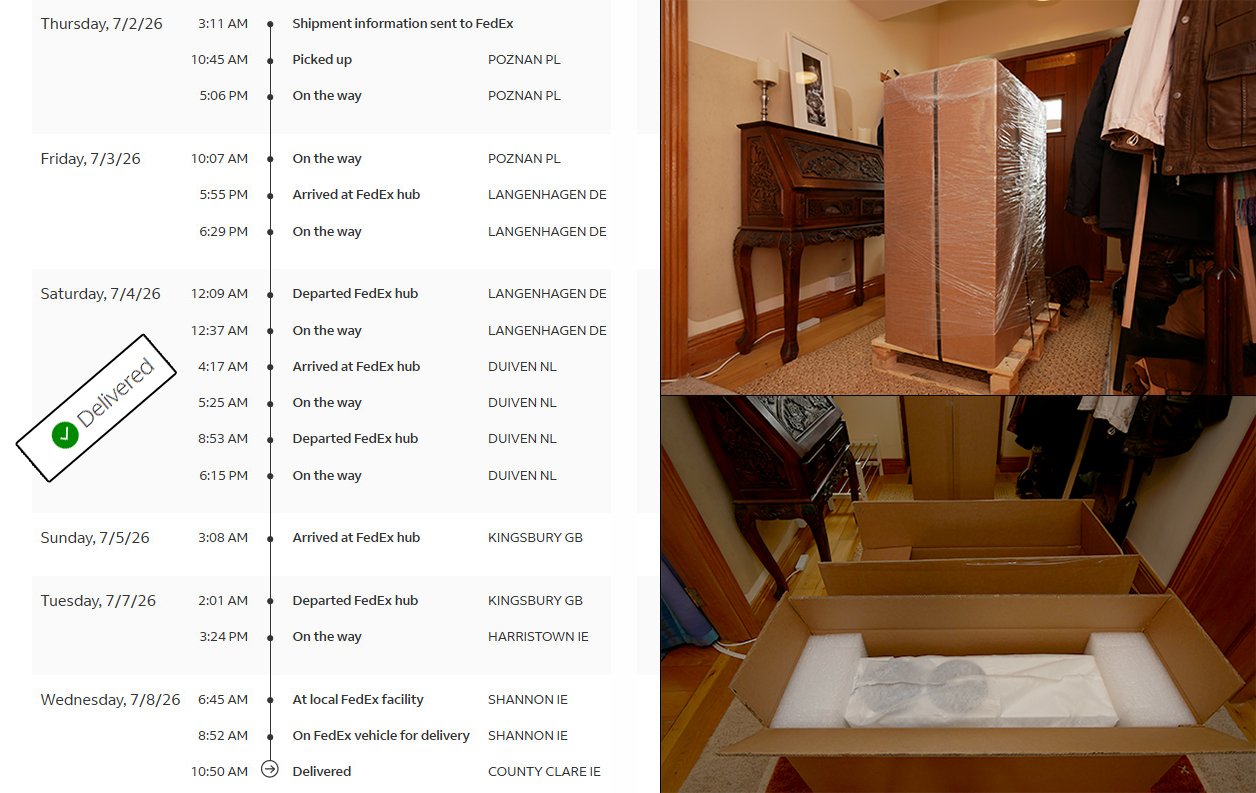
My Blue Train rolled into town a day early. Not FedUp but FedExcellence. Strapped to a half pallet then weather-wrapped just in case—the Emerald Isle wants plentiful rain to stay green unlike SoCal—each speaker unpeeled from robust double cartons then standard foam cradles. Rather than blue, my samples were white. Marek knows my proclivities well. When younger, many white people feel that a deep suntan has them look decisively more attractive. Meanwhile natively dark-skinned people might pursue skin bleach. Once we age sufficiently to embrace self love, acceptance of our DNA follows naturally. I'm twice pale now, of skin and hair. So my favourite speaker colour is white, with silver electronics to complete the mirror effect.









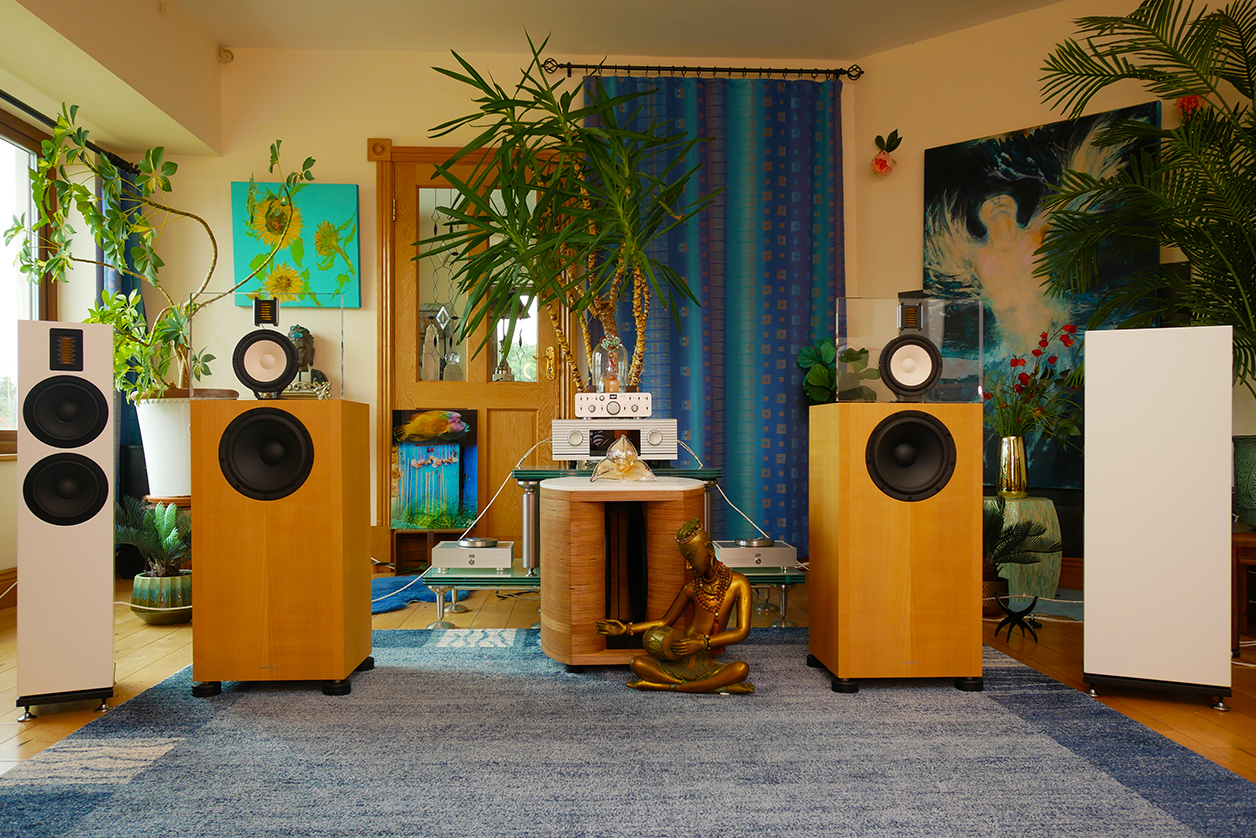
Next we see Blue Train's mass appeal rubbing shoulders with Qualio's burlier IQ. That follows the popular call of narrow being the straightest arrow. With claimed response to well within 10 cycles of the boxier IQ's 28Hz spec, that will undoubtedly have adherents. The floating plinth effect with a deliberate small gap and the winged WBT binding posts we already spotted are nice details, too. Time to move the Qualio to temp pasture and let the Verseo rule this roost.
First, a closer look at its drivers. Eagle eyes already saw that this Mundorf AMT is twice the size of what IQ flies whilst the Qualio makes up for it with twice the in-room surface by radiating open-backed. Here Marek's black trim conceals all driver mounts for a cleaner more styled look. Without fancy Avalon facets or curved Raidho cheeks to drive up the box build, I thought that this Blue Train cuts a nice simple figure which doesn't have the male gaze get hung up on anything in particular. For many domestic environs, less is more on the cosmetic score. Whilst there are no grills, I think this execution passes muster and cuts mustard without hiding its drivers behind cloth.
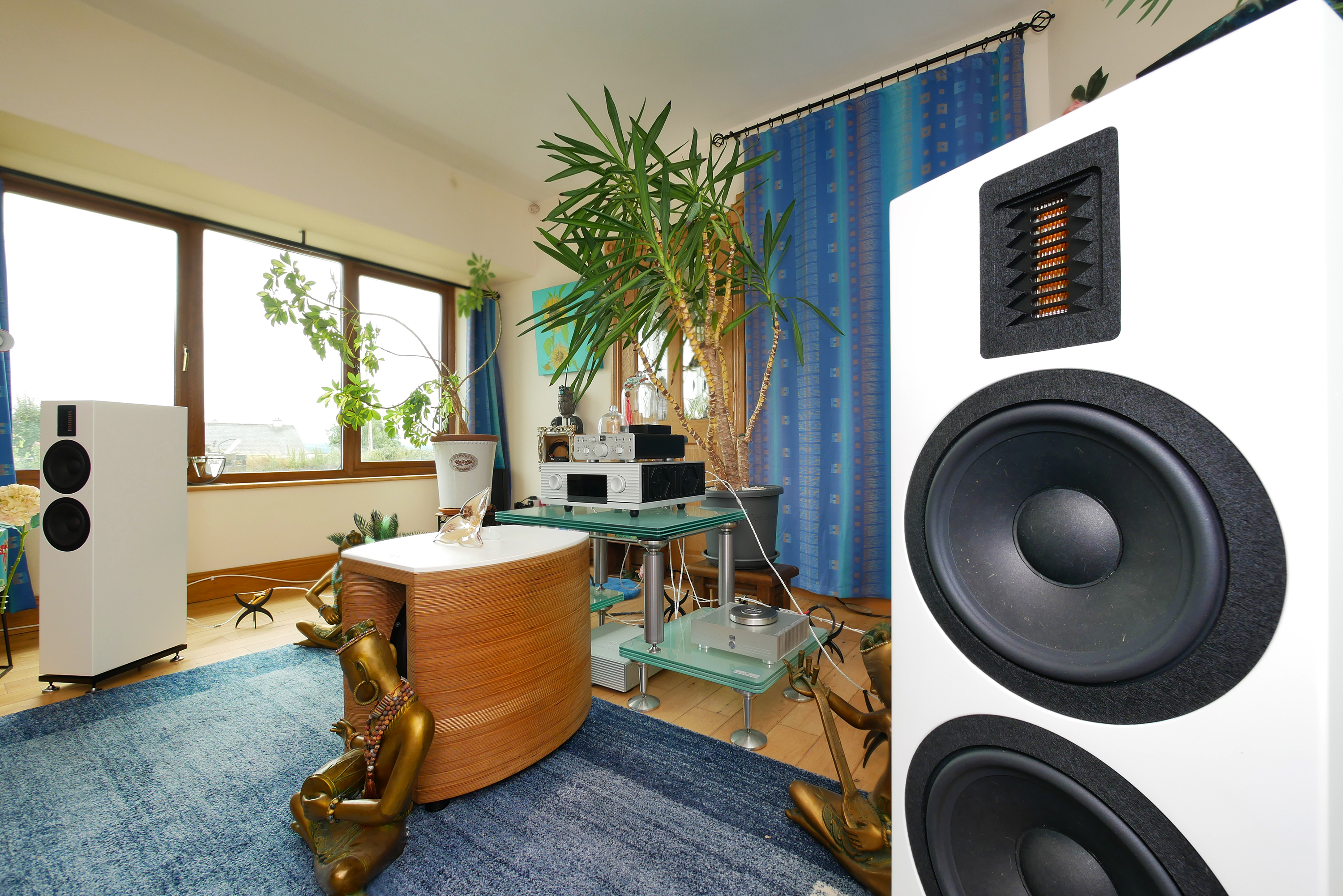 Wide-angle lens distortion makes the close-up Mundorf appear stockier than it is.
This setup gives me two easy options: regular stereo; and stereo 2.1. In stereo mode, a Sonnet Pasithea R2R DAC with split-level processing runs 4Vrms fixed out into a Hattor Audio passive-magnetic preamp. Its four silver-wired multi-tapped autoformers attenuate in 1dB remote-triggered steps. Next the now voltage/current-shifted signal meets the above spl Crossover MkII riding piggyback on a 300wpc Kinki/Vinshine Dazzle integrated which I operate in lower-gain bypass to circumvent its active preamp stage. In full-range speaker mode, the signal enters and exits the spl with zero processing. A simple toggle enables that bypass without any rewiring. In 2.1 mode the spl executes a 4th-order/100Hz signal split into a speaker high pass and subwoofer low pass. My primary reason for that labour division isn't extra bandwidth. It's directional bass by virtue of a 'super' dipole or RiPol so not classic omni radiation pattern. RiPol triggers noticeably less room gain with its lingering overhang whereby LF don't stop on time. Giving that dual 15" sub—each woofer sees a 700W/4Ω nCore-500 mono—bandwidth to 100Hz enfolds my 35/70Hz room modes in its advantageous quasi cardioid dispersion whilst the sidewalls, floor and ceiling disappear as reflective contributors. Two active PSI Audio bass traps in the front corners then cover 160Hz and below to clean up remaining pressure build-up which further undermines any drone of standing bass energies. And yes, if the main speakers are compact and bass limited, a sub solid to 25Hz does add reach and power. With my usual Qualio IQ already breaching 30Hz, that's a very secondary most limited side effect. Again, the sub's primary purpose is acoustic zero-DSP room treatment without classic bass absorbers. Those would need to be voluminous to work at these frequencies. I rather look at an admittedly bigger sub and two small black 'plant stands' in the active PSI traps. To test Blue Train's solo performance, I bypassed the spl xover whilst checking on room-induced amplitude peaks and whatever effect the bungs would have. For my best 'clean-room' performance where omni bass is inherently handicapped unless we use copious acoustic treatments, I had my stereo 2.1 split. "Both ports tune to the same frequency. You can close one or both. With the Blue Train the tuning won't change because each driver operates in its own chamber to ensure equal loading. If both drivers shared the same enclosure with two ports, sealing one would lower the tuning and slightly modify the speaker's performance."