 "I was going to write you after returning from vacation but here already are a few words about this project which I've been thinking about for years. As you know, I've worked on full-range and dipole designs for Cube and Qualio. I started Cube about 20 years ago and developed various concepts for many years. I produced wideband speakers in collaboration with Polish company stx years before the Cube F8 debuted. Back then these drivers weren't as advanced as they are today but the stx F155 and F180 were quite popular on the DIY market. Similarly, many years before we launched Qualio, I built Sensus Audio dipole systems which if memory serves, demoed at the Warsaw Audio Show 17 years ago. These systems used a modified Visaton widebander with 15" Monacor woofer. And you already know about my 16 years at Pylon creating mainstream projects. With the Verseo brand I combine all my previous experience which isn't surprising, but this experience may feed various visions including a 'concept car' and I'm committed to designing technology that people can enjoy for years to come.
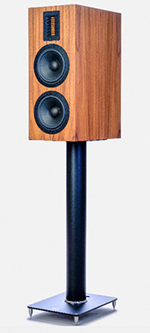
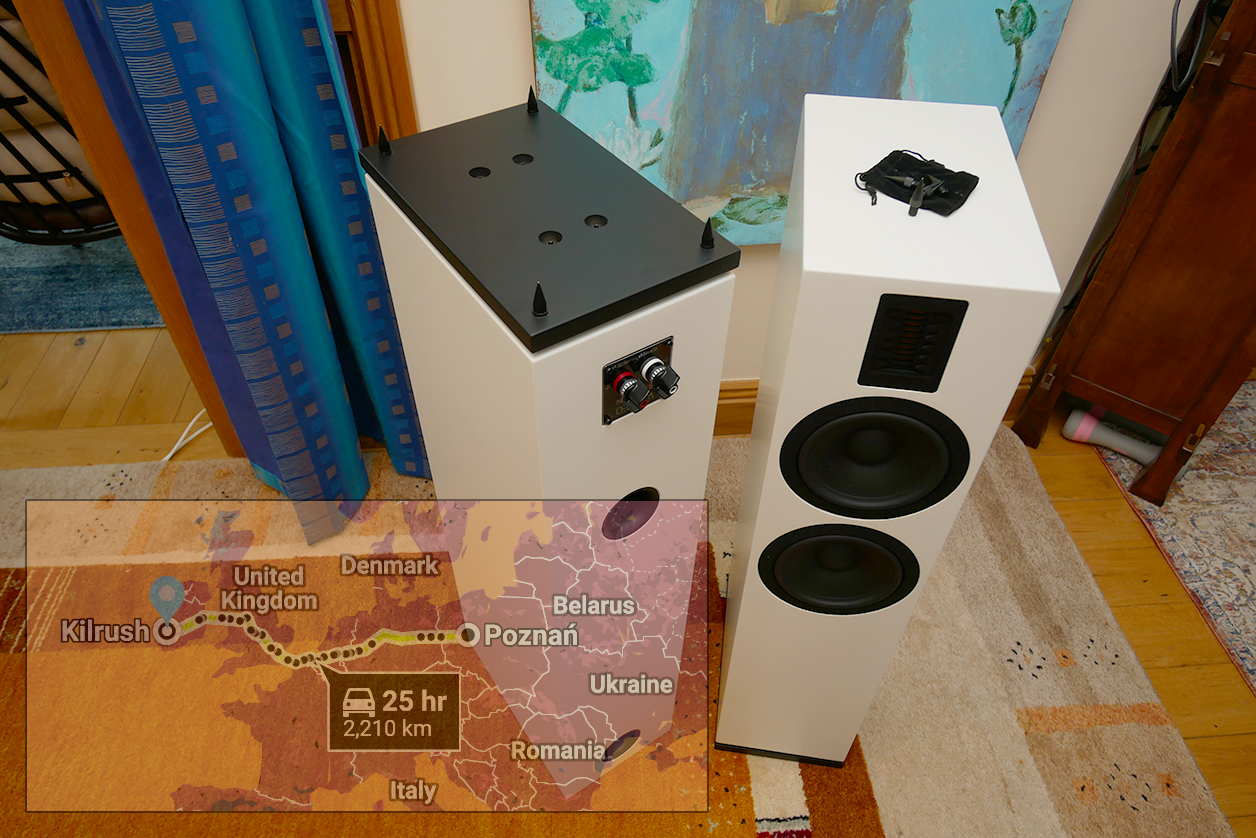
"The first Verseo Blue Train model is  a 2½-way 4Ω design. The tweeter is either a monopole Mundorf AMT or, in progress, a soft dome. Midrange and bass are handled by 6" SB Acoustics cellulose cones. Each operates in its own vented sub enclosure of irregular shape. This improves overall structural rigidity, resonance control, reduces standing waves inside the enclosure and allows for smoother tuning of the LF to room acoustics. Response is 35Hz-31kHz, efficiency 89dB. Finishes are any RAL colour in gloss or satin plus veneers. The speakers are equipped with a pair of WBT terminals and the crossover, similar to Qualio, uses Munforf/Jantzen parts. The version with the AMT driver in standard white or black satin/gloss prices at €5'900/pr. As you might have guessed, the model names come from album titles I like."
The Blue Train stands on a tidy footprint of just 20×32.5cm WxD and rises to merely 92.5cm. The Stardust stand-mount monitor on the same footprint scales down to twin 5" mid/woofers and 47cm height. This first Verseo crop clearly maintains Qualio's ported Mundorf/SB Acoustics faith including generic box cosmetics, finish choices and pricing 'hood. Playing blasé critic from a safe distance, my first take was uncertainty. Did these models pack sufficient difference which yet another speaker brand might sorely need to justify itself in an overcrowded market? Didn't Blue Train read like a Qualio Quantum without dipole aspect, Stardust like a monopole Quanteen with paralleled smaller cones instead of a single larger cone? I had to keep an open mind. More to the point, I had to keep my ears open. If this is how Marek Kostrzyński opted to kick off his own solo venture, there had to be more to it than meets the eye. After all, his Quanteen had proven to be anything but me-too just a week ago. And as far as cosmetics are concerned, one man's generic is another man's classic. For some basic math, the cone surface of two 6-inch drivers doubling up in the bass range equates to a single 8½" woofer. Unlike a 3-way using such a single woofer to then see a smaller dedicated midrange, Blue Train's upper cone runs wide open in the bottom to avoid a passive high-pass filter. That tends to be the core rationale why certain designers favour 2½-ways to then accept lower impedance in trade. For Blue Train and Stardust, Marek's intro had promised us "classics with a touch of style and a few new ideas". Having covered the drivers and cab, the new ideas must inform the crossovers?
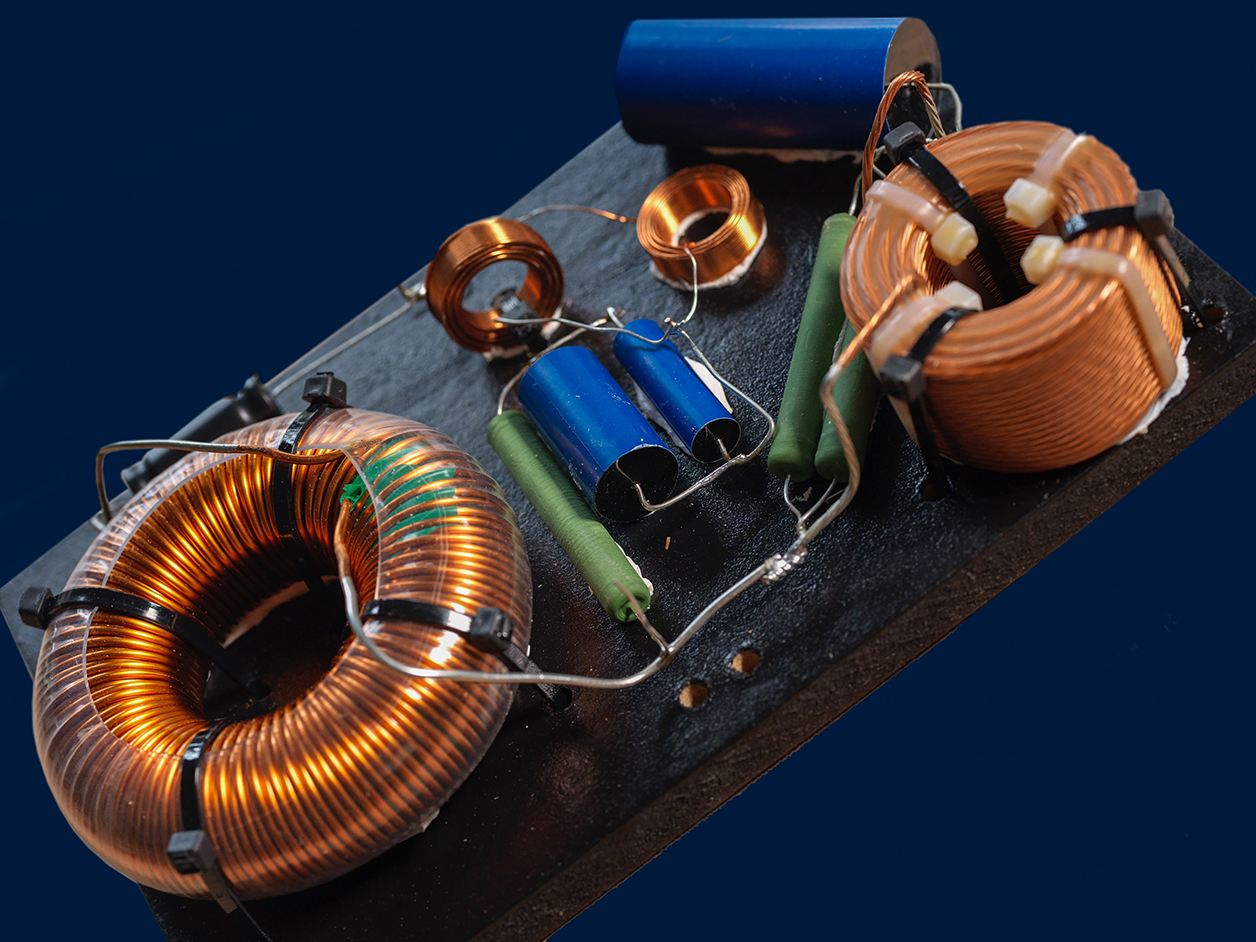
"This time I use 2nd-order slopes but consider their filter topology secondary to performance. The internal chambers and use of AMT drivers with damping material seem to work. The first impressions of places I took them to were excellent, the sound described as vibrant, colourful and engaging. Sometimes this concept implements with simple single-element filters, sometimes with complex configurations. I've built about 70 commercial loudspeaker systems in my life and don't believe there's such a thing as any best topology or holy grail. After all, successful designs from different manufacturers come with all manner of crossovers and driver combinations." Hence the new ideas concern the tweeter's damping and cab's inner geometry. Being invisible to the  naked eye, the latter isn't a sexy talking point. Still, successful elimination or reduction of a driver's rear wave reflecting back out through its cone is key to lower distortion and higher clarity. Here we've learnt of skyline internal wall patterns. We've read of cork absorbers with Sonus faber and sound|kaos; foamed aluminium liners with Audio Physic; 3D-printed inner waveguides with sound|kaos; unusual port shapes to control airflow and minimize turbulence. Particularly for tweeters we've seen meta-material absorbers first with KEF. Alon Wolf's sealed midranges may use semi-spherical rear chambers. Sven Boenicke's equivalents execute in milled solid wood. Pat McGinty uses triangular trap chambers. Michael Børresen has exploited perforated dividers for airflow management, break-up vanes in his vertical slot ports. Whilst we see none of it, such stuff matters. "The lower woofer cuts off quite low at ~300Hz. The handover between mid/woofer and AMT sits at ~3.5kHz. I should add that I don't like to list filter frequencies in specifications as they only refer to on-axis figures. By their nature, dynamic cones at the filter frequency lose pressure off-axis while tweeters don't. Therefore the crossover frequency shifts down. A fair estimate would be 3-3.5kHz. The woofer's 12dB/octave slope by its nature also has a smooth transition to the mid/woofer."






"By classic designs with a new approach, I meant a classic monopole form factor which I've given the sonic characteristics of our Qualio dipoles. Just as when I designed the first IQ, I intended to build a '3-way widebander'. Of course technically the IQ is a multi-way but I selected parts and tuned the speaker to share as many characteristics of our Cube ethos as possible. I created the damping around this AMT after comparing Mundorf's original plate and waveguide to different depths and shapes as I had already done with my custom waveguide in the IQ30. It's not that damping transformed the Blue Train's driver into the world's best AMT as though I were a master of magic. It's a specific solution that sonically comes closest to this driver's dipole version to achieve greater airiness and vibrancy. In Raal tweeters, foam pads with a saw-tooth edge control the vertical radiation. Perhaps there's more to it but it certainly doesn't fulfil the same function as my AMT damping which controls both vertical and horizontal response and changes the sonic character to approach a dipole. Such solutions are available for classic dome tweeters already but I've not seen them for AMT or ribbons. The internal divider isn't simply slanted and the advantages of an irregularly shaped woofer chamber manifest in better differentiation of lower frequencies thus superior transparency in the midrange. While none of these tricks are immediately obvious, in combination they make a real difference." Now we begin to appreciate Blue Train's raison d'être fully. Whilst presenting to our eye as a standard multi-way box speaker without Qualio's outré mohawk tweeter or open-backed mid, its sonics aim at a dipole gestalt which itself models the seamless point-source character of Cube's widebanders. We might say that Verseo's motto is, look perfectly normal, behave unexpectedly. The apparent enabler is avoidance of ubiquitous box talk. That's when driver rear reflections radiate through the diaphragm to smear the time domain and cause comb filtering in the amplitude response. Zero box talk is one prime differentiator of dipoles which don't trap their rear wave. Having created very successful hybrid dipoles with Qualio and earlier full dipoles for Sensus, Marek knows that difference. Now he pursues it again for Verseo whilst using classic box loading with new tricks.
I just wasn't crystal yet on what 'Verseo' aims to signify. Off went another email to tax Marek's holiday mood. He'd already corrected my inclusion of Willie Nelson's Stardust cover. "Willie Nelson's album is titled Stardust as I'm sure many albums by different artists are but when I named my bookshelf speakers, I had John Coltrane in mind. Willie Nelson is a great guy but country isn't my thing – except for the movie The Blues Brothers. There was a time in my life when I listened to a lot of Jazz and Blues from the '50s and '60s. I have particularly fond memories of Coltrane and still go back to him." Now the proper cover above reflects it. "As with Qualio, I simply came up with a name. Sometimes words come to mind from nowhere. After hitting upon Verseo, I checked to see if it meant anything inappropriate. In Spanish it means verse. I liked the meaning of the word, not its connotation. A short concise piece of text. For me it's synonymous with simplicity." That neatly shakes hands with my above takeaway of looking perfectly normal whilst achieving something more. Isn't that another way of spelling simplicity? The internal separator brace which divides the enclosure into an upper tweeter+mid/woofer chamber and a lower woofer chamber isn't a basic horizonal cross brace. A side view would show a central 45° up angle with shorter horizontal sections in the front and back. "Technically it works similar to a regular 45° slant but with a slightly larger surface. Something struck us and I don't know why we even tested it. But this variant turned out better than a simple diagonal wall. The larger surface area stiffened the enclosure slightly more and created different internal wave conduction. I had previously run other tests and our 2½-way system sounded better with a divided not shared enclosure. It better suited this particular driver configuration and revealed slightly more sonic textures. We also apply pyramidal foam liners on the inner walls, copper hookup wiring and crossover parts of Qualio IQ calibre." By now we recognize that the brand triptych of Cube, Qualio and Verseo is about one theme across three variations; perfectly sensible when all share Marek on the design team. Cube's ethos of single-driver point sources without absorptive filter parts established a sonic core target which Qualio and Verseo subsequently pursue with multi-ways: different means informed by one precedent. These speakers will thus share certain qualities without overlapping completely. If they did fully overlap, there'd be no reason for three brands.