In Germany's inglorious warmonger past, SS insignia were feared. They stood for Schutzstaffel (protection squads), Hitler's paramilitary elite forces which started as his personal bodyguard unit. In Topping's glorious present, SS abbreviates Sexy Specs. Though I'm playing word games, it's still about warfare; number's warfare. To arrive at the 151dB claimed S/NR figure for their smaller B100 amp, "the actual noise level is obtained by boosting the noise of the B100 by 40dB using a low-noise amplifier in front of the APx555B then dividing the measured noise by 100". Topping's elite squad of noise ninjas thus adds a 3rd S for 'sneaky'. It speaks to engineer Roland Krammer's assertion covered here that his own crosstalk attenuation of ~136dB in the Viro G1 DAC is, "of course, a theoretical value. Practice won't achieve it. Crosstalk from the supply voltage, neighbouring traces and other factors always inject a few decibels of noise. I personally consider such noise values myth and/or pure theory. A physical S/NR of -136dB is a marketing gimmick; or rather a special measurement scenario which naturally occurring conditions can't duplicate." There's more. Why make a power amp with a very low 11dB 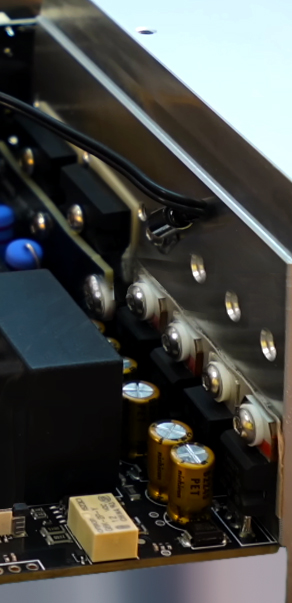 voltage-gain setting which requires completely non-standard high source voltage to be driven to full output? To shine up S/NR?
Topping's propaganda mentions a triple-feedback mechanism behind their SSS. Designers like Nelson Pass and Luca Chiomenti have repeatedly reminded us that the means to extremely low distortion can be worse than what they purport to cure. It's why their own circuits at FirstWatt, Pass and Riviera often shun feedback; including, in some models, ballast resistors. This is a very contentious topic. Best avoid its stinging nettles by delving no deeper. Designing and reviewing purely on the oscilloscope is simply like cooking from a recipe book without ever tasting. Does framing the B200 in such terms suggest undue negativity on my part? Not at all. I did watch some of its YouTube reviews. Given their comments, Grzegorz's own and my very particular nearfield destination and loads, I felt positive. In fact, one YouTuber familiar with Topping's portfolio stated that unlike earlier models, the B200 suggested to him that aside from their usual testbench freaks, Topping's team must finally have added actual music-loving listeners. He opined that the B200 no longer just ace the sneaky sexy specs but also the ear barrier. Had I timed my first Topping date to perfection then?
There's still my date's buzz cut, er buzzword persona to cover. The B200 runs a discrete NFCA gain circuit. The B100 gets a T'ang-ku-la module. Without explaining these terms, they're colourful but useless. When The Abso!ute Sound's Steve Stone asked his US-based Topping contact for details on the LA90 he reviewed, "the feedback structure is similar to our headphone amplifiers. The S/N figure is obtained through careful design of power supply, resistor choices and other fundamentals of design goodness." It had Steve follow said quote with "well, ok then". I learnt that NFCA is short for Nested Feedback Composite Amplifier. Nested tends to describe local not global feedback. Composite amplifier probably means multiple cascaded gain stages. For Topping's A90 I found a description of "fully discrete components to redesign the NFCA module. There are four NFCA modules building up a fully balanced structure with 39 transistors. The optimized hybrid voltage current feedback architecture along with ultra-high gain feedback technology provide excellent DC and AC performance."
With my new B200 [one half wave's six heat-sinked parts at right] I miss out on the secret T'ang-ku-la sauce but still partake of the NFCA alphabet stew. Okay then. Now our table is set. What did I expect? Given Topping's dogged pursuit of extreme S/NR and despite published figures which require measurement tricks, laboratory conditions and non-music signals, I felt certain that the B200 would ace that score. One of my questions was, would it trump Ncore's own measured excellence enough to matter? Once noise drops beyond human perception, does going any lower do anything but gratify the scope? How can we hear less than nothing when nothing already means no audible noise or distortion?
On the flipside, my inner snob wondered whether the means employed to arrive at said nothing would cause other demerits even outright flaws? My fridge magnet kept staring at me. For fox sake. I was hoping for foxy. My iFi iDSD Pro Signature DAC uses analog Alps-based volume and stout class A outputs of 6V RCA and 12V XLR respectively. That puts it closer to a proper preamp than standard DAC with digital volume. It additionally includes two optional tube modes. I tend not to use them but a simple click of a 3-pole toggle could switch them in should my fox arrive mangy. But as a happy owner of Chinese hifi—Kinki, Cen.Grand, Laiv, Singxer, Soundaware, FiiO, Aune, Denafrips—I was ready to finally welcome Topping into my crib. I frankly looked forward to it rather than having to apply for a return authorization and ship everything back to France. Given Amir's measurements, my 83dB nearfield loads could expect 160 watts into resistive not capacitive 8Ω, 210 watts into 4Ω and just 84 watts into 2Ω. Output impedance seems to be 5mΩ. My Nord monos do 400 watts into 8Ω, 700 watts into 4Ω and 550 watts into 2Ω to be wildly more powerful and have far superior low-impedance stability from their beefier built-in SMPS.





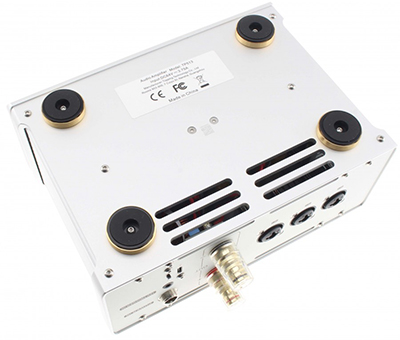 Finally it should go without saying but let's be redundant and say it anyways: given their spec-driven focus, the Topping B200 monos ought to be mostly untouched by voicing. By voicing we mean tweaks or parts swaps whereby an already stable and safe circuit gets tuned by ear until its designer deems the sound 'right'. Such tweaks may or may not manipulate the frequency response, distortion spectrum, behaviour under stress or other parameters but always involve extensive listening tests. Only very few designers have developed proprietary measurement suites based not just on classic electronic engineering but research into human hearing whereby they can fabricate a deliberately tuned/voiced circuit without any listening. Vladimir Shushurin of Lamm is said to have done so. He apparently knew exactly how his notion of correct sound correlated with very specific interrelated measurements. Once a circuit measured accordingly, he was done. He didn't have to hear it to be sure. Voicing designers guided by their own ears may happily sacrifice a few measured percentage points if it improves their sound.
Given Topping's pursuit of the lowest possible distortion and noise specs, we should probably assume that their team wouldn't consider such sacrifices acceptable. That's as far as I shall speculate. Anything more now requires my ears and is, by default, specific to my desktop's nearfield, its speakers and my SPL needs. Unlike my usual reviews, this writeup of a personal purchase limits itself to the system I bought it for. Incidentally, my class D Nord monos are voiced. Whilst the Ncore gain module and switch-mode power supply are stock, the input buffer isn't and instead a discrete class A op-amp module called Rev D which I think was based on Acoustic Imagery. The selection of this particular miniature circuit over against numerous alternatives was done by ear; and could still be changed by pulling out said module and replacing it with another. Popular choices come from Burson, Sparkos, Staccato or Virtual. Swapping socketed opamps is solid state's version of tube rolling¹.
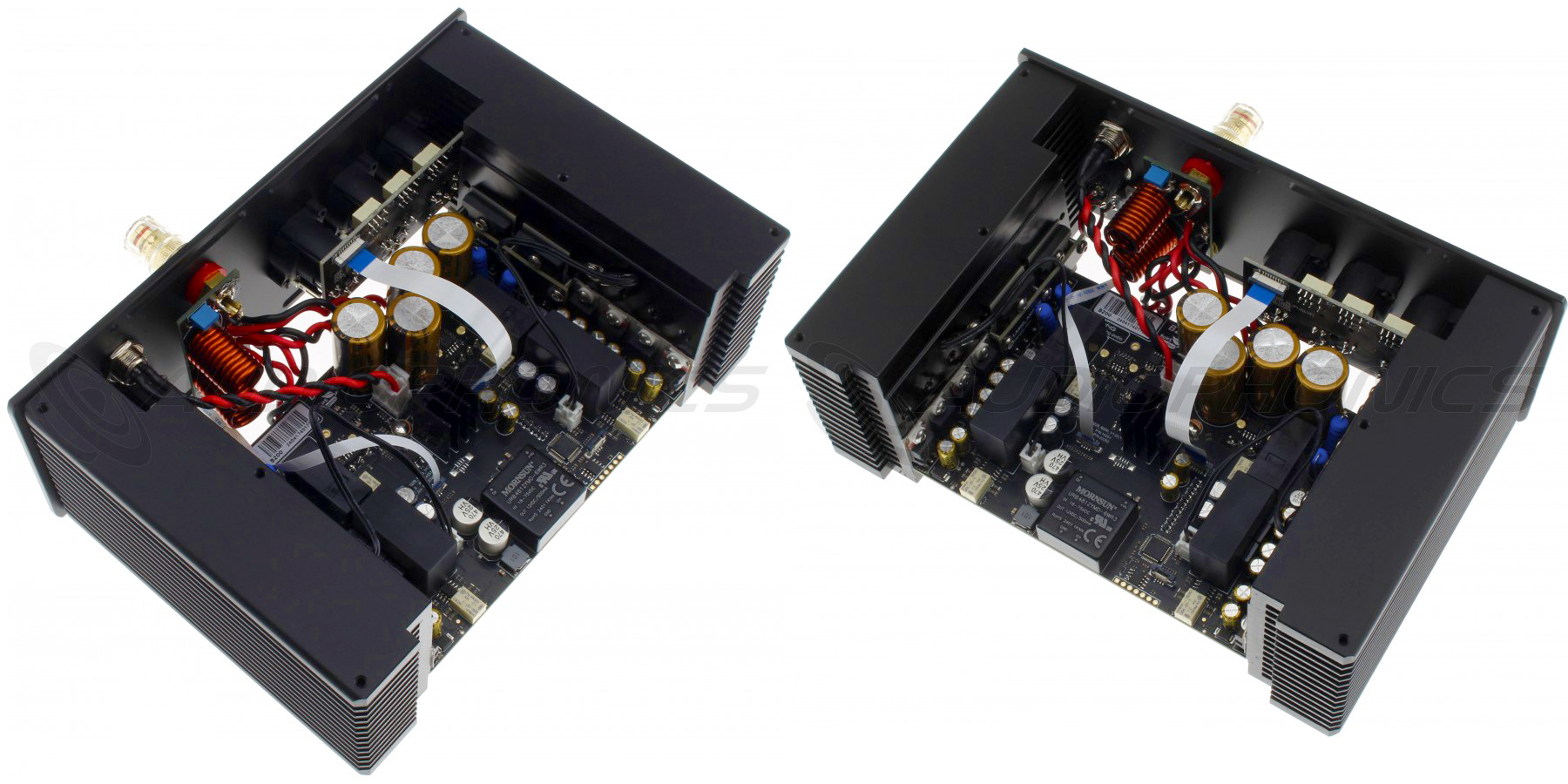 Photos from retailer Audiophonics.fr.²
¹ This tune-by-ear 'rollling' is contingent on swapping parts whose basic electrical parameters are identical. Whilst the sound might change, those parameters shouldn't to insure that the circuit continues to operate safely and as intended. It points at an interesting conundrum. If for example capacitors from different manufacturers or quality tiers can have identical core specs but sound different, how would a purely measurement-driven designer decide which capacitors to use? If no listening tests are involved, it would seem sensible to simply go for the cheapest option. Meanwhile high-end loudspeaker designers champion crossover capacitors from Duelund, Jantzen, Miflex and Mundorf, insisting that their often very high costs are justified because they sound a lot better. It's this fact which bolsters the argument that many sonically significant influences elude measurements either because we don't yet know how to measure them; or because we don't have access to the quality of test gear which might be granular enough. On that latter point, watch this interview with Edwin van der Kley Rynveld of Siltech in which he explains the level of CERN-type measurement gear they work with today to continue their R&D into cable behaviour.
² Most comb-type heat sinks use vertical channels to let hot air escape freely. Topping instead use horizontal slotting. Likely to protect their IP, the motherboard includes four sealed 'mystery' blocks which shield their innards from prying eyes. The Mornsun cube is a miniature switch-mode power supply. Leaving the main PSU external removes their potential radiated fields from the signal-path circuity which could improve the extremely low noise figures; and makes replacements in case of failure easier. That big laptop-style bricks virtually as deep as the B200 is wide plus their skinny umbilicals won't look as good in a standard rack as amps with built-in PSU is par for this course. But then Topping don't position themselves as a designer brand nor do they charge like one.