The myth of Null Island. "… they were approaching the coordinates of 0° latitude and 0° longitude where equator and prime meridian intersect. Russell stood on the bridge with the captain while Gail and a shipload of fellow cruisers gathered on the bow. "Everyone had their geolocators out, counting down … 0.01… 0.005 … 0.0001," Gail Lee told CNN Travel. The only problem? There was nothing to see but open ocean in every direction. That's because Null Island isn't actually a place at all." Ditto zero vibration—unless perhaps we employ a Reactio 2. Even with my spl Crossover MkII on the platform's four standoffs, once the 15-inchers started pounding out Reggae riddim, my hand still felt beats in the 'isolated' chassis. Ditto atop the platform itself. This tracked with all measurements I've ever seen for our sector's vibration attenuators. Their graphs always looked Himalaya-style jagged—differently jagged than the 'without' graphs and often at lower amplitude; but never remotely at 0°. Just as you wouldn't cruise to Null Island in hopes of seeing anything, don't expect this platform to null out all input mechanical energies. My hands-on takeaway was reduction not annihilation. Not that Stack claim the latter. That might just be our expectations. If so, they aren't realistic. But does it matter? Won't our ears already benefit from reduction? Versus the prior Auva footers, mine were deaf to further reductions on this solid-state line-level component. I needed more diva-esque scenarios. Princess on a pea, where art thou?
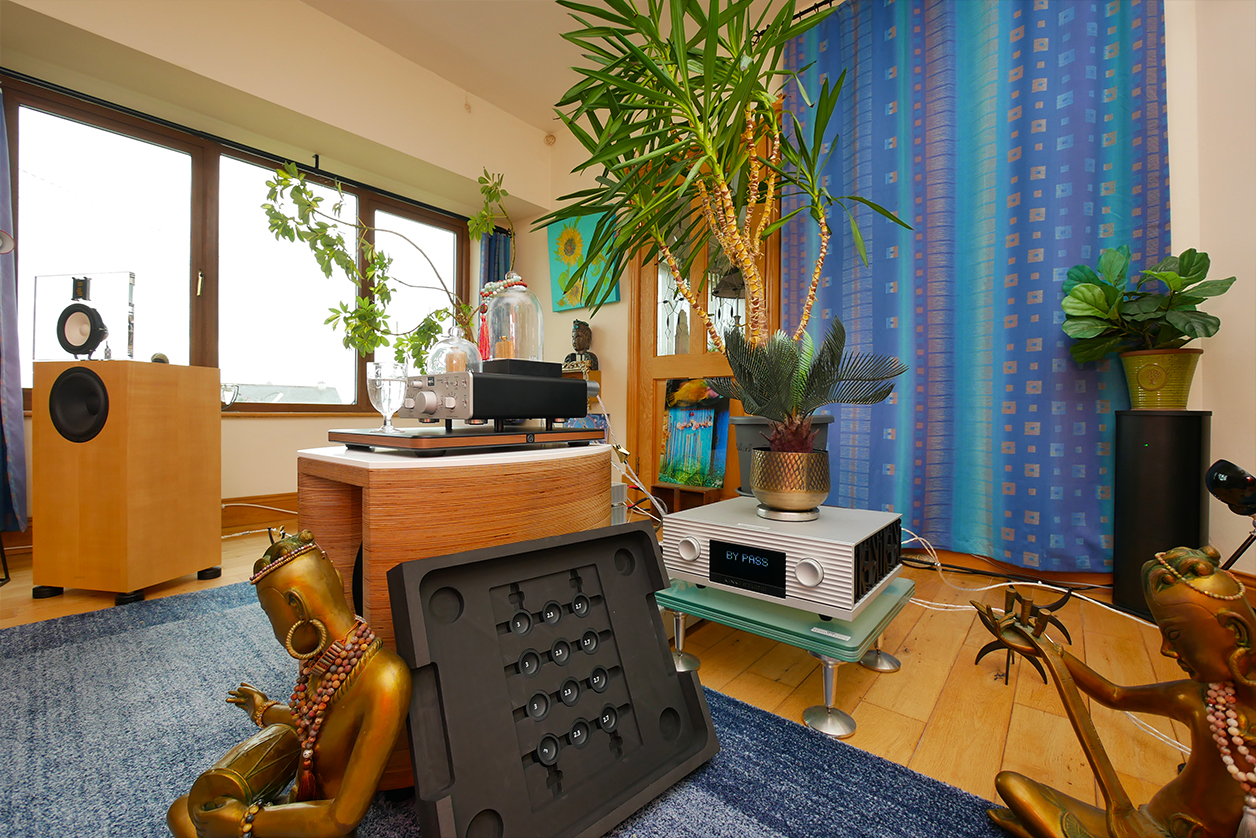 Carton insert with three extra sets of weight-rated silicone cups | a glass of water | an spl Crossover MkII on standoffs on platform on sound|kaos subwoofer on Auva SW.
Pet peeves. Two of my hifi ones are pear-shaped textures—tight above the sonic belt line, loose and ringy below—and associated grease spots. Those are nodes where despite general law and order, resonances still set off across narrow bands of just a few tones. Room modes are like that. Ditto structural resonances. When you play Jamshied Sharifi's One or Patrick Chartol's Istanbul and have a bass maker good to 25Hz, you will set off nodes unless you've strategically addressed them. Room EQ can notch out trouble spots in the acoustic domain but structural echoes remain. The easiest non-microphone way to track them is to play steady-state test tones in half-tone intervals from, say 80Hz to 20Hz. Set playback to a decent level then note down which particular frequencies are louder than others. My upstairs 15-inch sealed Zu sub sits on a suspended wooden floor. 'Floating' it atop Auva SW made a big difference but didn't fully linearize the staircase into the bassment to make all steps the same size. That interface suggested an ideal platform intercession. Of course spending $1'450 on a cost-effective sub only to isolate it on a costlier platform seems backwards¹. Yet such are the challenges of quality deep bass. If put out there like a tiger escaped from the zoo, it will draw blood from our acoustics and structure. Once we clean up bigger spills, gains in clarity quickly keen our ears to find remaining stains even more objectionable. Ideally my upstairs would have its own pair of PSI Audio active bass traps as already drain my main system. I've simply not had the funds. How much stain removal would today's platform accomplish?
_______________________
¹ Spending thrice on a sub would relativize today's spend but not eliminate it unless such a sub included equally effective mechanical resonance stoppage. With most subs, more money tends to only buy more loudness and extension. That just makes the severity of structural coupling worse. Spend more, cause more problems. As I see it, resonance control with subs is foundational.











Clearly less removal of nodes and nonlinearities than the original switch had managed between stock footers and Auva SW. Yet with the platform in play there still was more LF intelligibility and clarity to be had. This tracks my experience also with UHF noise filters. None of them block out all noise like an FBI file redaction would which makes whole sentences even pages illegible. Noise filters pale out even obscure a few letters, perhaps enough to eliminate certain words. But attentive listening might still be able to work out the meaning of hole-ridden sentences—if we continue with this image. Add filtration atop filtration. Realistically, success means being with a process that has no clear end. My brain can't spit out hard percentages on a report card like AI might with microphones and oscilloscopes. To suggest a rough delta, the platform added a third more goodness over the original stock⇒Auva SW swap. It's testament to the latter's effectiveness on the ledger's '+' side; and a suspended floor's toxic reactivity to an output/reach-capable subwoofer played at stout volumes with material hitting 25Hz on the '-' side. More isolation does more cleaning; simple as. On the dial, the benefits go both ways. We can play more quietly and already enjoy bass finesse. We can also go gonzo because it stirs up less muck. Visually I really liked how Stack's low profile slipped in without drawing the geek squad's ire. Let's face it, this setup is geek city already. USB bridge. I²S. DSD1'024. Outboard active xover for sat/sub division. Mono amps. Outboard passive crossovers on the monitors. Multi-stage isolation rack. It all has has a visual impact. Compared to that special-ops crew, the Auva platform was the most civilian.
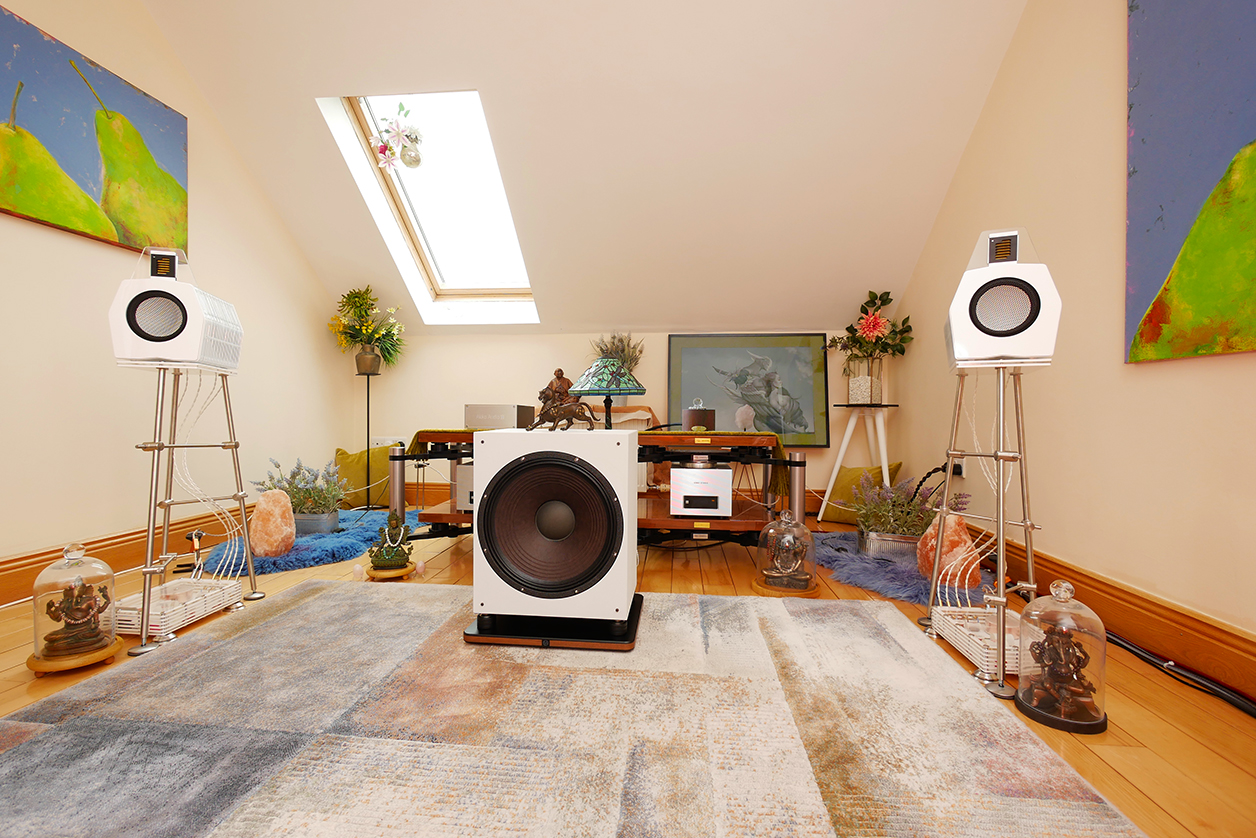
In hindsight, me accepting this gig was a bit anti-climactic because I couldn't meaningfully track a large variety of applications. Unlike aftermarket grounding where I'm still quite green, I've walked the anti-vibration path for many years with isolation racks and speaker/sub isolators from makers like Artesanía, Carbide, Grand Prix, Hifistay and sound|kaos. All of my stuff is isolated already with proven solution. Plus, I've never done vinyl which seems a prime destination for this platform. I no longer do CD or tubes. Neither did I have nor ask for two platforms to replace my pre-existing speaker isolation, much of which is already by Stack. In my book, the top app for the Auva platform actually converts standard furniture picked for décor reasons into purpose-tweaked isolation racks. Its low-rider profile won't interfere with spacing. Its hard aluminium top will resist marring. The micro threads allow precise levelling. A load rating up to 100kg should accommodate most reasonable scenarios. The modular concept can test a single unit under all our gear then place it where gains are highest. Over time we can add a second or third platform if we have both means and need. As a most satisfied user of purpose-engineered hifi racks, I readily acknowledge their high cost, unwieldiness in fixed double-wide guise and industrial or laboratory looks which many living rooms won't like or even tolerate. That's where Stack Audio's latest Auva platform can become a decisive difference maker. And as platonic as the subject is to most who haven't yet tried serious mechanical isolation to reap its very real rewards, this product looks sexier than most. What's more, Stack's stacked 60-day satisfaction guarantee eliminates blind-date risks. Plus, a Dutch order fulfilment centre in Weert avoids post-Brexit customs hassles for EU orders. It all adds up to quite the excuse eliminator. How much easier could it be to get our feet wet and sample proper resonance control inside our own four walls? Can't hear a meaningful difference? Return it. That this offer even exists tells us of Stack's track record. Living with an improvement for 59 days to make it the new normal then removing it on day 60 is painful whilst day 1 was pleasant. Humans favour pleasure over pain. Stack know this. Hence their gracious 2-month home-trial privilege.