
Country of Origin

Reviewer: Srajan Ebaen
Financial interests: click here
 Main system: Sources: Retina 5K 27" iMac (i5, 256GB SSD, 40GB RAM, Sonoma 14), 4TB external SSD with Thunderbolt 3, Audirvana Studio, Qobuz Sublime, Singxer SU-6 USB bridge, LHY Audio SW-8 & SW-6 switch, Sonnet Pasithea, LAiV Audio Harmony; Active filter: spl Audio Crossover MkII; Power amplifiers: Vinshine/Kinki Dazzle & mono Ncore 500 Nord Acoustic amps on subwoofer; Headamp: Enleum AMP-23R; Phones: Raal 1995 Immanis; Loudspeakers: Qualio IQ [on loan] Cables: Exact Express Flame, Furutech; Power delivery: 2 x Kinki/Vinshine Tai Hang on amps and source stack, Furutech DPS-4.1 between wall and conditioners; Equipment rack: Artesanía Audio Exoteryc double-wide 3-tier with optional glass shelves, Exoteryc amp stands; Sundry accessories: Acoustic System resonators, AudioQuest FogLifters; Room: 6 x 8m with open door behind listening seat; Room treatment: 2 x PSI Audio AVAA C214 active bass traps
2nd system: Source: FiiO R7 into Soundaware D300Ref SD transport to Cen.Grand DSDAC 1.0 Deluxe with POW; Preamp/filter: Lifesaver Audio Gradient Box 2; Amplifier: Kinki Studio EX-B7 monos; Loudspeakers: ModalAkustik MusikBoxx; Subwoofer: Zu Method; Cable loom: Exact Express Earth; Power delivery: Vibex Granada/Alhambra, Akiko Audio Corelli Corundum & Castello Solo; Equipment rack: Hifistay Mythology Transform X-Frame [on extended loan]; Sundry accessories: Furutech cable lifts, Furutech NFC Clear Lines; Room: ~3.5 x 8m
2nd headfi system: DAC: Cen.Grand DSDAC 1.0 Deluxe with POW; Headamp: Cen.Grand Silver Fox; Headphones: Raal 1995 Magna, HifiMan Susvara
Desktop system: Source: HP Z2 workstation Win11/64; USB bridge: LHY UIP; Ethernet bridge: LHY EFI; Ethernet reclocker: Stack SmoothLAN; DACs: Audalytic DR701 & Gustard R26II; Headphone/preamp: FangSound Dionysus; Speaker amps: Topping B200 monos; Loudspeakers: Virtual Hifi Viper; Headphones: Final D-8000, aune SR7000, FiiO FT7
Upstairs headfi system: FiiO R7; Headphones: Meze 109 Pro, Fiio FT3
2nd upstairs speaker system: Source: FiiO R7; DAC/pre: COS D1; Amplifier: Kinki EX-M7; Loudspeakers: sound|kaos Vox3 with Dynaudio S18 subwoofer
2-channel video system: Source: Oppo BDP-105; All-in-One: Gold Note IS-1000 Deluxe; Loudspeakers: Zu Mission; Subwoofer: Zu Mission; Power delivery: Furutech eTP-8, Room: ~6x4m
Review component retail: €1'707.72 incl. VAT
 |
 |
 |
 |
 |
 |
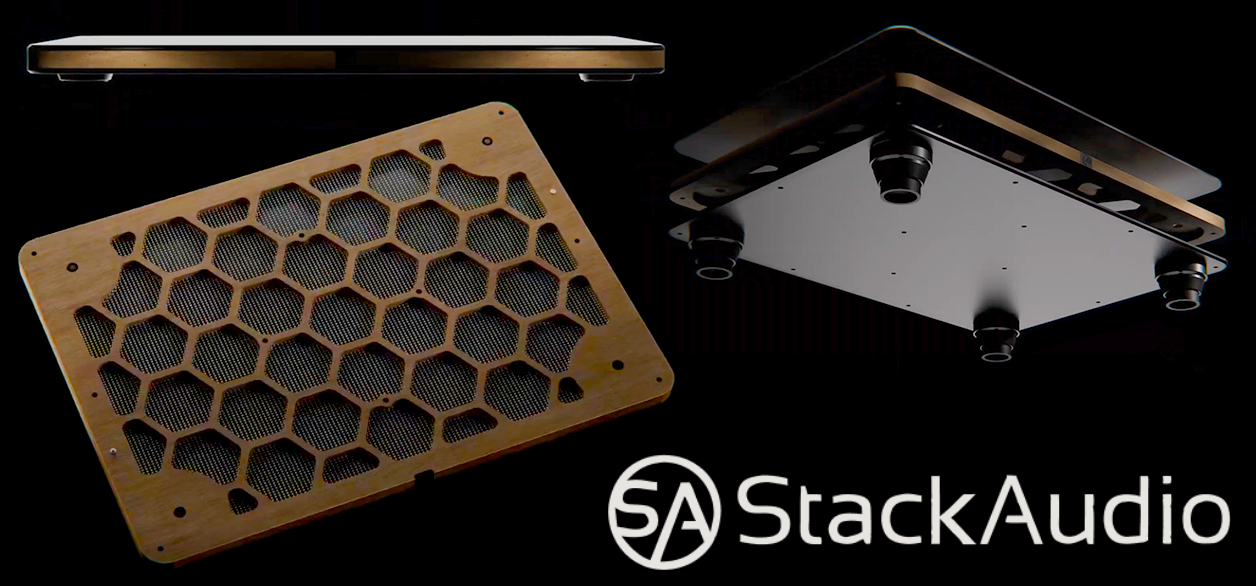
 I got milk, you cookies. Let's dunk. It's what Stack Audio must have thought given their particle damping then silicone-based elastomeric isolation products. Now those two techniques hook up and fresh from the oven is this platform. By swapping out finely threaded weight-rated footers, we can support different gear. Four footer quads to cover common weight ranges include. Between thin machined plates sits a thicker honey-comb core with 35 particle-filled cells. Et voilà, 1+1=3 when two proven methods for attenuating mechanical vibration join forces to escalate effectiveness. Think fussy turntables, CD transports, kit with microphony-prone direct-heated triodes, subwoofers and loudspeakers. From platitude to platonic platform? Given the amount of coverage this brand enjoyed in our pages last year, why still more? Simple. Resonance control done right makes a real difference. It just tends to get short-changed when on a whole it's seriously platonic—unsexy. The platitudes around why to spend money elsewhere are legion. Now it helps to know of things which work without magical thinking; are priced fairly; and don't size and look in contravention to shared living spaces. So hack it, more Stack.
To learn how this material sandwich stacks up, I asked their Josh Stephenson. The photos show apparent aluminium plates surrounding a wooden layer. But his comment of "definitely our most intricate product to build with all the particle cells, sandwiching and hand-finished veneer" suggested otherwise. Why veneer wood? What about the micro spheres acting like sand in a golf-course bunker? Are they plain steel shot or more exotic? "We use two 6mm precision-machined aluminium plates combined with an internal core of Fibrapan Hidrofugo moisture-resistant MDF for exceptional stability. Combining metal and wood this way presented engineering challenges to attain perfect fit and balance. Finite Element Analysis carefully shaped the internal structure to achieve optimal vibration dissipation and rigidity. The veneer fits around the outside. While we can't disclose our exact fill ratio or particle mix, R&D was rigorous. We suspended the platform from a test frame, fit it with multiple accelerometers, excited it then captured the response using a DAQ system and in-house analysis software. This evaluated how different particle combinations and fill levels dissipate energy. There were many variables to work through so this phase was extensive. To understand the real-world vibrations and frequencies we had to address, we measured a wide range of setups. We placed accelerometers on different stands, surfaces and equipment plates to gather baseline vibration profiles. These measurements formed the foundation for the subsequent tuning work. The difference in cell sizes is purely down to structural rigidity not this tuning side of things." Milk and cookies. Like peanut butter and jelly, it's a simple recipe. Yet the deity lives in the details. Let's leave the devil in the dumpster with the reject prototypes and milk gone sour. Soon it would be my time to dunk. Which amongst my systems included the most resonance-critical interface?












Some basics if you're new to this. Hit a tuning fork whilst holding its stem. Then hit it again but place the stem on a wooden desk. The fork barely audible at first made a much louder sound once coupled to a resonant material. Now think of the morse code gunslingers in Hollywood Westerns sent down railroad tracks; how they'd lie ear on ground to detect approaching cavalry. These examples illustrate how once coupled, resonance amplifies; how certain materials transmit resonances across distance. Stringed instruments like piano, guitar or violin exploit the same principle. Their strings couple to resonant bodies made of particularly responsive wood species like Spruce known as tone woods. If railroad tracks weren't made of steel but rubber, forget morse code. If violins were made of plastic, they'd sound far more muted. Even boom trucks hard-couple their woofer arrays to a car's skeleton to get louder. A vehicle's various structural sub sections simply exhibit their own resonant frequencies to—overwritten for effect—become one-note players. The desired extra bass loudness isn't uniform but arbitrary so generally a ringy mess. Not only is structural gain delayed as a mechanical response after an input signal. It doesn't stop on time to become a blurry echo. In a hifi with loudspeakers not headphones, speakers are the by far gravest generators of mechanical energies. Their transformation into varying air pressure which we perceive as music is what we want. Any coupled structural resonance that's narrow band and time delayed we don't because it's not music signal but noise so distortion. Isolating the resonant structures of floor and furnishings from the mechanical triggers of our playback hardware can't fail to clean up the sound. We eliminate secondary sound makers. Their silencing relies on decoupling hence successful stoppage of mechanical energy injections. Enter equipment isolation. It must start with our speakers and/or subwoofers to address their primary interface of the floor. But a poorly damped turntable could still be prone to footfall or passing lorries. Now that vinyl spinner needs its own mechanical isolation from whatever it sits on. Possibly likewise for CD transports or microphonic direct-heated triode gear.
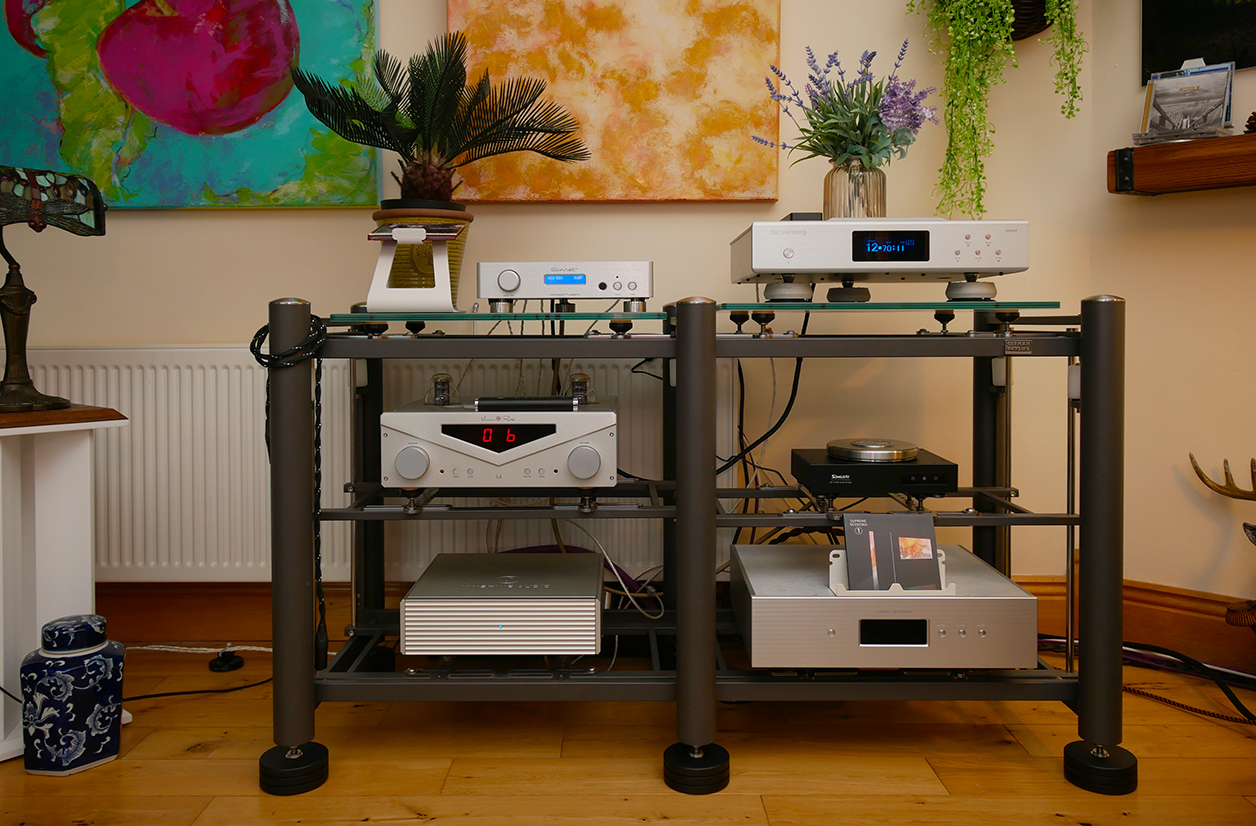 Auva Platform prospects? Direct-coupled 300B preamp, CD transport. Artesanía rack already decoupled on Auva isolators.
Once we have addressed our primary structural disturbances and lowered our system's mechanical noise floor, we might notice that continuing our war on what now are smaller resonances still yields benefits. Much depends on our overall system resolution, listening acuity and what value we place on enhanced detail retrieval, clarity and separation. For some the singular address could be to get their speakers off the floor. Done. For others it could be a mere beginning which, by removing the grossest overlay of structural resonance, opens doors to finer layers and their response to subsequent isolation addresses. Further variables are the actual structures we live in—a concrete basement certainly differs from a suspended upper-storey wooden floor—and what we place our hifi hardware on. Is it designer furniture, a purpose-engineering equipment rack, other? Suffice to say, once we step, uh, foot into the world of vibration isolation, we might discover ever finer layers of distortion whose removal keeps improving our experience. If our isolators are broadband, we shouldn't expect tonal shifts, just increases in small-signal resolution. The one exception are speakers and subwoofers. Whilst the elimination of late structural gain cleans up the time domain and general clarity very demonstrably, it also reduces output. Bass will stop better with more articulation and pitch definition so less smear and blur but feel leaner and lighter. Active bass systems can easily compensate with their bass attenuator. Passive ones cannot. With them the trade-off is superior clarity and definition vs more weight and loudness.
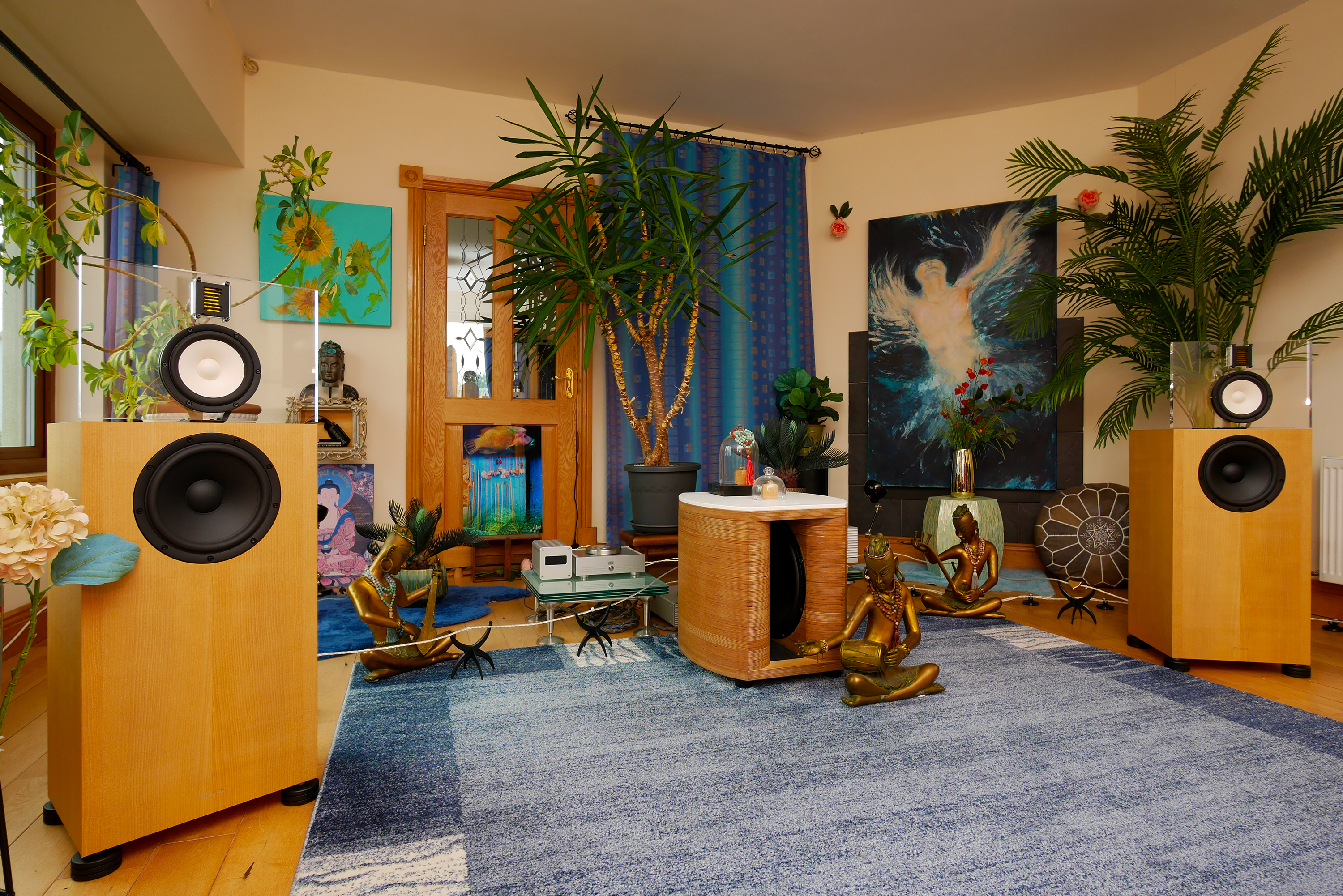 Auva isolators beneath speakers and sub.
Plainly put, bass distortion sounds louder but dirtier. I prefer clean 'n' tidy. The amplitude compensation for loss of room and structural gain which active bass affords means I get to have cake and eat it.