For cake for breakfast and lunch, here Zu's 15" Method sub sits atop Auva SW isolators then an extra platform not needed elsewhere just then.
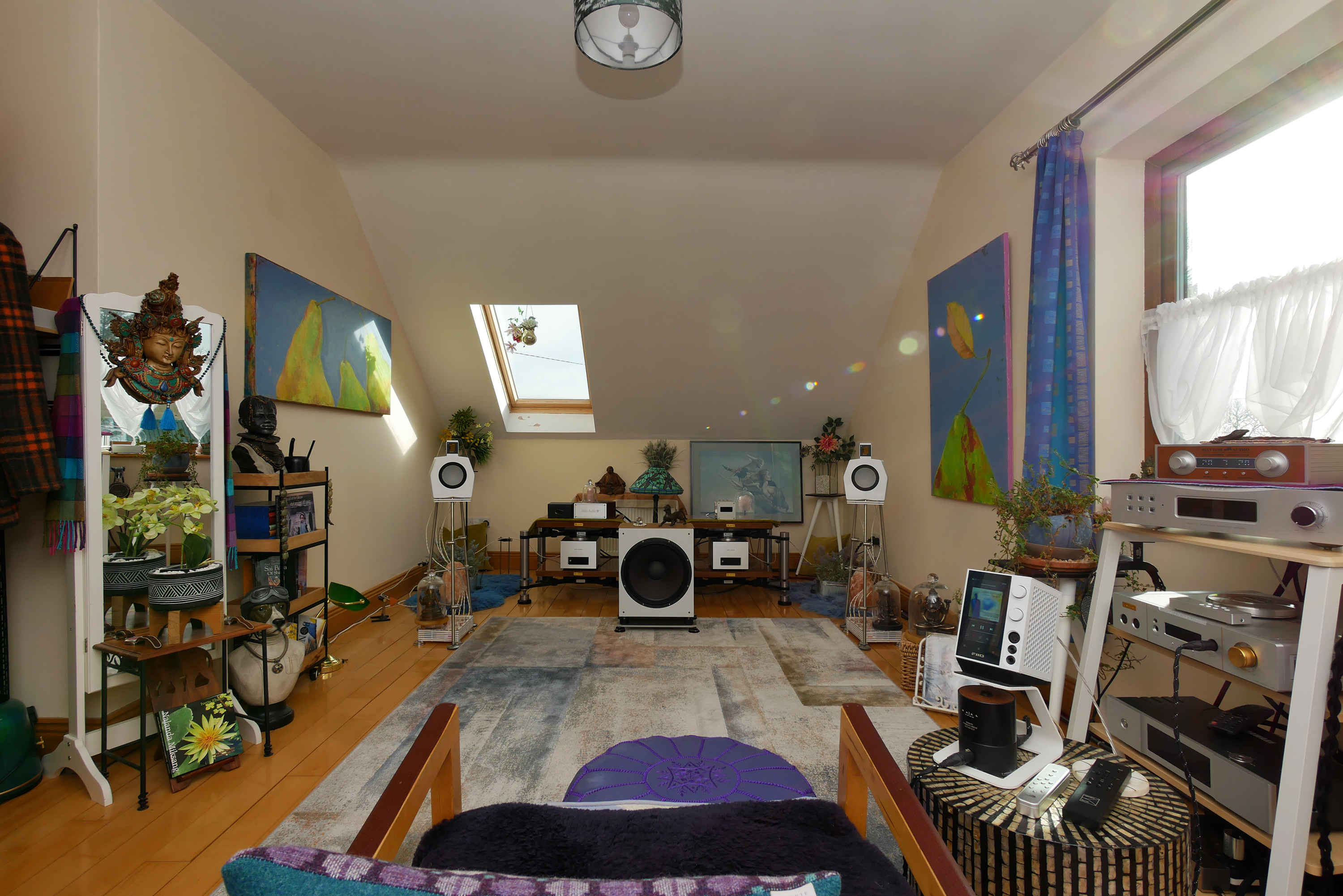
To spread this topic around, I encouraged Josh Stephenson to contact my regular Warsaw contributor at HifiKnights.com. A month later, Dawid Grzyb published his take on the Auva 70. Unlike speakers which may work in one room but not another, for one listener's taste but not his mate's, this resonance-attenuation tech works universally. After adding spl audio's Crossover Mk2 to my arsenal, I decided to place it atop my dual 15-inch folded open-baffle sound|kaos sub. It's not because this was the smart choice. It's because—cough, how quaint—I like the looks and easy access to the controls. Unlike the sub's bottom astride Stack Audio Auva SW, nothing whatsoever damps its Corian top plate. With two 700-watt monos powering high-output face-to-face woofers tuned for a 5dB/20Hz rise in Audirvana Studio's software PEQ, this bass beast generates lots of mechanical energy. Placing my hand atop the sub then the crossover on it, I could feel the bass beats which my ears heard. Well-proven isolators between sub and filter box attenuated this leakage some yet plainly failed at shutting it down. What actually worked best were Stack's component Auva turned upside down so their silicone absorbers couple to the filter's stock footers. Claiming no sonic benefits from eliminating possible microphonics rattling the crossover's innards, this vibrationally super-active interface struck me as ideal to first test the new platform in a worst-case scenario. In fact, I could put a glass of water atop the platform and see whether vibrations from subwoofer calisthenics below would cause even minor ripples. I had a plan.
By early May, first production was underway and a review sample available. "At long last we have the platform ready to go at and are delighted with how it turned out but without doubt, this has definitely been our most complex project yet." Final specs locked in a 45x38cm WxD footprint of 3.4cm height accompanied by 9kg of mass. Max load capacity is 100kg i.e. 220lbs. Feedback from the first three customers had already posted on the platform's product page, all of it most satisfied.








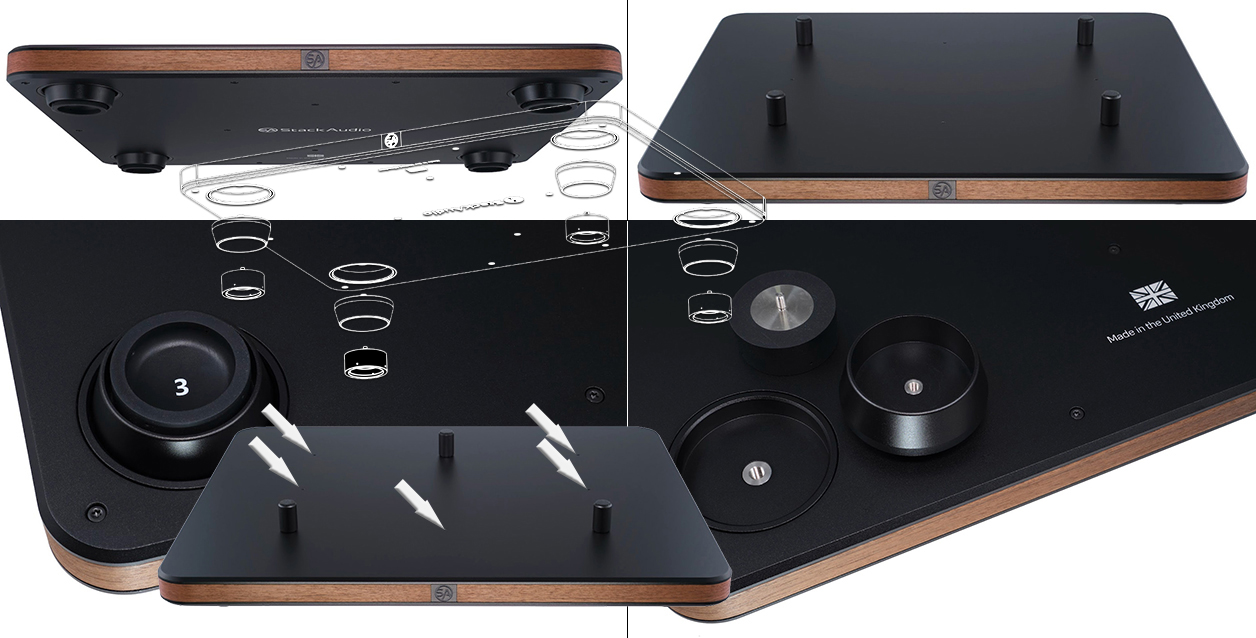
Without meaning to steal any Stack thunder, it seems fair to at least in passing mention that the Anchorplate from Belfast too is a multi-stage platform. It combines a top layer with hexagonal cuts to break up plate modes; a central core with more patterning; and spring-loaded suspension pins at the bottom. Maker Titan Audio refer to it as broadband control from a composite isolation core. Its dimensions are very similar to Stack's but at 1.5kg, weight is significantly lower. Now back at the Auva platform. Its interchangeable viscoelastic shoes are clearly numbered to identify weight rating. #2 covers up to 31kg; #2.4 32-61kg; #2.7 62-76kg; and #3 77-100kg. Included studs can optionally arrange as three or four standoffs in lieu of our component's stock footers. So the top plate includes eight threaded bores to fix these studs to different spots. We saw a Stack Audio logo in the front; and a 'made in the United Kingdom' declaration replete with Union Jack on the bottom. This lowrider isolation platform's 45cm barely exceed the standard component width of 43-44cm or 17-17.3". Unlike those oil-rig contraptions popular in a maximalist corner of our hobby, the sleek simple Auva platform will appeal to minimalists who desire performance but want to see less of it. It can also make an ideal stepping stone to transform regular furniture repurposed for audio for its domestically agreeable looks into a performance-based equivalent of an expensive maximalist high-end rack. By addressing individual components, we may judge which one benefits most and least to spend strategically; or approach conversion of standard furniture to engineered isolation supports in stages one piece at a time. And let's not forget loudspeakers where poor or absentee floor decoupling can trigger structural resonances not just for us but as noise migrating past our own walls, for neighbours particularly with the stout long wavelengths of subs. For many such loads, Stack Audio's higher weight ratings will be ideal. After all, how many people host transducers heavier than 220lbs? The platform's low profile too is advantageous for speaker apps because it won't much disturb tweeter height. And the minor 34mm offset can still be countered by creating minimal tilt and elongating the fine-pitched bolts of the rear footers. The optional studs are not meant for level trims and if used, should screw in completely. Ditto the inner silicone-bearing parts. We adjust height with their outer metal sleeves.
 Whilst waiting on my loaner to cross the narrow Irish Sea, I spotted this in a Roy Gregory review on the Reiki Audio SuperSwitch X, a minimalist LAN relay with outboard power supply, both of which can be optionally fitted with Stack Audio Auva. "What I wasn't expecting was just how much of that focus, body and articulation comes from the Auva feet. Much as I prefer the looks of Reiki's standard lower feet, the Auvas' musical impact was as hard to credit as it was to ignore. At a saving of £350, opting for the standard feet makes no sense at all. With the Auvas doing their thing, the body, diction and presence of voices was far more impressive, engaging and communicative… a timely reminder as to just how sensitive digital circuitry is to mechanical interference… for those already using the earlier versions, the X Series offer a seriously worthwhile step up in performance. Just don't be tempted to skimp on the feet: you have no idea just how much performance you'll be missing out on if you do."
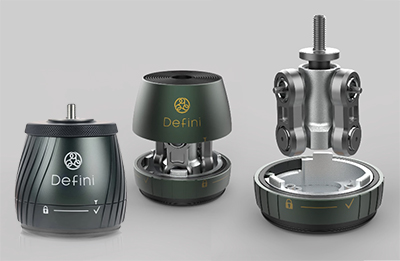
When other brands start offering your mechanical isolators as upgrade options, it's a lovely endorsement of efficacy. Here it also doubles as reminder. Don't discount Stack's seemingly simple approach that doesn't end up in a contraption, exudes no hifi bling nor contains more complicated inner workings like these Defini isolators from Hong Kong. Here true efficacy is not about glitzy exotica but how two apparently basic solutions—viscoelastic damping + particle-collision energy dissipation—combine then execute. To go active isolation and Teutonic precision engineering, we'd need to look at a Seismion Reactio 2 platform. That demands a cool $16K. 'nuff said.