Wood, silence and intent. All amplifiers are designed to reproduce sound. Then there are amplifiers which seem to question what sound is. SPEC seem to belong to the latter camp. Rather than approach their RSA-EX1000 as just another class D specimen, it made more sense to approach it as one would a violin by asking what kind of voice it seeks to produce—and why. It was with this attitude that I began my evaluations. I immediately felt that I was listening to a different type of amplifier. The general feeling was one of imperturbable lightness, an epicurean way to beauty driven by inner calm and the quest for natural impulses like breathing or emotional equilibrium. Sounds unfolded with ease like water springing from a Renaissance fountain where masterful hydraulics and aesthetics work in synergy with gravity to depict satisfying liquid trajectories. Naturalness accompanies timbre neutrality. Here the EX1000 was not one to draw attention. Its voice was always clear, be it when called upon by sedate manners or more affirmative energetic matters. It did so effortlessly and with a charming feeling of levity. Its presentation was open, with no inhibition or restraint in the treble. That was finely elucidated but never acid or grating unless the recording itself was inherently unpleasant which the EX1000's aristocratic temper did not try to smooth out. Clarity and openness did not mean lack of body however. Just don't expect a Sumo wrestler. Rather think more feline long jumper or volleyball player. In my time with the EX1000, I noticed that it needed multiple hours to reach its most accomplished sonic equilibrium so decided to just leave it on.
 Ravel's piano works are studies in harmonic complexity. The opening of Ondine is all about shimmering overtones and delicate dynamic gradations. Few artists have captured those better than Arturo Benedetti Michelangeli. Here the EX1000 excelled, with decays unfurling naturally, harmonics unfolding not collapsing. There was no artificial spotlight, just detail emerging organically from tonal fabric. Compared to my tube-hybrid AIC-10, the EX1000 was less lush but more precise. Transients defined better, articulation keened without sacrificing fluidity. With a recording like Shostakovich's Quartet N°8 with the Pacifica Quartet [Cedille], the EX1000's inquisitive talents became evident. The quartet's interplay rendered in a clarity that bordered immodesty. Each instrument was laid bare nude to reveal its identity. Image stability and separation were unshakable yet ensemble cohesion intact. Throughout the compositional journey from tragedy to catharsis, the amplifier's ability to preserve micro harmonics paid dividends. The texture of bow on string was palpable yet never exaggerated or heavy-handed. The emotional intensity of the composition conveyed without editorializing. The EX1000 did not romanticize Shostakovich but presented him.

 Upping my game on tragedy and scale, I put on my beloved DG recording of Mahler's 6th Symphony with Bernstein conducting the Wiener Philarmoniker. It's a daunting stress test for any hifi. The demands of timbral integrity at any given volume, visceral impact, spatial dimensionality and coherence are extreme. Not only was the RSA-EX1000 up to the task, it never made it seem difficult. It always kept articulation, textural clarity and rhythmic agility at the backbone of its delivery. These traits had more prominence than sheer weight and LF mass. The music's excitement, freshness and immediacy conveyed with efficacy and were made even stronger with the understated unforced way by which the EX1000 handled these characteristics. Festina lente as us Latins say. The SPEC's articulation, transparency and ultra-high resolution made listening to Telemann's Die Stille Nacht with Dutch bass Peter Kooj accompanied by the L'Armonia Sonora Baroque ensemble especially captivating. Slight changes of vocal inflection, the singer's breathing, the organic fabric of strings and the Hilversum Lutherse Kerke's peculiar acoustics were exposed with icastic evidence. Stark dynamic changes in the vocal register presented with ease and no signs of hardening or alteration of image contours.











 Blue City on Three Blind Mice with the Isao Suzuki Quartet + 1 stands as one of the most impressive examples of how the energy, swing and presence of musicians can be captured by skilful sound engineers. I played it at higher volume than usual and the RSA-EX1000 rewarded me with a rendition as lifelike as I could hope for dynamic impact, speed of attack, instrumental body and layering of a small ensemble in space. As I had the tubed Ferrero L9 preamplifier on hand for its own review, I tried the combination even though it opposed SPEC's logic of voltage-gain minimalism. The Ferrero L9 increased harmonic density, tonal saturation and further enhanced the perception of dynamic swings. Yet its tonality grew darker and more masculine. Connecting my LampizatOr Horizon 360 DAC direct to the EX1000 highlighted the amplifier's minimalist philosophy by providing exceptional transparency, reduced noise floor and a more immediate non-mediated presentation. The result felt fresher and more direct. In my system, the EX1000 proved remarkably sensitive to upstream changes. It did not impose a strong character of its own but behaved like a magnifying lens. This made the choice between DAC-direct and preamp less about right or wrong and more about synergy and personal taste. A further testimony to the EX1000's revelatory flair was how responsively it reacted to power-cord and interconnect rolling; or joining my other electronics to the Faber's Power La Potenza grounding box. The latter once again proved to be an effective tool to unleash the last few precious percentiles of performance by wa of enhanced dynamic and colour contrast and instrumental separation.
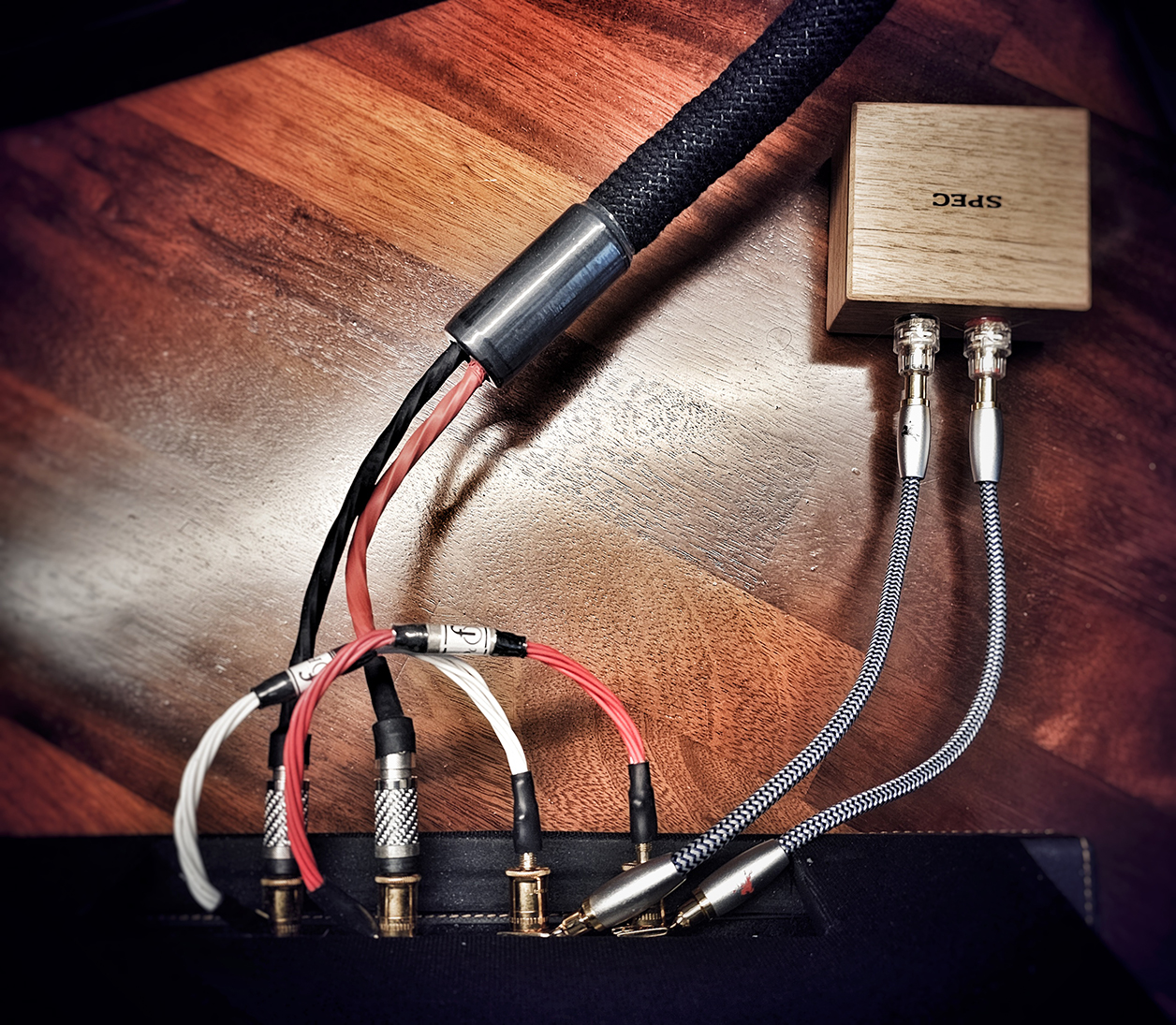
By now I was midway into my review. Whilst doing research on SPEC and their product history, my curiosity was then caught by their Real Sound Processors. These are designed to reduce the amount of speaker back EMF. I assumed that they would be a worthwhile complement to the RSA-EX1000 so reached out to SPEC for a unit. Shuzo-san suggested the RSP-AZ9EX and a week later I had two gorgeous boxes plugged into my Diesis Audio Aura SE speaker taps. The RSP was Shirokazu Yazaki-san's final project before retirement, its operating principle first presented in 1971's Japanese MJ Audio Technology magazine in an article by Mr. Akira Yasui who discussed how an impedance compensator could improve the dynamic (de)coupling between a solid-state amplifier and loudspeaker, i.e. how the current flow between the two varies with time by absorbing a significant part of the back EMF. This in turn would allow better control over the loudspeaker hence superior sound. Additionally, SPEC's RSP are designed to reduce the variation of the speaker's impedance as a function of frequency which again eases the amplifier's job with the expected result of better resolution, less distortion and superior timing. When describing the RSP, Mr. Ishimi remarked that these products are even more relevant for amplifiers operating in class A/AB where in most cases back EMF enters through their feedback loop. It's a far more detrimental mechanism compared to what happens in their Class D electronics. The RSP-AZ9EX is the top-of-the-line Real Sound Processor initially introduced in Japan in 2017 under the name RSP-AZ1 where the AZ suffix indicates the use of exotic Arizona Capacitors oil caps. The RSP-AZ9EX consists of a pair of finely machined walnut bricks with the SPEC logo on top and two high-quality binding posts sticking out from the back. Felt feet are underneath. It's another minimalist design where material selection, mechanical design and internal component selection were driven by sound tuning achieved through extensive listening tests. To use the RSP-AZ9EX I connected each box with a pair of speaker jumpers to the terminals of my Aura speakers in parallel to the input coming from the amplifier. Being passive, there was no power supply to attach.