
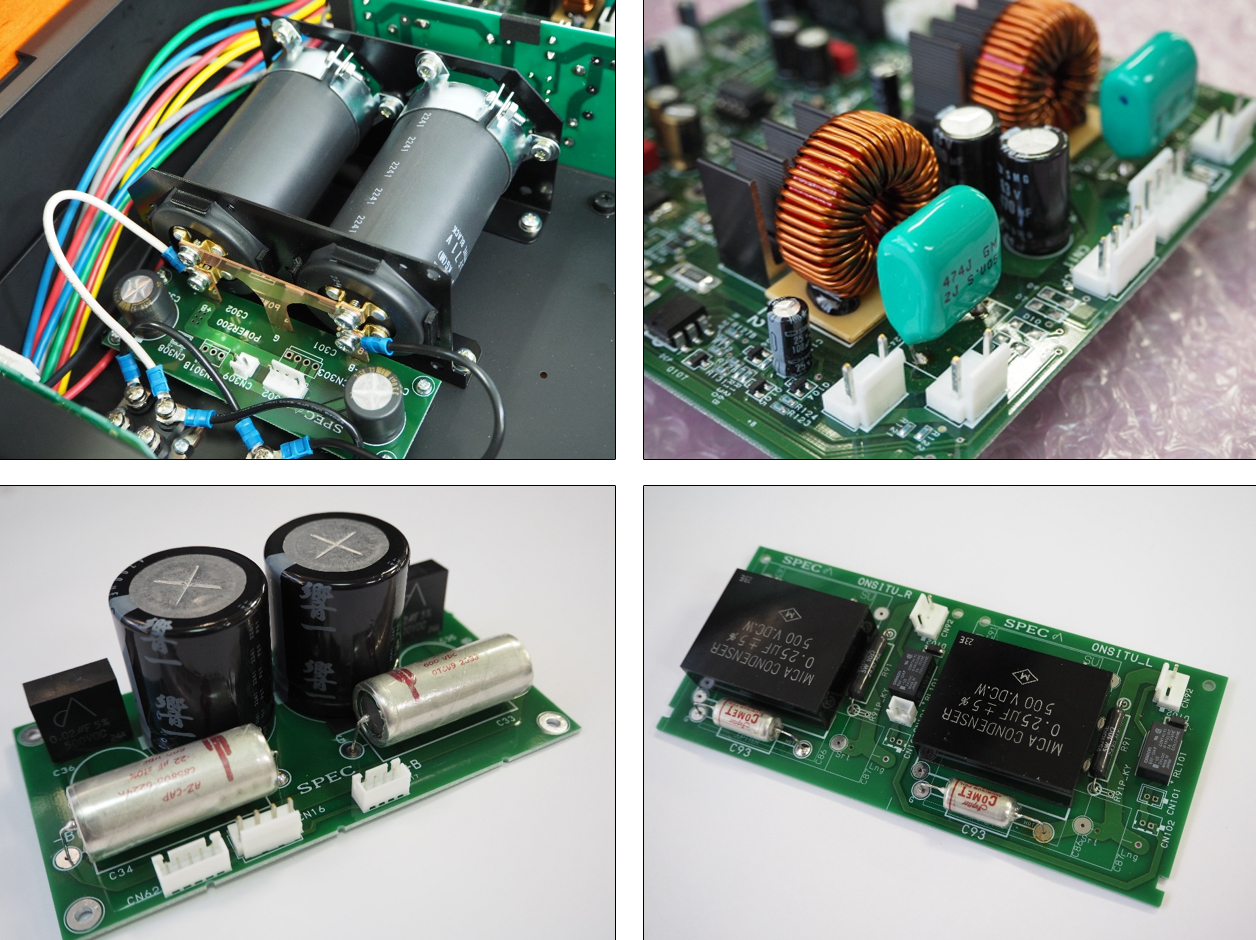
If the power stage does the heavy lifting here with silicon MOSFETs, the power supply and low-pass reconstruction filter are where SPEC modulate the voicing they strive for. It's here that the capacitor blending takes place. In the RSA-EX1000's power supply, we find a mix of electrolytic capacitors, paper/oil/aluminum-foil Arizona Capacitors and exotic mica caps from Jupiter branded SPEC. In the signal processing board, mica and oil capacitors from Jupiter got the final nod from their master mixologist. The perfectionist quest for SPEC's Realistic Sound did not stop with parts selection. EMI and mechanical vibration control are two other design areas they focus on strongly. Both the rectifier block dominated by two imposing capacitors and the R-core AC transformer—a 600 VA component specifically designed for SPEC—are massive units to need proper structural and electromagnetic integration. SPEC exploit custom steel brackets for the former, EMI shields for the latter. EMI shielding extends to the most sensitive and/or polluting parts of the amplifier hence the signal and power boards are complemented by a full-body EMC coating of the inside housing. Very low heat generation in a high-power amplifier enables a hermetically sealed enclosure which helps EMI containment. Here the use of organic materials like wood could come as a surprise. Yet the sublimation of the RSA-EX1000's mechanical design is in fact its chassis assembly. It was approached like a musical instrument. There's metal for the inner body, maple for the side panels, laminated spruce for the bottom plus a different blend of both wood types for the front and rear feet determined in listening tests. According to Mr. Shuzo Hishimi, current chairman of the company, "we source our woods from companies in Takayama City/Gifu Prefecture in the heart of Japan, a region known for its thriving woodworking industry. This includes the Hokkaido-grown Japanese maple used in our isolators."
In Tsutomu-san words: "The EX chassis uses spruce on the bottom, maple on both sides. The properties of these woods control the chassis vibrations and establish an appropriate resonance mode for a rich energetic sound. Incidentally, spruce and maple are the same materials used in violins. Amplifiers are sensitive to resonance characteristics. Hence we stress that an amplifier is a musical instrument. The EX1000's ability to express the tone of a violin so well may be due to the sound adjustments made by using materials from stringed instruments." About tuning by means of controlled auditions: "Before conducting a musical evaluation, we perform basic ear tuning by listening to solo performances of various instruments and focusing on their authentic timbres. During comparisons we spend a considerable amount of time on trial'n'error. The idea of bringing out the original musicality by matching individual timbres is a method we developed over a long period since launching SPEC. We believe it to be an important process in logically constructing realistic sound. We tune in accordance with the concept that we have promoted for some time. A violin must sound like a violin, an oboe like an oboe to faithfully convey the musical expression contained in the performance."











After appreciating SPEC's efforts put into perfecting the RSA-EX1000 at its ambitious price, I was curious to hear Tsutomu-san's thoughts on the challenges involved in a one-box design and how they managed the trade-offs to pre/power separates which they offer in their RPA-MGCEX/RPA-MG1000 or RPA-MG3000 flagship combo. "I believe the question refers to the challenges of an integrated amplifier compared to a complex preamplifier + dual-mono power amp configuration. Our integrated merely adds a selector and electronic volume control to the power section. Hence there is no significant difference with a power amp. When focusing on the functions essential to realistic reproduction, both power and integrated amplifiers have similar constructions. Therefore there are not many challenges unique to integrated amplifiers. Since the inside of the enclosure is somewhat cramped, we take utmost layout care to avoid interference. When we send a signal from preamp to power amp, its level at the preamplifier output must sit considerably below the source level to compensate for the power amp's own considerable voltage gain. This means that the finer harmonic components within the signal are reduced to ever lower levels which approach the system's noise floor, resulting in the loss of subtle timbre cues necessary for realistic reproduction. Therefore having a larger signal appear at the power section is advantageous. This notion is based on our company's values, specifically the goal of reproducing realistic sound. For this reason our power amplifiers have an embedded electronic volume control, allowing them to accept line-level input signals without suffering excess gain and its extreme attenuation needs."
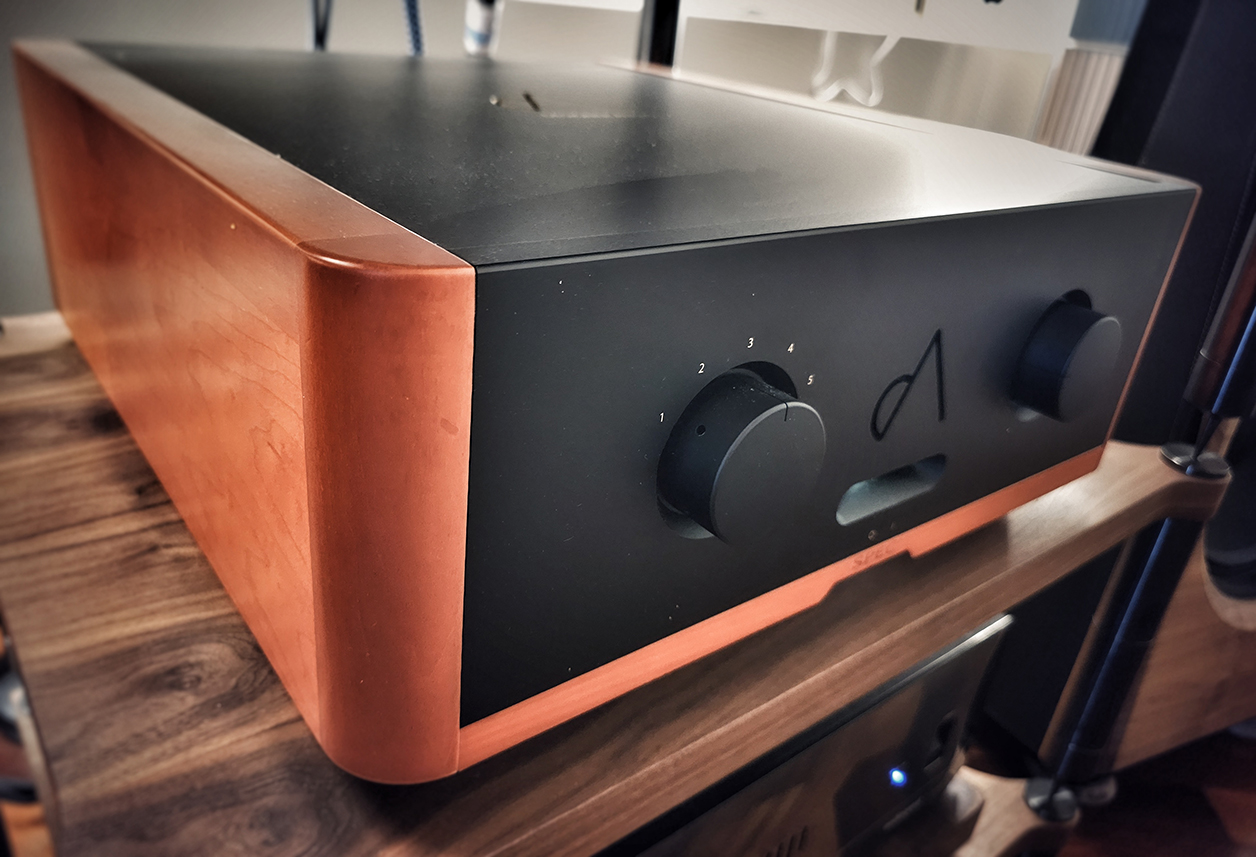
As minimalist as it is, the SPEC RSA-EX1000 remains a serious piece of hardware, measuring 45x18x53cm WxHxD and weighing 28kg. The front panel holds a source selector and volume knob—both quite satisfying to operate though some back-lighting could have helped—and a slot for the power indicator below which locates the mains rocker. As Mr. Banno mentioned, the volume control implementation underwent special care whereby the attenuation command remains outside the signal path. The intent is to maintain maximum dynamic range and S/NR regardless of level which becomes especially important at low SPL. At the rear we find 3 x unbalanced and 2 x balanced line inputs. One each can be cut by 6dB if the source is unduly hot. The maximum acceptable input voltage is just 2.3Vrms. Input impedance is 8kΩ. A set of very solid speaker terminals accepting bananas and spades covers 4-16Ω loads and dispatches 200wpc. About their remote control, Mr. Banno was straightforward: "Our high-end amplifiers in particular amplify extremely minute and delicate signals while maintaining their quality. We believe that remote control transmits common-mode noise originating from the remote's micro computer through the cable especially its ground. That affects the minute signals that should be amplified whilst degrading their clarity. We think that the minute signals amplified by the EX1000 are so close to the noise floor that we don't want to disturb them with the remote's microcontroller and its relatively low clock frequency. Because we have not been able to resolve this issue to our satisfaction, we welcome your evaluation without the wired remote-control connection." So I did just that.