I was unable to detect any shortcomings of differentiation. Separation too was very good. It was easy to follow any detail in a recording, be it a soloist or certain instrumental groups. As a result, Rimsky-Korsakov's composition was so enjoyable that I immediately supplemented my Roon playlist with several new albums of classical music. While playing those, the Reference presented a similar set of virtues starting with very good control. Thanks to that I could enjoy Mahler, Beethoven or Mozart in the same beautifully effortless and dynamic way that was so rich in minutiae, coherence and differentiation that I craved ever more symphonica. Kinga Glyk's Dream eventually directed my attention at amplified bass and its deepest reach where the Soundastic brought forth from my Ubiq woofers truly low, weighted, energetic but also tightly gripped e-bass. Pace and rhythm were great and on subsequent albums from Marcus Miller to Stanley Clarke, the Reference had a lot to say on very natural timbres and textures but also the very individual phrasing of various electric bass maestros.
Such good differentiation made each of these familiar albums very exciting. Their bass was actually slightly more convincing than over my Shinai amp although I preferred that when it came to acoustic upright. The Soundastic had the faster attacks but also immediately stopped the sound as needed. The advantage of the GrandiNote was a better portrayal of sustain and decay with even better tonal saturation to have me favor its presentation of acoustic bass. A Story of Polish Jazz by Jarek Smietana on excellent AC Records vinyl proved the integrated's class and sophistication. In the Jazz/Rap opener, it effortlessly kept the pace as imposed by the musicians, led the rhythm perfectly and very expressively followed the vocal rapping like a staccato conversation. The album is unique for its many Polish jazz masters. The Soundastic proved not only refined but versatile so was capable of conveying with equal realisim Jarek's guitar and Stanko's trumpet, Muniak's saxophone and Urbaniak's violin, Adam Czerwinski's drums or Karolak's Hammonds; to mention only some of the exceptional musicians which appear on this album.
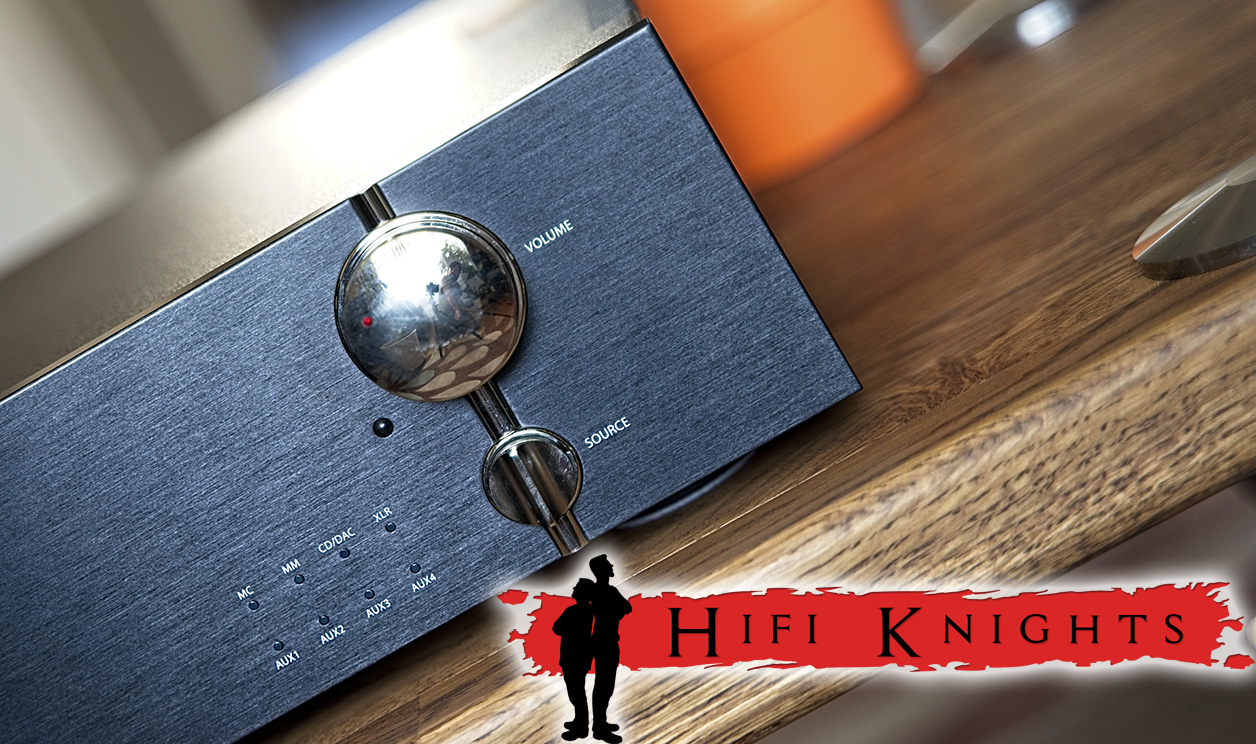
 Volume knob | rotary selector.
The Soundastic provided me with an open consistently smooth performance, good insight into the deeper layers of the music plus easy access to details and subtleties. As this is a high-quality release, the amp had opportunity to prove itself to the fullest. Cymbals were crisp, vibrant and energetic just as the drums on the other side of the band were fast, tight, well-defined, hard, fast and reaching as low as the recording required. My Shinai was a bit more dense and warm with a certain if not big advantage on resolution but it's also about twice as costly and a pure amplifier without volume control, input switching or phono. While listening to the Reference, I felt no shortcomings and didn't miss anything compared to the sound I'm used to. It really delivered excellent performance which I fully enjoyed – not often the case for me with pure solid-state amplifiers.












Although more than two years passed since I reviewed the DM-250, I have no doubt that the new integrated is the more refined, better sounding and of even higher class. The simplest description of the basic difference between them is a higher-order presentational culture. The point is not that the DM-250 missed anything but that the Reference now delivered a denser, more refined so essential reading. The new Soundastic also offered slightly better resolution and separation. Then the DM'250's core feature of energetic exuberance has tamed a bit so grown more refined. The superiority of today's loaner and the talents of its designers were best evidenced by the fact that the new refinement didn't manifest as any decrease in dynamics or energetic abilities but as still superior speaker grip. Now relaxed highly sophisticated playback resulted in a fuller, richer and better differentiated ergo more complete presentation.
The treble also seemed more refined – more open, vibrant, energetic and differentiated yet also smoother or simply more realistic and natural. Likewise the midrange. That seemed more saturated and colorful if not as much as another excellent Polish product, the Circle Labs A200 (or my Italian GrandiNote Shinai). I guess it's the bass, its momentum, tight control, differentiation, speed, texture and timbre that resembled most what I remembered from the DM-250 audition although even here I believe that the Reference's potential is still greater because its bass seemed to go even lower with more saturation. So Soundastic it is now!