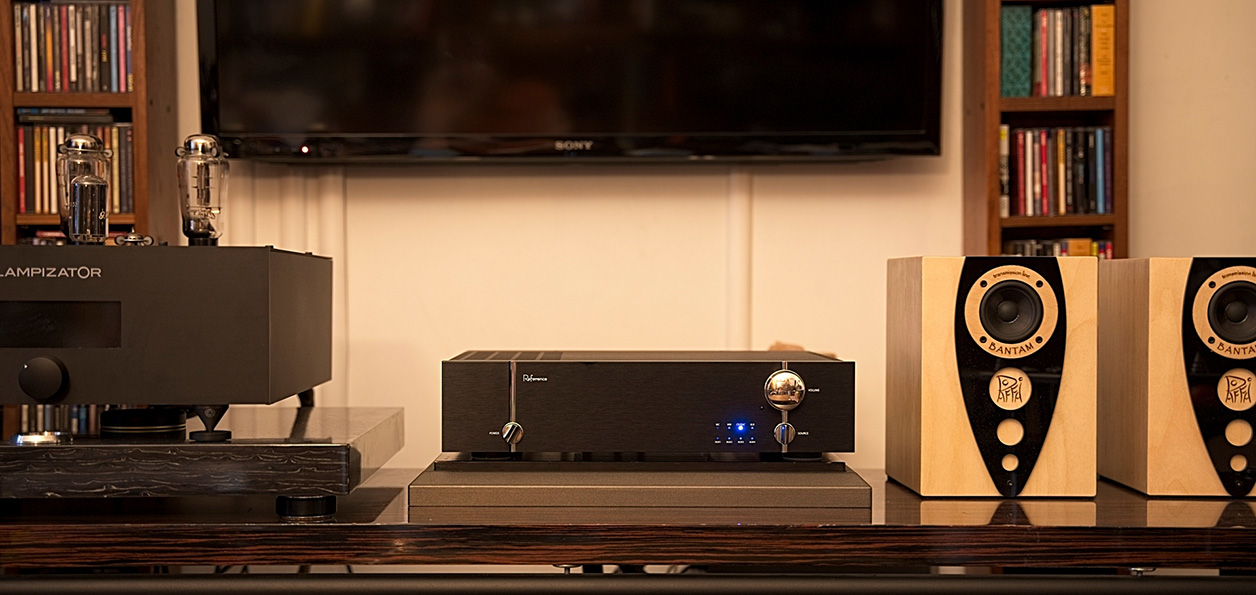
My first listening sessions were supposed to be casual. I connected the amplifier to my Ubiq Model One Duelund Edition and fed it signal from my LampizatOr Pacific DAC. The idea was to give the Polish integrated time to acclimate while I took care of other writing/translating chores. But the Soundastic had its own plans. It didn't want to remain in the background though I had set volume deliberately low. It just wouldn't be ignored. A long Roon list played album after album including Trombone Shorty by a fantastic New Orleans trombonist. His lively incredibly energetic style is easily recognizable and was again this time. At background levels the Reference beautifully presented all those features. My limbs involuntarily tapped out his lively rhythms, my head kept bopping and my focus gradually shifted from the work in front of me to the natural true timbre and texture of the master's trombone as well as other accompanying instruments, the brasses in particular.
The sound was pure, clear but not bright. Any actual brightening would have immediately turned unpleasant with such close-mic'd sharp brasses. Instead it presented juicy, strong, on the breath with great pace and rhythm so was the great fun I associate with New Orleans music. I had no choice but give up work and prime the volume. It made no dent. The sound remained exceptionally clean so without a hint of distortion or coloration. At the same time it was quite dense if not as much as my twice costlier Italian Class A Shinai. It remained well sorted and transparent. Each element of the complex mix occupied its own well-defined 3D place on the soundstage to confirm the excellent control the Reference exerted over my challenging speakers. The presentation seemed effortless yet had proper drive. The sound was powerful since the brass instruments were recorded up close and there was also that unique joy of playing music and having fun which I find characteristic for Trombone Shorty.









The next album kept me from getting back to work again. It wasn't even the famous first Blade Runner soundtrack but an extra disc from a special anniversary version of previously unreleased bonus tracks. On my part this was an intentional 'smart' move as I'd initially planned to avoid involvement and focus on my work at hand. The original soundtrack would surely have prevented it as I love the film and its musical milieu. My clever plan failed miserably when once again the Soundastic pulled me by the ears into the extraordinary world created by Vangelis Papathanassíou. The Polish transistor amp surprised me now with the huge space it rendered and its openness in which I discovered familiar and less familiar sonic motifs. Although these tracks weren't directly from the movie to recall specific scenes, I still saw Ridley Scott's original world in front of me. It was dark, raw, rainy, sometimes depressing as a dystopian vision but fascinating and distinctive. The Reference perfectly built up the moody atmosphere of this world to convey with just sounds as many emotions as the combination of film plus soundtrack does. This drew me in completely.
At this point I should have skipped trying to play music in the background but I did make one more feeble attempt to get back to work. Once the excellent recording of Rimsky-Korsakov's Capriccio Espagnol began however, I was pulled away from my laptop's screen – first to significantly increase the volume level, secondly to gaze at the huge sonic panorama which unfurled. The orchestra exceeded the speakers' width which is not as easy with the Ubiqs as it is with my GrandiNote MACH4 line source. That surprised me also with its multi-layered depth though at this stage it probably shouldn't have. Before I had a chance to take a closer look, the orchestra took off for good showing momentum, scale and power in truly impressive fashion. The amp kept a tight grip on my larger more difficult sealed speakers. It made sure that the presentation remained well organized even during the densest most dynamic passages. Although disciplined and focused, the reading was still effortless, fluid, coherent and natural. The latter resulted from better saturation than the DM-250 which stemmed largely from higher resolution and a quieter background.