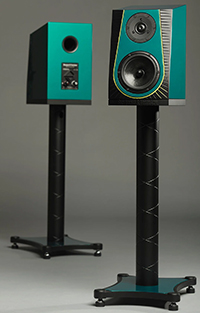
 Not quite. Where some Danish brands went offshore at least in ownership—China's GoerTek Inc. acquired a majority stake in Dynaudio in 2014, Klipsch now own Jamo—Raidho remain resolutely Danish. Some domestic brands like Storgaard & Vestskov outsource their drivers but manufacture complete enclosures in-house. Raidho flip that more common recipe to outsource cabs but make their own drivers. Denmark once hosted the rather famous speaker cabinet plant Hornslet Cabinets just north of Aarhus. They supplied brands like Aerial, Audio Physic, Dali, Linn, Living Voice and Naim yet stopped operations in 2013. Today many Nordic brands source their enclosures from China. That's not just for cost effectiveness but quality. The latter isn't only about complex compound angles and fancy curves in wind-slippery shapes. It's about flawless execution of veneers and gloss lacquers. Were equivalents made in Denmark with the country's far higher wages, taxes and environmental regulations, enclosure costs would skyrocket. Because Raidho continue on-site driver production, that math still factors for half the bill of goods. Here it's meaningful to look at Storgaard & Vestskov's Frida [right], a 5¼" 2-way monitor with SB Acoustics tweeter and SEAS woven-mineral mid/woofer at €15.5K; and today's X1.6 Reference 6½" two-way in its simple rectilinear box—the TD models get shapelier—but fitted with bigger more exotic and fully proprietary drivers plus extra passive radiator; at 1/3rd less. Whilst expensive is as expensive does, a closer look linearizes perspective. And, Raidho's planar tweeter is a quite different proposition than a 1" dome tweeter. Børresen meanwhile paralleled the launch of the X1.6 Reference with their €10K/pr A1. That's a triple rear-ported 5" 2-way monitor with carbon-skin aramid cone and ferrite motor plus another take on the planarmagnetic tweeter. In that comparison too, Raidho offer more for the money whilst going for a simpler enclosure.
Now we toss the history book at Fenrir. While he makes quick wolf of it, the raidho rune stands for journey, travel, purposeful movement and life's rhythm. Its literal meaning in Old Norse was 'to ride'. Rather than for a ride, let's say that Raidho mean to take us on a journey. Here we remember Leif Erikson's discovery of America half a millennium before Christopher Columbus. "Scientific testing of cosmic-ray events in tree rings officially dated a Norse timber cutting in Newfoundland to exactly 1021 AD". This is about the L'anse aux Meadows site on the northernmost tip of Newfoundland island. Spanning 8'000 hectares, it contains the remains of eight buildings constructed of sod over a wooden frame, with over 800 Norse objects recovered including bronze, bone, stone artifacts and evidence of iron production. The Vikings certainly got around in their longboats. The eponymous TV series celebrated that very fact in its last season when Ubbe's expedition to Iceland moves on and finally arrives his tiny crew in today's Canada only to there find Ragnar Lothbrok's favourite but long-missing boatbuilder Floki. Back to 2026 Denmark, reserving 8-inchers for sub duties would be too exclusionist. Hence this wind-slippery X2.8 below just announced in time for the Vienna show became a proper 3-way with dual 8s and more Mundorf/Nordost splash. With pricing of €27K/pr in gloss white or black and €30K for Walnut, there's a big gap to the X1.6 Reference. Creative shoppers could fill it with an off-brand subwoofer to undercut the X2.8's claimed 32Hz reach whilst bagging big savings.
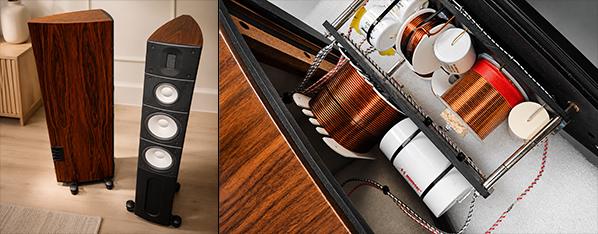 Meanwhile for the same Vienna trade show, Storgaard & Vestskov announced their new Astrid. That remains a pure 2-way of 4 x 5" polypropylene mid/woofers to radiate as a cylindrical line-source with 6 ports on the rear. It's mentioned here not to muddy the waters but as a reminder. Until not that long ago, Raidho too held steadfast to such smaller drivers. Pursuing larger Ø with their in-house composite cones is a more recent development. So is the dawn of integral 3-ways. Of course Raidho's new subwoofers can turn any of their 2-way monitors or floorstanders into effective 3-ways. Here the meaningful distinction is that such 2.1 or 2.2 combinations won't add a high-pass filter to a 2-way's mid/woofer but go active on the woofers' low-pass filter then make those drivers adjustable to room and taste independent from the master volume.
If one plans on such separation of labour, the X1.6 Reference is arguably overkill already. Now the X1.t model below it, a 5¼" 2-way, will be perfectly sufficient. It reaches low enough to hand over to a mono sub. Having invested into extending their very best driver tech to dedicated bass makers, Raidho opened their doors to interesting new possibilities which will still speak with one voice as it were. Let's also reiterate that the new €500/pr stand in black and white looks like an improvement over their earlier effort whilst pricing right to also accompany monitors from the Scansonic portfolio. And whilst on reiterating, the X1.t and X1.6 Reference shave off coin over the pricier X models by sticking to squared-out cabs. That actually increases cubic volume over the narrow-spine versions. In any case, Pandrup R&D has clearly been firing on all cylinders.








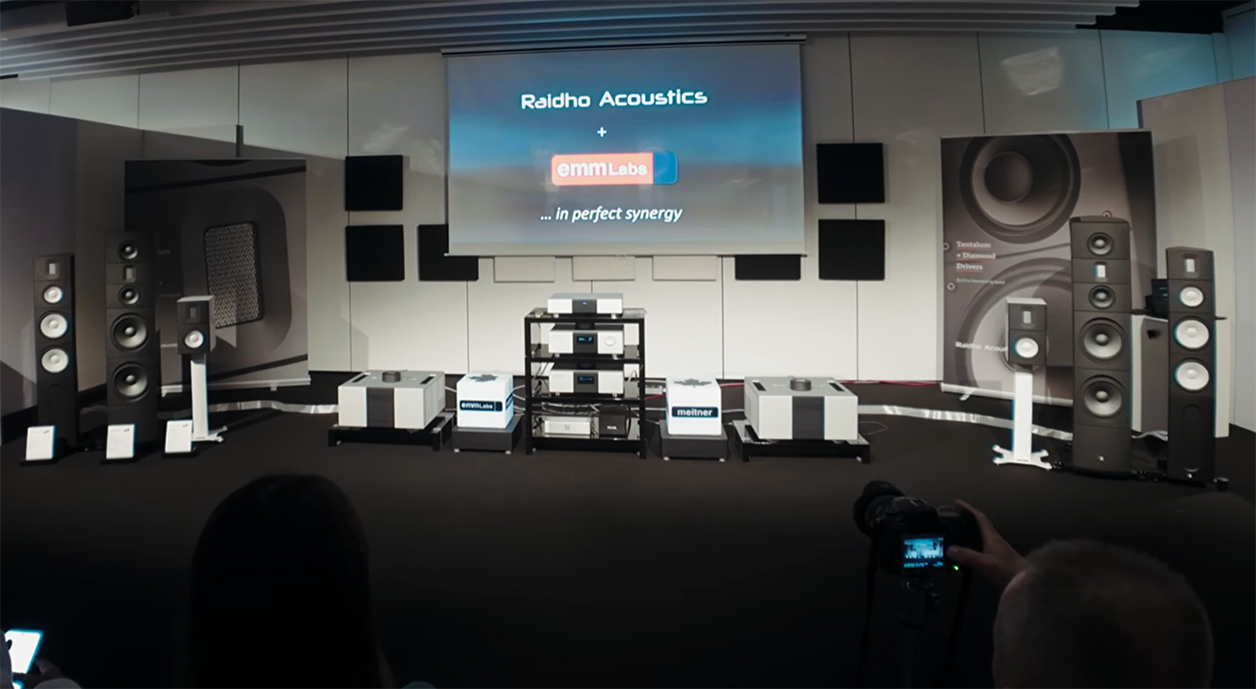 Raidho at Vienna 2026.
The original X1.6 had spec'd at 45Hz-50kHz, 87dB, >6Ω, 3.5kHz crossover, 20x36x26.5cm WxHxD and 11.5kg. Would the Reference version differ at all on any of these paper values? After all, the press release only mentioned the switch from port to passive radiator; and upgraded filter-parts pedigree. Should we expect a change in -3dB bass reach then?
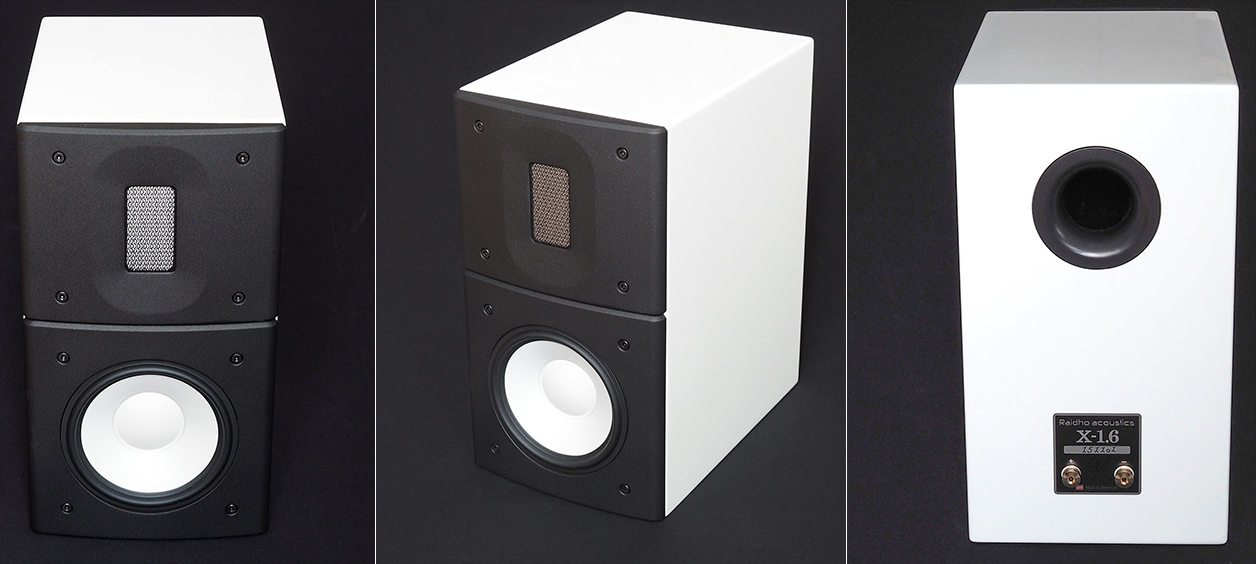 From a review of the X1.6 by my fairaudio colleagues in Berlin. Click image to read a Google translation of it.
On September 21st, a Raidho group email contained a link to their 2026/2027 catalogue and within that PDF, final X-1.6 Reference specs. The only changes over the predecessor are cabinet depth extended by 3.5cm to 30cm; and the F3 of 40Hz five cycles lower. I took the opportunity to ask my contact Morten about sample availability when the email itself only mentioned the new universal stand in matte black or white which can be had with a ScanSonic badge, Raidho badge or no badge at all to suit all other monitors of appropriate size. "We are still working on the speaker. Sorry for the delay."
… to be continued…