Enter the ABR aka auxiliary bass radiator. Our tour guide is Grzegorz Rulka of Virtual whose Cobra uses six of them – per side. "A passive radiator is a cone without voice coil or magnet. It's a tuned mass/spring system. The cone is the moving mass, the air trapped in the enclosure the spring. When the active driver moves out, internal air pressure drops. The higher atmospheric outside pressure pushes the radiator in. When the active driver moves in, internal air pressure rises. That pushes the passive radiator out. It seems that the passive moves out of phase yet at the system's resonant frequency, this relationship changes. Around this frequency pressure fluctuations from the active driver combined with the inertia of the radiator's mass cause the passive to move in phase. At or below the resonant frequency, the active driver still moves but output drops off. Now the passive moves with much larger excursion to take over a significant portion of the sound. It acts like a tuned port but instead of letting air escape, its mass and size resonate with the enclosure volume. The radiator converts internal air pressure changes into LF output. It's about synchronized motion at specific frequencies to reinforce bass. For a long time I didn't fully understand how passive radiators work nor was I particularly interested. I could achieve excellent bass with cabinet size and ports. However, if you want small passive speakers with powerful, deep and fast bass, a port can become physically impossible. This is where radiators shine.
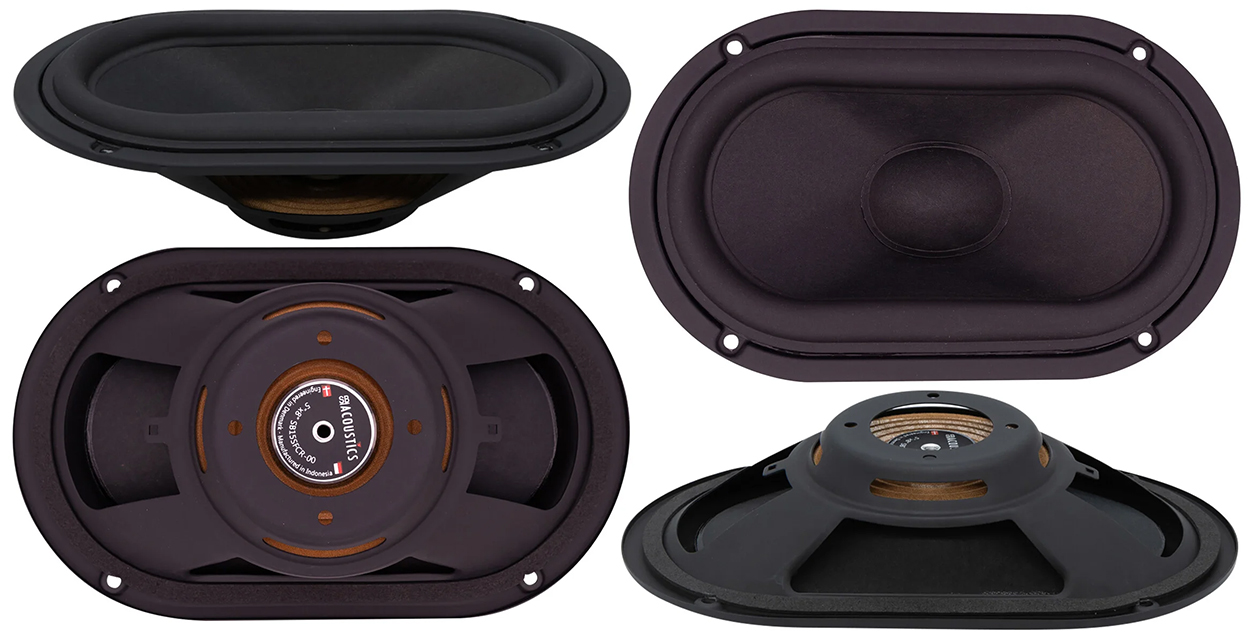 A 5×8" ABR example from SB Acoustics.
"Across their range, we essentially treat them like active woofers. They are limited since the active woofers set their max excursion. However, for scale, pressurization and sheer impact around the tuning frequency, they can be viewed like normal woofers. They almost behave like a passive subwoofer driven by the main cone's energy. It's not just about cone area (Sd) but moved air volume (Vd). My Dayton radiators have a maximum excursion of ±19mm, essentially twice what normal woofers can do. For Cobra, six radiators per side have a total Sd of ~817cm² and Vd of ~1'552cm³. Many 15" woofers have an Sd of ~830cm² but to maintain 19mm excursion, we'd need an active 15" sub. Cobra is smaller than a 15" sub. Of course an active sub would be able to do more since ultimate output of the radiators is set/limited by my two Dayton woofers. Still, it's an incredible solution. Even more intriguing with multiple radiators is that the internal cabinet volume now has very little influence on the tuning frequency. Since that depends on the mass of the radiators as much as internal volume, we simply add a bit more mass to all the radiators to shave off enclosure volume. We make the box smaller. For optimal response and low distortion, it's best to keep each radiator of the box as close in width and distance as the others."












From Buchardt to GoldenEar, Mårten to Tidal, Radiant to Virtual, PS Audio to Sonus faber, Scansonic to now Raidho, ABR have enjoyed a renaissance including the extreme high-end. They even show up in subwoofers. Raidho marry their own active subs of twinned 8" diamond-coated Ceramix cones to dual 10" radiators; or two 10" woofers to a quad of their radiators. Hello open secret. Raidho traditionally promoted 5¼" drivers then added more of them to scale up cone surface for bigger models. The X.1.6 introduced a 6½" version but it took many more years before the Ceramix concept hardened with synthetic diamond could grow to 8" and 10" diameters. As a diehard fan of stereo 2.1, I could build an ambitious 3-some with X1.6 Reference plus central TD8 sub dovetailed symmetrically with my active outboard spl Crossover MkII. Of course the TD8's premium Walnut burl would clash with the simpler white or black of the X monitor but black too is available for these subs.
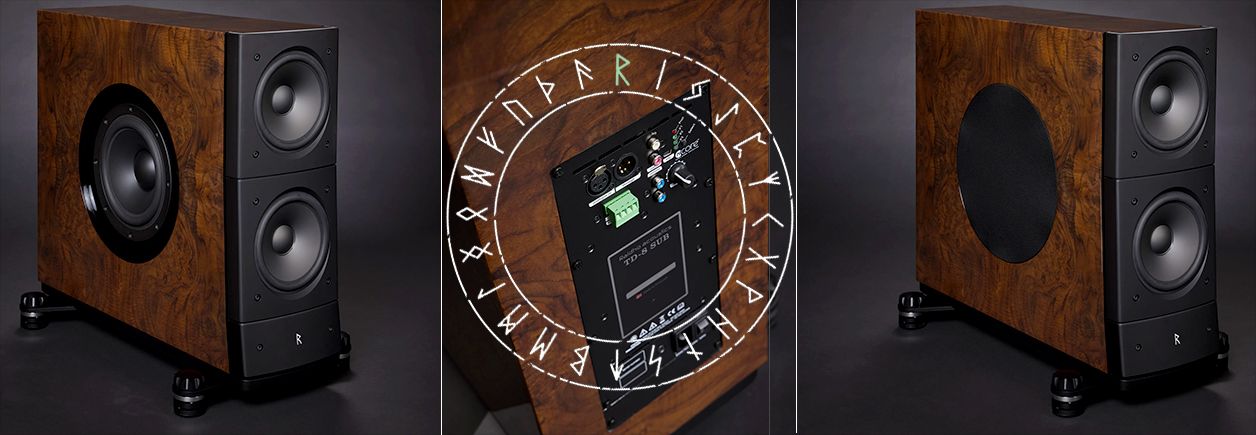 Superimposed is the Elder Futhark, the oldest form of the runic alphabets used by Germanic tribes.
To keep up with their blazingly fast planar tweeter, Raidho were always careful to give their mid/woofers hair-trigger reflexes. Hence the preference for smaller very stiff cones of lower moving mass. Where premium brand Raidho's entry-level X range remains out of reach, Scansonic under the same Dantax Radio A/S umbrella cover lower price points. The same publicly traded Dantax entity active since 1971 also operates brands GamuT and Harmony. For more Dansk hifi history, driver manufacturer ScanSpeak of Denmark's Hørning created the original Scansonic brand in 1970 for a newly developed line of loudspeakers. By 1977 Dantax A/S acquired ScanSpeak and moved production and manufacturing to Pandrup. In 1985 a fire destroyed their ScanSpeak factory but production quickly resumed in new Aabybro premises. In 1987 the Videbæk Loudspeaker Factory aka Vifa acquired the ScanSpeak drive-unit operation. Scansonic the speaker brand remained with Dantax. Vifa's ScanSpeak absorption led to Vifa-Speak A/S. By 2000 that enterprise combined with Peerless to become Danish Sound Technology which Taiwan's Tymphany acquired in 2005. Four years later Danish investors returned ScanSpeak to Videbæk. By 2006 meanwhile ScanSpeak's Ulrik Schmidt, Frank Nielsen and other engineers had begun peeling off to launch Scandinavian Audio Research. By 2009 that became Danesian Audio to partner with Indonesia's Sinar Baja Electric and produce their range of SB Acoustics drivers. Raidho meanwhile which first started in 2001 still operate out of Pandrup where Dantax situated them after their 2009 brand acquisition from founders Michael Børresen and Lars Christensen who today work under Audio Group Denmark. End of history lesson?