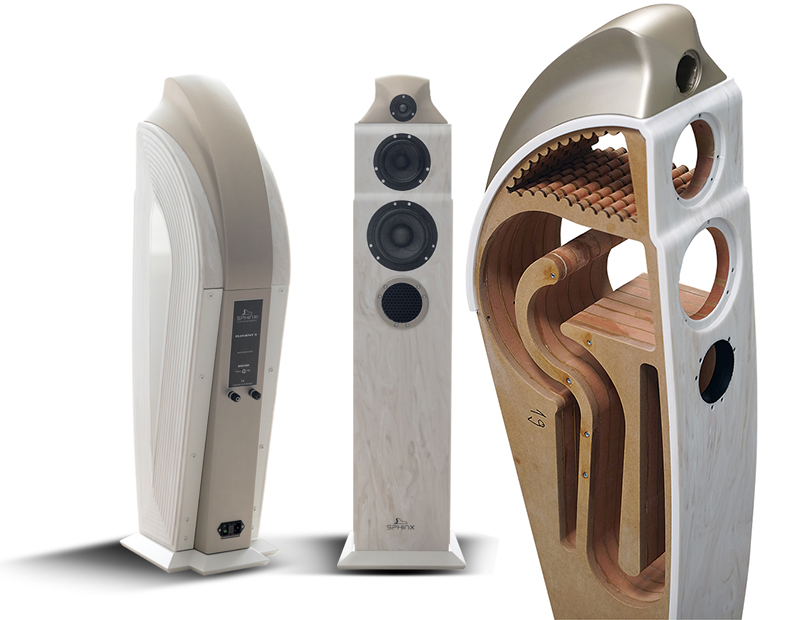
 Whilst waiting on the nodes of times to turn, Poland's High Fidelity published a report on Edwin van der Kley's visit to Krakow to demo this new Sphinx Element 3 speaker. Reviving the brand with initially two speaker models meant hiring an acoustics engineer tasked with analysing as many speakers as possible to establish a formula for how specific design solutions impact the sound; particularly the bass response. At the end of his research, their engineer used his data acquisition cache to develop software which predicts cabinet behaviours. Contrasting all designs he'd modelled, he then came back at Edwin to recommend that he focus on transmission-line speakers. This he did despite existing simulation models showing clear comb-filtering issues and resonances in the upper bass/lower midrange though also offering the lowest cleanest bass of all alternatives.
To work out the remaining issues took an extra two years of non-stop R&D. It determined that existing formulae for TL geometries are flawed, lack important steps thus lead to equation errors finally design mistakes. The Sphinx team of Siltech/Crystal Cable ended up with this twin-channel line of varying lengths to delay certain frequencies and fix classic problems that bake into incomplete earlier predictive software simulations. As one advantage for their approach, Edwin lists that it doesn't need large drivers so can exploit smaller lower-mass diaphragms for faster impulse response and better off-axis response.
Given today's review's focus on a novel radial TL, I thought this parallel development to be of interest and relevance because it comes from a design team known for its scientific rigor who concluded that of all the existing speaker models—ported, sealed, dipole, horn-loaded, TL—the transmission line offers the best bass performance. We even see that Node's embrace of unusually small drivers follows similar thinking just solves the line geometry issues in a very different manner altogether.
… to be continued…