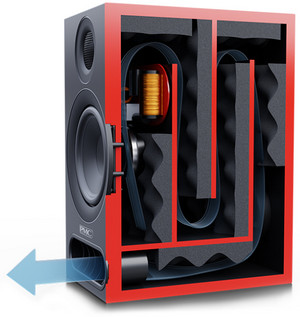
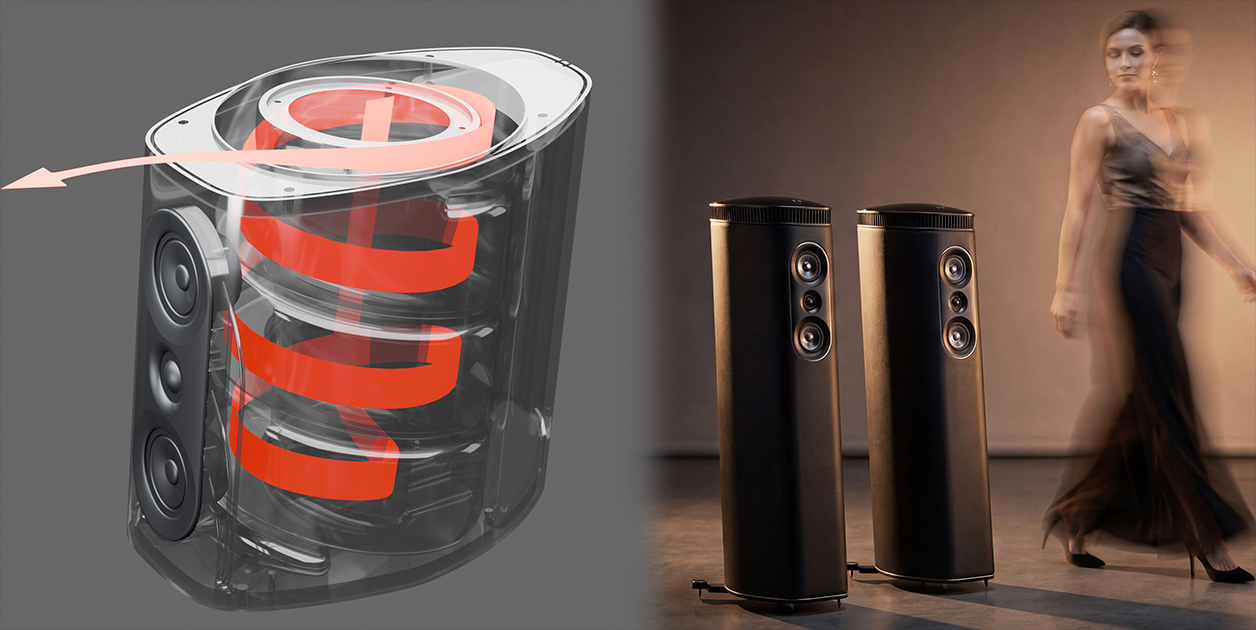
 First, let's revisit transmission-line basics. A TL is a long, often circuitous, folded and tapered tunnel or maze which a woofer back wave must travel through. Fibrous materials like acoustic foam, long-haired wool or fibreglass lines the transmission path to absorb certain frequencies and control sound velocity. The length of the line often corresponds to a quarter wavelength of the target frequency and introduces a strategic delay to the rear wave so that by the time it exits the line's mouth, it does so in phase with the woofer's front emission. This adds itself to the overall sound pressure to create a stronger deeper bass than would otherwise be possible. Meanwhile the damping materials attenuate unwanted midrange frequencies and prevent them from reflecting back out the woofer cone. Design challenges are a TL's required length when tuned to very low frequencies which can increase enclosure size unless cleverly folded which then makes the build more difficult; and the need for precision of the line length, type, quantity and placement of absorptive materials for optimal performance. From that we appreciate how Node's helical concept fits a longer line into a smaller cabinet to tune it for lower louder bass. From PMC: "The transmission line effect over a bandwidth of around two octaves centres on the main resonant line frequency and over this region controls the motion of the driver, massively lowering distortion and raising maximum possible SPL. The resonant line frequency is defined by the acoustic length of the line and is the frequency at which one quarter of a wavelength is equal to the acoustic length of the transmission line." [A classic PMC transmission line at right.]
We appreciate how Atom's trickery implies that whatever the helical line doesn't absorb means secondary bass emissions at least one cycle behind the woofer's 'direct' output which reflects off the skull cap's inner surface and rim. After all, to not cancel but reinforce, the woofer's out-of-phase rear radiation bouncing off the bottom of the cab then spiralling up before exiting must delay enough to get back in phase. This differs from sealed alignments which trap that energy inside the box to interfere with the driver; and rear ports whose output only meets the direct radiation once it reflects around our room. At Node, front and rear waves meet and mix inside the enclosure then exit through the same slot. We also appreciate that as a 3-way, Node's transmission line needn't absorb midrange frequencies like the above 2-way PCM does. Meanwhile Node's midranges encounter the wavy cross-cutting channels of the MonoCell filler on their sides. It has the rear waves enter all the tiny tunnels to exhaust themselves rather than reflect back out through these cones delayed in time. That said, it appears that the TL concept can pursue two different goals. One is to absorb all of the woofer's rear wave by progressively damping it. The other is to let the lowest frequencies pass delayed sufficiently to exit the TL mouth in phase with the front wave. That obviously incurs a small time-domain penalty. With Node, the woofer's front emissions hit the immovable object of the top cap in ultra proximity. That adds brilliant mechanical breaking so more self damping atop what the transmission line already does.
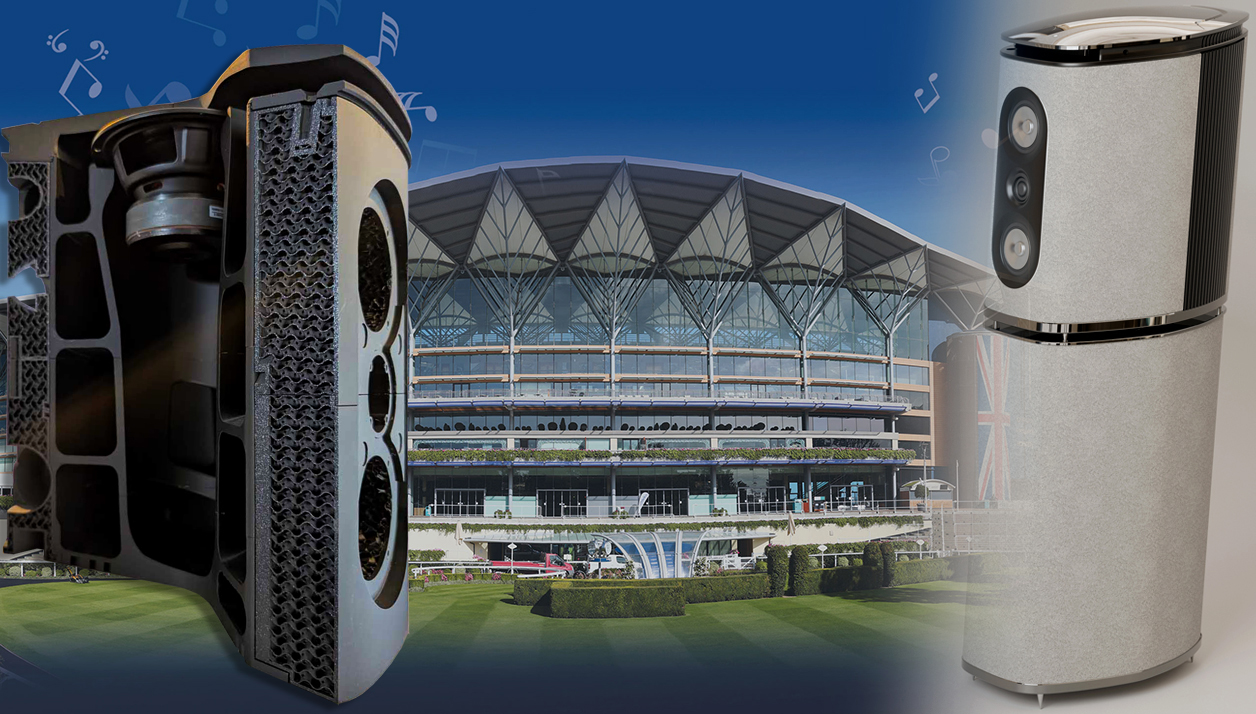 A novel solution to pursue a quiet enclosure in a pre-production version.
 Even prior to the full reveal, the PMC quote already explained how proper TL loading doesn't merely add bandwidth by lowering its driver's resonant frequency. It avoids rear pressure on the driver which reduces excursion requirements over what a ported or sealed driver would undergo for the same SPL. That eases amplifier drive and lowers throw-related distortion. Like a sealed driver, a TL rolls off at 12dB/oct. so half as fast as a ported driver. That too benefits extension.
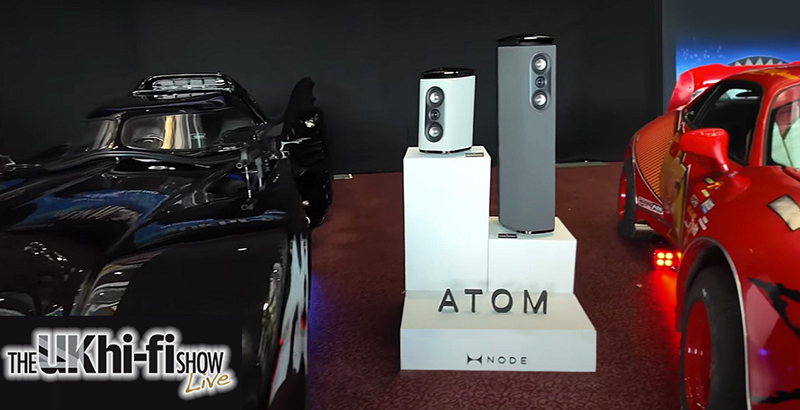
So Atom's shape and dimensions aren't just about a sleek narrow look which hides a bigger driver. Loading that woofer through an absorptive line has benefits beyond a typical port. It becomes an acoustic performance parameter, not mere out-of-sight cosmetic nicety. Node's silent show display amongst flash cars demos how compact these Atom models are once contextualized in actual surroundings. Node also had an active Atom exhibit playing tunes with a Melco server and spl electronics; and a second one with Hylixa on Aurender and Valvet electronics.
David's first post-show comment: "The event was a huge success for us and a lot of people were very excited about our new products!" It's what any product launch hopes for; that and follow-on orders. By December 19th, "we're in full-scale production/development mode. Some minor tweaks are being made so we want to be 100% before we give the green light and launch the range for sale. Currently formal first production is scheduled for March 2026". At that juncture my Albedo Audio Achema date had wrapped to conclude that a properly implemented transmission line as the Italians do it has apparent in-room integration advantages over ubiquitous ports. It thus was most opportune that in the new year I'd be able to follow up with Node Audio in the very same room.











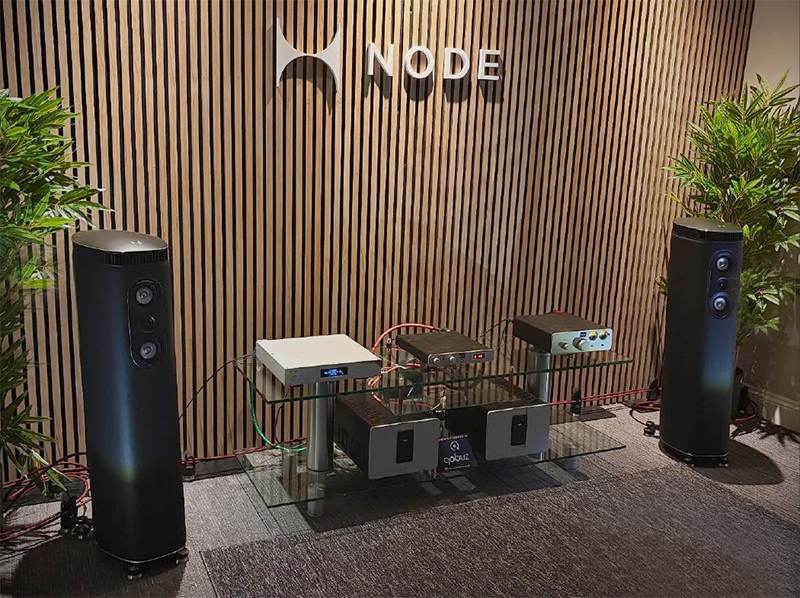 Three months after I'd penned the above, the Audio Show Deluxe 2026 of Whittlebury Park near the famous Silverstone racetrack took place where Node bowed production versions. See right.
Now final specs dropped: 0.85" neodymium-powered soft-dome tweeters; 2-inch spiderless magnesium-alloy mids; and either 5¼" or 6½" long-throw paper-cone woofers. The Atom 525 sets its crossover points at 250Hz and 2'750Hz, sports 84dB/4Ω sensitivity and bandwidth of 34Hz-27kHz -3dB. It weighs 13.7kg/ea.
The Atom 650 duplicates the filter points but drives bass reach down to 28Hz whilst sensitivity goes up to 86dB/4Ω and weight to 21.7kg/ea. As the passing lady all blurry from spiralling demonstrates below, these speakers reach to about the belt line – very compact and tidy given that these midranges are just 2 inches in diameter to present a most narrow profile.
"Sorry for the radio silence this side—we've been busy! We'll look into the review units as soon as possible. We only just assembled final production models today." That email arrived three days prior to the show opening.
Whittlebury visitors thus heard the world premiere of the finalized Atom 625 fresh outa the oven powered by German spl electronics fronted by a Melco server. Unlike the fabric-wrapped pre-production version, the columns now seem clad in real leather; and quite a number of possible colours at that.
Saville Row. It's not just for suits anymore.
When you put two guys with real design credentials in charge of cosmetics and finishing as headphones famously do with Antonio Meze, such folks simply can't help but stress the dress code to look sharp and stylish.
By July 27th so past recovering from the first HighEnd show in Vienna, "we're desperately trying to get a few review pairs ready but they keep going to distributors. We're now producing pairs specifically for review and should shortly know that timeline." By September 15th, "we still haven't had a chance to build review pairs, having to react to sales opportunities instead. I'll be in touch."