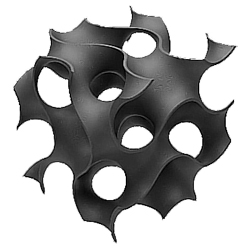
Before we get at the nuclear fusion of listening, let's briefly touch on the promise of spiderless midranges surrounding a tweeter like a quasi coax. They mirror Audio Physic's custom units from Monacor; the Alpair¹ range from Markaudio which in fact looks rather similar; and most extreme, the Belgian Illumnia drivers which omit even an outer surround. Why is arachnophobia a blessing not curse? Because by definition a speaker spider resists the outstroke. That absorbs energy whilst adding mass which lowers efficiency. Eliminating it makes a dynamic driver less lossy. It's how fear of spiders transforms into a resolution benefit. No need to see the hifi psychiatrist. Atom's 3D-printed damping fill again recalls Audio Physic now for their open-cell ceramic foam which acts as both absorber and mechanical stiffener. Meanwhile Node's 3D-printed enclosure had a recent parallel in the Virtual Hifi Viper and Cobra cabs from Poland. Additive manufacturing goes places subtractive manufacturing with 5-axis CNC routers cannot. In short, these Atom models unify advanced industrial design with the very latest in hi-tech manufacturing methods.
____________________
¹ I reviewed Lindemann's two models which use them as widebanders augmented in the pure harmonic realm by a small AMT; and own the MonAcoustic SuperMon Mini which parallels two isobaric Alpair as widebanders also augmented on top by a small folded tweeter. These are very special drivers.

3D printing has become a bit like movie FX for our sector. If someone in Hollywood can imagine it, film makers can now visualize it, be it aerial combat between dragon riders or acid-dripping aliens fighting invisible dreadlocked predators. Having the idea of a rotating transmission line starts with a pint and napkin at the pub amidst the din of other tall tales. Manifesting it is another task altogether. With Hylixa Node already had their in-house proof of concept and the necessary infrastructure of industrial equipment and trained operators. By adding enclosure volume without laying a dinosaur egg, particularly Atom 650 adds bandwidth from a more conventionally shaped object. Being UK based, it reminds me tangentially of Wilson-Benesch as another outfit likewise entrenched in their domestic hi-tech R&D resources and state-of-the-art production processes. Meanwhile far bigger outfits continue to order their gloss-lacquer MDF enclosures from China. Horses for courses is a fitting takeaway considering Atom's global reveal at the famous Ascot racetrack.










Here's a rundown of diverse node meanings. Electrically it's a point in a network or diagram at which lines or pathways intersect or branch off. It also applies to traffic, mathematics and astronomy. In botany it's the part of a plant stem from which one or more leaves emerge. In human anatomy we have lymph nodes consisting of a small mass of differentiated tissue. In Physics a node is a point at which the amplitude of vibration in a standing-wave system is at zero. Room modes exhibit such nodes. It's also a point at which a harmonic function has the value zero, "especially a point of zero electron density in an orbital". In daily use, related meanings are junction, fork, branching, intersection, confluence, convergence and crossing. The brand name Node Audio thus has layers. Whilst on British ingenuity still, did you know that Chord Electronics opened a lab specifically to develop cables based on combining copper with carbon nano-tubes to increase conductivity for fewer signal losses?
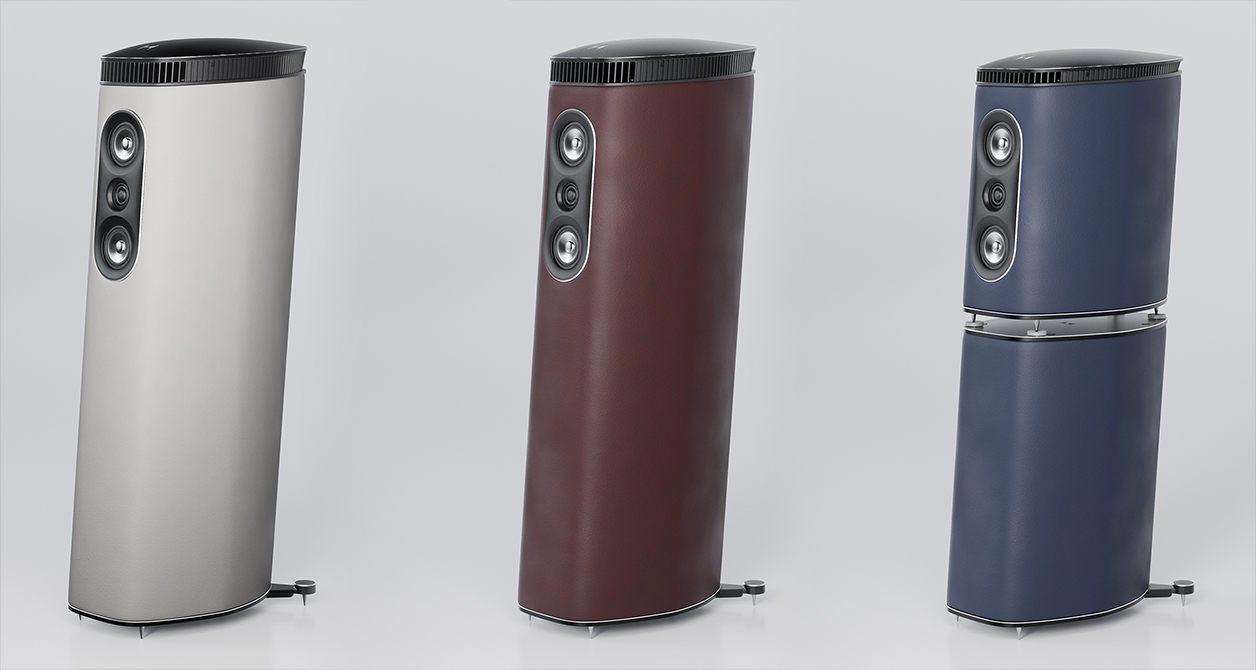
 Looking at these Atom renders, the closest likeness of execution and design language I spot is Denmark's illustrious Bang & Olufsen. Such a stylish combination of highly polished metal and fabric is quintessential B&O. That of course is a leviathan operation compared to Node Audio's tadpole of an underground boutique. For a tadpole to command the resources for such creations is quite the super node of confluences. The intervening six years since Hylixa's launch might just hint at the many challenges involved to see this concept to fruition? How does one even model the acoustic behaviour of a helical transmission line, never mind successfully execute it outside of simulation software in the material world? From my side of the techno-peasant fence, it's a bit of a flap and fluster served up with a sprinkling of tizzy plus side order of agitated abashment. Now recall that Atom 650 stands just 97 centimetres tall. Ditto for Atom 525 on its own stand. All of their internal complexity packs into really compact shapes. That wants to make friends with interior decorators everywhere. The built-in rake insures that driver axes aim up to avoid rug-rat imaging. Does the TL loading portend different room interaction in the bass than we expect of ports? That and much more we'd learn once the Ascot show of the September 27th/28th weekend had come and gone and perhaps visitors shared their impressions on various online platforms.
[At left, a look at the 3D-printed MonoCell damping module.]