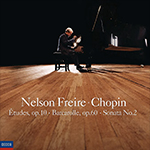
 A great demonstration of the balance which the Aero strikes instead could be heard most ideally in Nelson Freire's superb reading of Chopin's "Sonata #2" whose "Barcarolle" and "12 Études" on this album are equally stunning. The third movement of that sonata is the famous "Marche funèbre" often performed on its own because of its gravitas loaded with emotion. With the Aero you hear the strings being hit, the body of the grand piano oscillate, the room add its reverb. You hear it all yet nothing sounds out of place, exposed or exaggerated. Compared to the Holo Cyan 2, the piano takes on more weight, scale and complexity and all the small-note decays trail significantly longer, adding far more layering to the textural quality of the recording.
The same can be observed on intimately recorded vocal performances. Andreas Scholl's rendition of Purcell's King Arthur's “What Power Art though?" is a master class of vocalizing that is also a half-exhaled sigh craftily modulated as he whispers through parts of the aria. To date, no other DAC in my system has played this track with such believable realism and closeness. It was hard not to admire Scholl's mastery of delivery. Maybe more than anything, the Aero's tonal prowess lets you enter the musicians' multi-disciplinary virtuosity. We hear more of their intent and spontaneous choices without ever feeling that the music is being deconstructed.








To complete the picture of the Aero's character, there are a few aspects of musical playback where it is good, sometimes excellent but not best in class for its price. Imaging is deep and well layered but width could sometimes feel a little more constrained than I'd like. The soundstage rarely extended beyond the speakers even on tracks I know to be mixed with out-of-phase effects that should wrap around my head. The Aero aims to sound real and so won't necessarily parlay all the digital trickery one may find with electronica. Yet it does paint a very realistic picture of a symphonic orchestra, just not a broadly enveloping one. Since we are on visual elements, image outlines can be a bit fuzzy and undefined at times compared to a Holo May or Tambaqui as two masters of painting with high-contrast sharpness. All in all, the Aero may not be the best choice for listeners heavily biased towards visual cues who want the most 3D rendition facing them. The Aero images more than well enough to suspend disbelief, it just doesn't chisel out images to the ultimate degree.
It's also not the most forceful DAC when it comes to percussive attacks, be those real drums or synths. Bass is deep and rich but won't punch as hard and taut as you will get from any discrete R2R Holo DAC. If you think about large kettle drums, the Aero wraps their mallet heads in sheep's wool whilst a Holo Cyan 2 packs them in leather for that violent chest impact. If your favourite hifi regime comprises all-day Japanese kodo marathons, you may feel underwhelmed by the Aero. Yet if you want to hear the drums in Saint-Saëns' Third Symphony bloom and reverberate forever in a large church or concert hall, the Aero has a treat and trick for you.