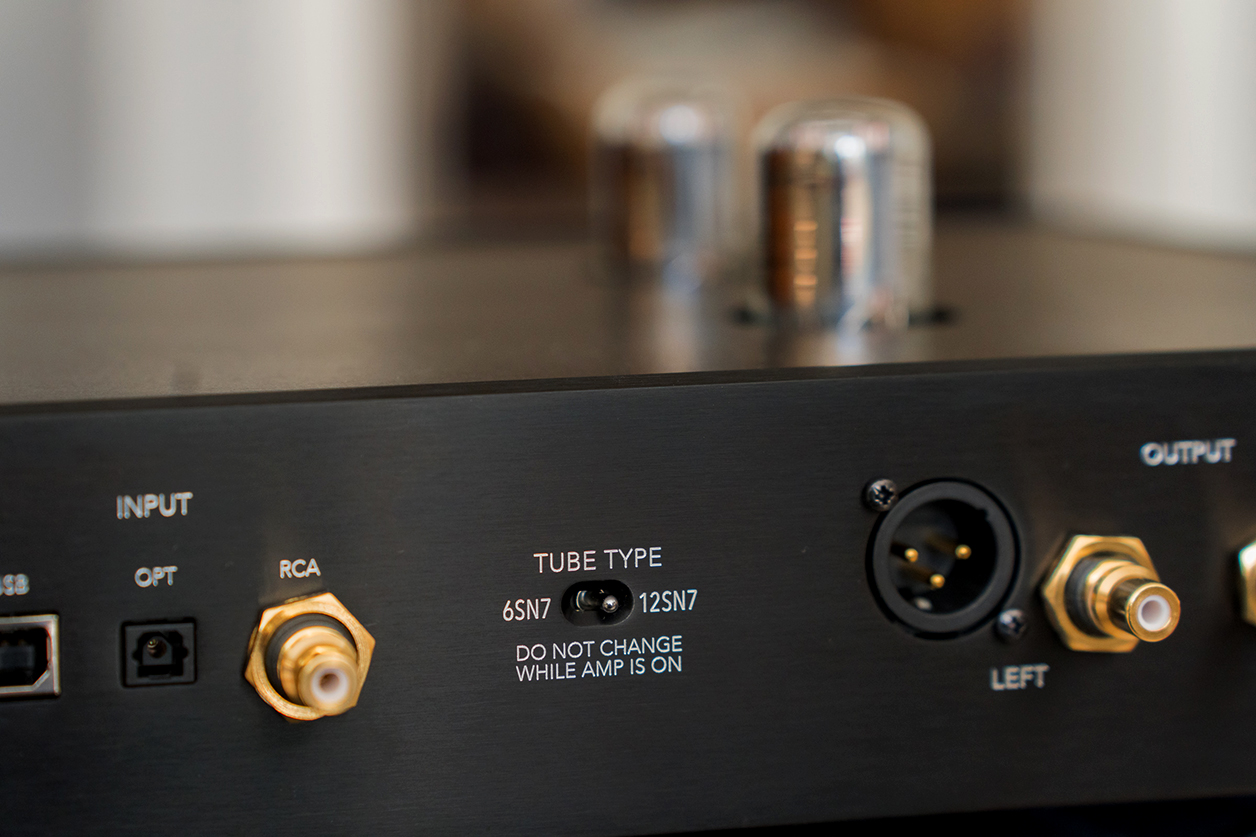
It is hard to argue with LTA's logic to keep their very first DAC focused on a unique sound experience which, as we'll see shortly, they certainly deliver. Let me dispense with a few final logistical details before I jump into my listening impressions. My Aero sample came with 12SN, not the 6SN7 upgrade option. All my listening notes are thus based on the ‘basic' glass. All local file playback and Tidal streaming was handled via a USB connection between my trusty Aurender A10 into the Aero. CD playback off Jay's massive CDT2-Mk3 transport used the coaxial input. Without further delay, let's now jump into the Aero's only reason to exist: to reproduce music beautifully. I'll skip straight to the punch line.  The Aero combines fluidity, dynamics, detail and tone in such a natural way that it won't attract undue attention to anything yet reveals everything. It is the DAC for live performances, acoustic instrument mastery and emotions of creative expression. Without a doubt, the Aero's core strength lies in unravelling complex harmonies and revealing the trailing edges of notes that comprise each instrument's unique textural signature.
One of my go-to tracks to assess whether a component can truly portray fine tonal nuance is "Mediterranean Sundance" from Friday Night in San Francisco, possibly one of the most popular displays of flamenco guitar virtuosity you'll ever hear. Simpler DACs make the three guitars sound the same. Good DACs start to convey the energy of the duelling guitarists. Great DACs make your heart race and you'll clearly hear that the right guitar sounds slightly more full bodied than the left. The Aero had no problem sharing the energy of the live event and the tonal differences between instruments, putting it in a category above the Holo Cyan 2 I recently reviewed. That hinted at the fact that differences between the guitars factor but couldn't plumb their full depths which the Aero painted with a far more revealing and nuanced tonal palette.









Usually whenever a component provides such insights into the body and overtone signature of instruments, it will sound soft on the leading edge to exhibit somewhat muted attacks. Only the very best gear can do both equally well. The Aero doesn't quite do both equally well since it prioritizes the decays for a profile that's very slightly laid back. But it's very expressive dynamically and just short of the very best. It's not able to deliver the electrifying accelerations of a top-line Holo or Mola-Mola Tambaqui but sounds more energized than anything I've heard or owned by Audio Note, LampizatOr or Playback Design which all provided great flow, colours and tone but won't catapult you out of your seat. When provoked, the Aero will get you to sit up. It just won't make you jump out of the seat. At four times the price, that's for the Tambaqui which will toss you across the room if the music commands it to. Maybe a different way to phrase this observation is to say that the Aero doesn't try to take you by surprise. Your foot will tap, your head will bop, the music will flow without reservation but none of those reactions will feel forced onto you. No bright light will illuminate every nook and crevice as you'd experience with a Chord Dave or older dCS. With the Aero there are plenty of dynamics and resolution but those aren't its primary raison d'être.