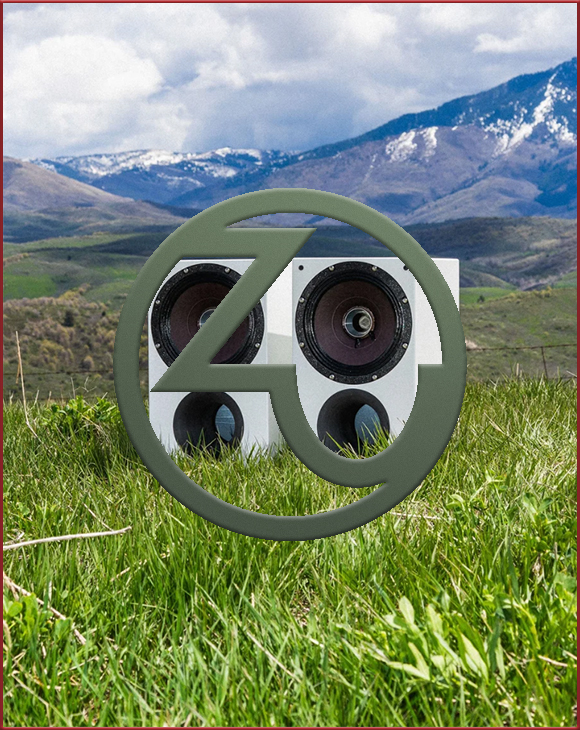
As this reviewer's revolving doors had it, roughly coincident with inking today's assignment in June 2024, a pair of Cube Lotus 10 cleared Irish customs. It's a multi-whizzer classic 10" widebander in a large box. It's compensated with a 300Hz low-passed 10" custom woofer on a 1st-order slope. Both drivers are designed and built by Cube. As one of its designers explained, "our priority wasn't sub bass but coherence between the drivers and generating bigger scale and greater coverage for larger rooms."

It's more Captain Obvious. Today's 4-incher is clearly meant for different apps than a dual 10" even if conceptually it's one more 1½-way just inverted by adding a woofer not tweeter. The Polish crew's flagship is an attempt at upscaling their previous best. Go bigger and louder for more capacious clients. Norbert's rationale for the Mini is the opposite. Downscale to go where even his larger monitor not big to begin with can't or won't. Lotus demands €21'000/pr. Mini gets €1'800. The Polish freight came to 180kg. In the box, Mini should be ~10kg? Even at 18kg it'd be 1/10th like the price. Intro. Done?







 Just a few final points. I don't know why at Cube, Rethm and Voxativ, widebanders and ports don't talk to each other. Instead the designers of these brands prefer variants on back-loaded horns including tapered quarter-wave tubes. That invariably necessitates far larger cubic box volumes. Norbert's happiness to embrace ports for both his Move and Move Mini shrinks them. Why the recipe of widebander + port remains so obscure is a sphinxy riddle I haven't cracked yet. That it can be done successfully the Move already proved. So did the Camerton Binom-1.
To wrap our intro with a green bow, the Combo's power draw claims 8 watts with headphones, 20 watts at speaker room levels. Many light bulbs consume more. And to now shift our narrative into hands-on mode, by December 6th so half a year after the Munich High-End sneak peek, my samples were airborne. Potential subtext seems clear. Much time can pass between having working prototypes and ironing out all production wrinkles for a formal first run. If EU hifi manufacture at competitive pricing were easy, far more university graduates would enter our sector rather than IT.
That recalls the hoary observation that to make a small fortune in hifi, one must start with a big one. It explains why so many brands have transitioned from private ownership to portfolio items of multi-national concerns. Earlier this year Bose acquired McIntosh and Sonus faber from Dallas investment firm Highlander Partners. Seven years ago Samsung absorbed the Harman Group which itself had gobbled up numerous audio brands. In mid December this year, PML Sound Int. which already operated Anthem, MartinLogan and Paradigm acquired GoldenEar from the Questgroup, owners of AudioQuest.

In this climate, Lindemann remain an old-school holdout of a small family-run business. To some shoppers, supporting small independents not conglomerates is its very own attraction. So is domestic manufacture which here applies to Germans and on a broader scale, fellow Europeans. To wrap background, any dive into Lindemann's DNA shows a past with ultra-ambitious kit. Norbert cut his teeth in the unapologetic high end. Today he's far more inspired to leverage that experience into still attainable goods than contribute to the 1% fare that this year again occupied the top floors of the Munich MOC. Some of my colleagues who still attend the show have stopped going upstairs years ago. They find those exhibits utterly irrelevant to their audience. So does Norbert. Now we're all on the same page.