The entire Move Mini concept is about taking the time-coherent directness of quality HeadFi out of the skull into a room where its scale can increase to 2 metres across and unfurl real depth layering. Nearfield focus reduces SPL requirements hence excursion and its distortion, seriously diminishes the room's influence and cuts resolution losses over distance. Now all we want is the smallest possible point source that can generate the loudness and bass reach our desktop needs. In short, 85dB rear-ported Move Mini is a specialist tool for a very particular job. It's not a sledgehammer. It's a jeweller's screwdriver. It's an IEM of SpeakerFi.

Like a quality in-ear monitor, it promises extreme resolution for a virtually hardwired connection to our tunes bereft of the blur, fuzz and time confusion that bedevils so many big multi-ways. If I look around our digs, I see five widebanders: a 4" sound|kaos Vox 3a in Ivette's office; a 10.3" Zu Soul VI in our 2.0 video system; a 4" MonAcoustics Mini in my upstairs rig; a 6" Qualio IQ in my main system; and a 10" Cube Nenuphar v2 in backup. I clearly have a soft spot for the type. In fact the only classic multi-ways with a 2-way crossover left are the Acelec Model 1 and EnigmAcoustics M1 alternating on my desktop; and Sven Boenicke's W5 in my wife's studio. This state of affairs reflects Raal's ribbon headphones as my transducer reference; and an attempt to have our speaker systems approximate their incredible clarity and resolution.












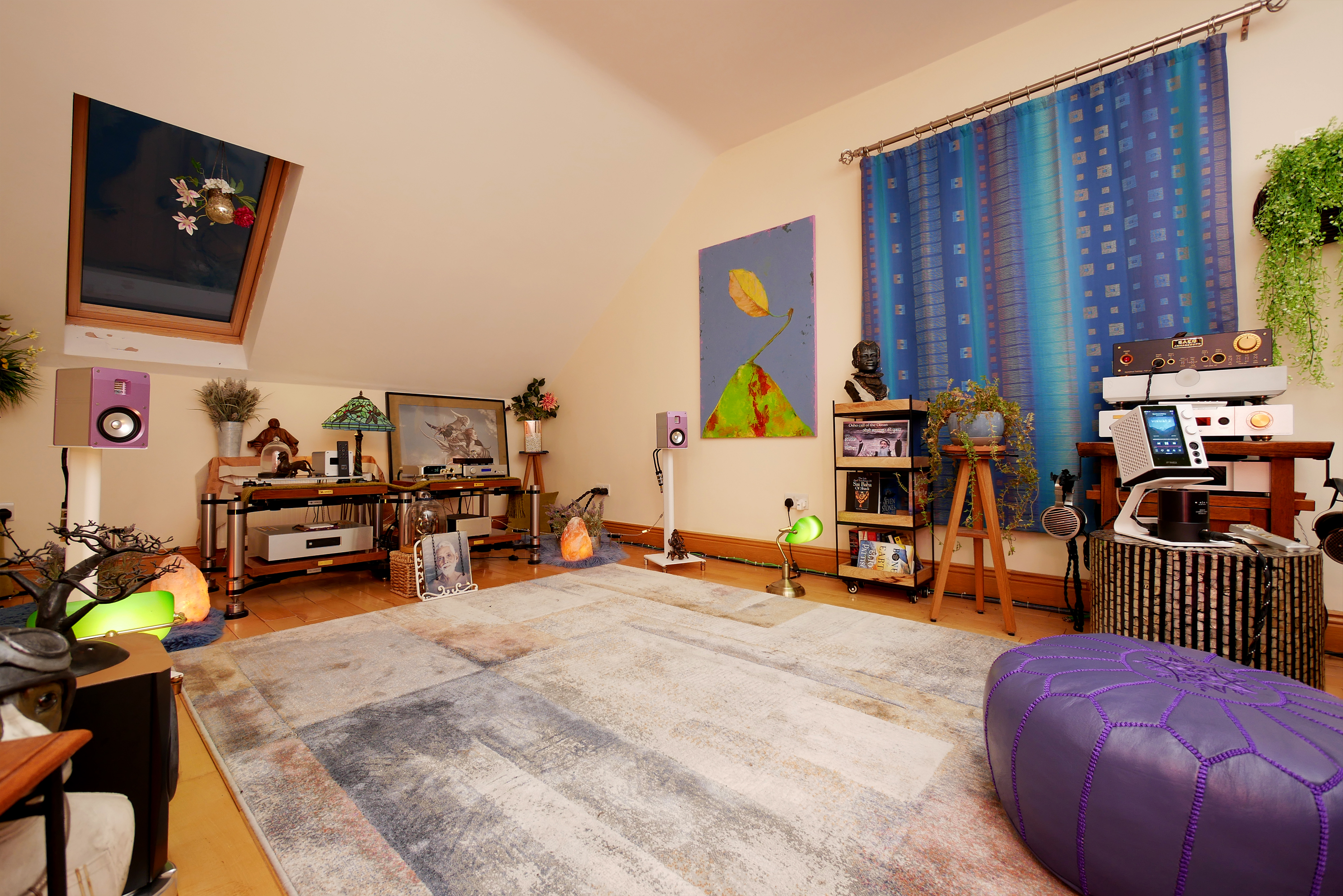
With Move Mini's driver in residence with invisible isobaric doubles just in the silver finish, I had this alternate destination below. Here MonAcoustics SuperMon Minis occupy pride of place. Given free-air positioning, they cross out actively at 70Hz/4th-order to a 2×9½" force-cancelling sealed Dynaudio sub from their Pro range. Playing precision traffic cop of signal routing is a Lifesaver Audio Gradient Box II from Manchester Pál Nagy. It's how subwoofer-savvy fans can have their cake and eat it. Because time alignment is key and this sub runs 2.5ms of digital latency, I place it 86cm closer to the seat. Norbert's version of our lilac Koreans could land straight on the same low-mass stands. Shy of a potential gain adjustment from differing sensitivity, they promised to be perfect stand-ins.
 To not ruin a super-lucid monitor's unique selling proposition simply wants a bit of care to seamlessly patch in a sub. It's not difficult with a well-damped sealed version; external analog crossover of adjustable filter points and low-pass attenuator; obeying basic time-domain considerations; then exploiting proper mechanical isolators particularly on suspended wood floors. For the latter, my secret weapon is the sound|kaos string-suspension Vibra 30. It's the most effective compact mechanical decoupler I've come across. Particularly on our talkative top floor, floating a sub is key. Otherwise structural gain spoils the party by always hitting behind the beat. As with anything, the right tools are half the job. The other is knowing how to use them. That includes not gassing out small speakers even when high-passed. For silly SPL you'll want proper jackhammers. That's the right tool for that job. If you need to play something loud before it sounds good of course, something is very wrong already. Here unfiltered widebanders often hold an ace. They come on song much earlier on the dial. That's good for our hearing health and domestic peace. It's just no dorm room artillery or eviction notice. It winks at more sophisticated listeners and their second systems.
Did I mention that these grills attach magnetically to the baffle's stand-off bolts? That the AMT's turned oval wave guide increases lateral dispersion? That the inputs go bananas so don't bring spades to this duel? That one finish suits all? That the Mini can't top the Groove like Move? Now you know.