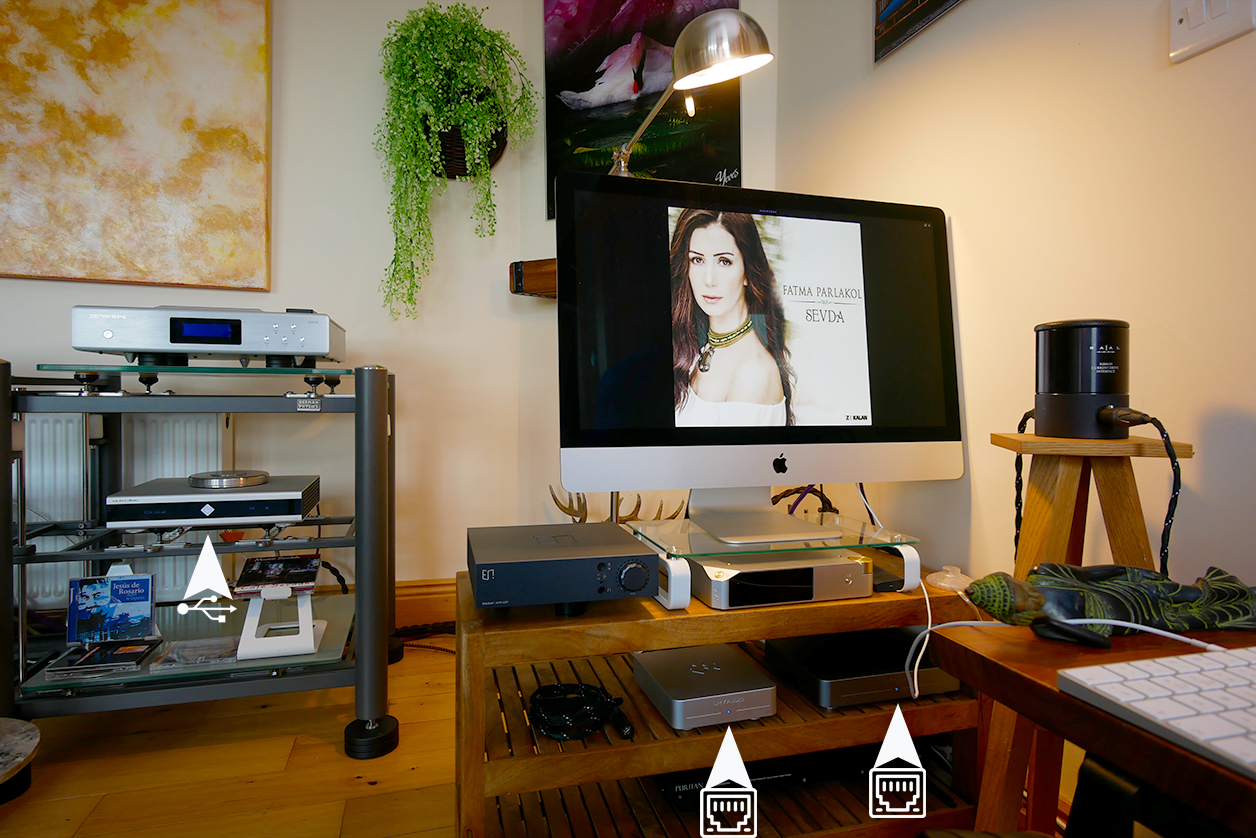
No doomed fights with windmills. In the bigger system and larger room with its hybrid dipole speakers being more lit up and lucid than the warmer office monitors, the effect had scaled up. Just as soon as my inner inspector clocked it, curiosity yanked out what in the next photo is the right LHY unit hence receiver of the 20m CAT8a spur. That now switched over to the left unit, the EFI of single RJ45 i/o internally converted to optical and back. If my ears heard any difference, now they really weren't sure. For my intents and purposes, this was the domain of hallucinations. The right unit could depart without crimping my style. For future streamer reviews of course, its extra RJ45 ports would be vital. Functionally it'd have to stay; like an AC outlet multiplier when we don't have enough wall sockets. But my ears had hit critical mass with two slaved units between router and desktop; plus one terminating the long LAN link from one room to the next. Effective ultrasonic noise filtering as a revitalizing tonal tonic? I usually hear noise traps in the domains of ambient recovery, possibly micro dynamics and sometimes more upper-harmonic presence. Their lot are the prime beneficiaries of a lowered noise floor because these sonic qualities constitute the digital data of the least significant bits. Again, bit-perfect Ethernet protocol doesn't drop data unless our connection is iffy. But out-of-band noise presenting during D/A conversion then migrating into downstream components does have an obscuration effect which often compromises the smallest signals the most. At least that's been my experience. What two extra rounds of broadband galvanic isolation from the extra LHY unit shifted was the area this massaged. More pronounced upper harmonics from my prior hymn sheet weren't it. This tonal makeover was more akin to cutting treble reflections from nearby windows by closing heavier curtains. Whilst bare windows create more seeming airiness, the drawn curtains actually betray it as noisy spittle which fakes up excess aeration then bakes in. Banishing it with drapes—or ultrasonic noise reduction in this instance—won't change our tonal balance or resolution. But it will enhance smoothness and calmness. I simply hadn't seen this coming with today's hardware type; nor how obvious it would be.
My takeaway from this exercise is simple. Fibre-optic noise isolation on the LAN has real potential to optimize this ubiquitous data pipe. It even works if we have no fibre cable; or just one SFP port. In the first case, LHY's $499 EFI is our man—the left unit above. In the second, today's deck suits because its copper/SFP transceiver module will have a standard CAT5-8 strip enter its fibre port whilst all other RJ45 ports gain equally from its noise beheading. That second pathway was utter news to me; and must have been to our readers since in all these years, not one of them ever pointed me at this plug'n'play option whereby an Ethernet cable gains its own optical termination like an instant sex change. Consider me finally hip on the matter. Kudos to LHY Audio for including one with their AS600 Pro. For many systems, this network switch may indeed be all you'll ever need or want. That its three frontal status LED for external clock, signal lock and power are no longer blue like the power lights of my older units but a more stylish white is the chocolate sprinkle on the cream on this cake…
PS: When a reader inquired more about the SFP copper adaptor, Google AI had this: "An SFP-to-RJ45 copper module converts signal from the switch's electrical/optical interface back into standard electrical copper signal. The physical copper wires inside the Ethernet cable connect directly to the pins of the adapter, maintaining a continuous metallic and electrical circuit whereas optical isolation relies on a non-conductive dielectric medium like glass fibre to block electricity. Copper cables conduct voltage potentials, surges and ground loops. What you lose with copper adapters is surge protection since lightning strikes or nearby power transients can still travel down the copper cable straight into your switch port; and ground loop elimination because differing electrical ground potentials between connected buildings or remote equipment will still cause current to flow through the cable shield or conductors."