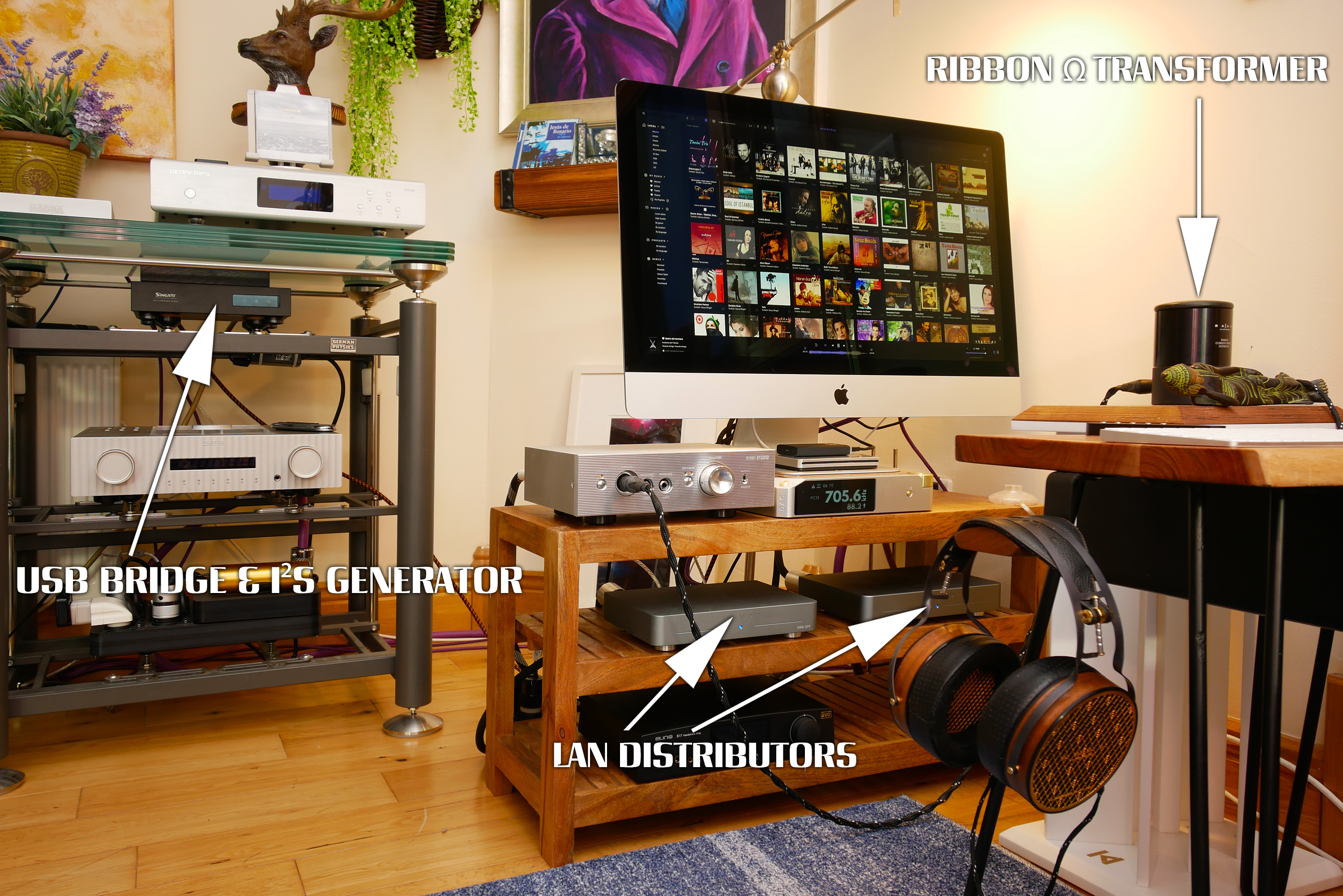
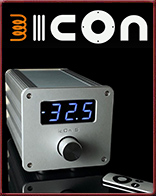
Time to jump into the deep end of the pond. Audible gains would sit on a millimetre not inch or yard scale. Today we strap on a magnifying glass onto little things. Those presuppose our far bigger room/speaker and speaker/amp dualities sorted already. So one of my test stations was high-level HeadFi to take the room out of the equation entirely. Kinki's THR-1 drove Raal 1995 Immanis headphones. Source was a 27" iMac with most current OS. Audirvana Studio streamed local files off a 4TB SSD or cloud equivalents through daisy-chained LHY LAN distributors. Audirvana's SoX engine upsampled the signal x 4 before outputting it to a Singxer SU-6 USB bridge. The latter's I²S feed hit Laiv's Harmony DAC which drove the Kinki via XLR. Later LHY's external master clock repurposed from this desktop synced Micro and the second network switch to introduce another layer of audiophile complexity. With the Serbian triple ribbons our most resolving transducer, I applied the highest magnification. The only thing headphones can't do is speaker-style soundstage scale. To track such changes needed speakers. Hello desktop whose nearfield proximity creates quasi HeadFi immediacy and resolution but projects out of the skull to nearly 2 metres across and slightly beyond the front wall. I obviously had to rejig the below to regain iFi's volume control which Laiv's DAC lacks. Wearing a virtual invisibility cap, a Lifesaver Audio icOn4 autoformer passive felt most fit for purpose. It's the sonically least intrusive energetically most unencumbered preamp in our collection so the best way to add remote-controlled attenuation without fingerprinting the sound.

After receiving a small box of just 1kg, Micro unpeeled from overkill packaging. That includes a small wall wart with four fittable AC plugs to cover US, EU, UK and most remaining scenarios if not the rare Suisse. Being so lightweight can capsize Micro once festooned with digital i/o wires. Hence my unceremonious wooden wedge against the desktop's monitor shelf. Once I hit the power button, proof of life was instantaneous. We'd expect no less. Students of basic business practice might remember Audio Alchemy's small-box rabbit farm. They already predict a multi-outlet compact power supply for Laiv's emerging Micro range; within it possibly more problem solvers like a clock, USB decrapifier, LAN switch & Bros. With LHY's external clock wired up, one press on Micro's right-most top button could defeat that. Before we go sonic, it's necessary to mention Micro's jewellery-type finish. It's no more or less than Laiv's bigger kit but seeing it at half size again and now with elegant frontal silk screen elevates the impression of bijou luxury. There's no ringy bent sheet metal or ugly screw in sight. Of course €849 for a box that fits on an SACD jewel case isn't chicken feed. Just so, kit like Micro narrows the expectation gap with smartphone standards regardless of how unreasonable true parity is. One industry is enormous and employs city-sized factories across sundry continents. The other is ultra niche and utterly irrelevant to the Spotify masses. Just so, brands like Laiv are nails in the coffin of LegacyFi which still managed with man-cave basics. That wheel of audio dharma has turned. So has what it means to be current, fresh and desirable in 2025.












My desktop had reconfigured on the last day of 2024 to approximate an affordable Lindemann speaker/amp set that had embarrassed my far dearer status quo. Now replacing iFi's high-gain iDSD Pro Signature set to on-the-fly DSD1'024 resampling with the Laiv DAC+AVC wasn't happyning. The new combo overplayed the 7-year old 400-watt Ncore's lean cool attributes of my recently resurrected Nord Acoustics mono amps. I didn't like the sound so skipped to the headfi rig next door; but not before exploring the external clock. That too wasn't happening but for it, happy news. Despite quite extreme detail focus, I couldn't make out an iota of difference other than a changed LED colour from white to blue and back. Micro's internal clock which overrode the Harmony DAC's own with the latter's I³S source-clock mode engaged was just as effective as LHY's. Spitting out a clock signal is all the LHY does. Sending out new clock pulses on I²S's dedicated clock line whilst also dispatching actual l/r-channel music signal on the protocol's parallel lines made Micro the more complete multi-tasker even if its singular output is far more restrictive than my Singxer bridges. My basic takeaway was that my ear/brain wasn't keen enough—or my external clock insufficiently posh—to bother using Micro's clock input. That was great news for less-is-more fans. Think revised Intel sticker: 'Clock inside'. Forget about adding another box and high-speed cable?

Time to change seats and answer that question. Here's my main downstairs HeadFi station prior to Micro's arrival.