If we wish, we can cover an allotment of ground beyond bits are bits, beyond bit perfect being the be-all end, beyond established Ethernet integrity equating the standard's built-in error correction with sonic finality. Does any of it make sense if our system and listening skills are super basic whilst our musical habits focus on hyper-compressed synth fare? As I wrote elsewhere, the trouble with basics aren't the basics. It's insisting that there's nothing beyond them to call those venturing there names. If you were still hazy on µ aka mu not moo, it's an abbreviation for micron. It makes this deck the Micro Digital-to-Digital Converter. Considering its small size, that's fitting indeed. Going forward, let's call it Micro. Again, we're not converting to analogue. This is just a reclocking digital signal router. As in the olden days of CD transports, there will be many to insist that it couldn't possibly matter. Yet that didn't prevent C.E.C. from authoring very well-regarded belt-driven CD transports, Esoteric from engineering a whole range of VRDS transports whose OEM versions showed up in many an ambitious machine whilst the best remained reserved for Esoteric models. The streaming of files, be they local or cloud-based, has given rise to its own transports aka servers. Those can be one-box wonders; or split out into separates. Those could be external SSD, SD cards or thumb drives, a PC/Mac-based software player for library access with resampling by plug-in algorithm and finally a USB or Ethernet bridge like Nagra's petite Streamer to reclock and buffer before a DAC converts to analog. The underlying rationale for separation tracks the difference between a GP and specialized doc. The former knows a bit about everything, the latter is an expert on ear/nose/throat, heart, brain, eye, blood or knee. A proper 'phile argues that just as you'd not get a mitral-valve replacement from a GP, you'd not entrust digital signal routing to a cell phone. "Streaming ain't brain surgery" you say? Stick to WiFi and call it a day. You'll never hear me say that doesn't work. It just won't work for our household's last-century brains. Those come without microwave immunity. Add 22+ years on this beat and I'm now diving in the deeply committed no longer casual shallow end of our pond.
From that end of the pond, my hierarchy of best-to-worst digital transmission method for classic not networking DACs¹ is I²S, AES/EBU, BNC, RCA, Toslink. It's a conclusion drawn over many years with the occasional benefit of otherwise identical cables like AES/EBU and coax from the same brand and range. On the shallow end, one might not tell them apart. On the deep end, things break out into shades of grey. Once other little helpers enter the picture, many small things can compound into a bigger thing or trigger a threshold crossing. That's when like critical mass or the 100th monkey, we join a new layer of intelligibility and meaning. It's as though an elevator usually only reaching to the 5th floor suddenly spits us out on the 6th for better views and fancier interiors. Still speaking figuratively, it comes after we've done enough work on the 5th. Setting Micro's I²S pins is done "with the buttons on top of the unit. Both the I²S input and output on the Harmony µDDC support the same eight modes as the Harmony DAC." Micro's solitary output makes it into a reclocking I²S generator so different from Mutec's €749 MC1.2+ which omits I²S altogether in favour of Toslink, BNC, AES/EBU and USB. Where the Mutec is a crossover product from the pro market, the Laiv is an advanced 'phile type that pros wouldn't know what to do with. I-squared-what? Possible ailments from mismatched I²S pins are no sound at all, clicking distortion, channel inversion, issues with DSD even compromised imaging. Laiv's eight schemes cover the most common configs. But there's still a chance that your DAC with I²S over HDMI falls outside the eight. So ensure a money-back return privilege when you purchase a Micro just in case your DAC is such an outlier. Ideally of course, Laiv will eliminate all gambles and demystify the compatibility issue with a published list of known I²S converters and which of the Micro's eight settings is the right one for each. Solving that puzzle should be on the seller not buyer. They're the experts, not us.
______________________
¹ For networking streamers, fibre optics beat Ethernet copper but the delta depends on implementation.








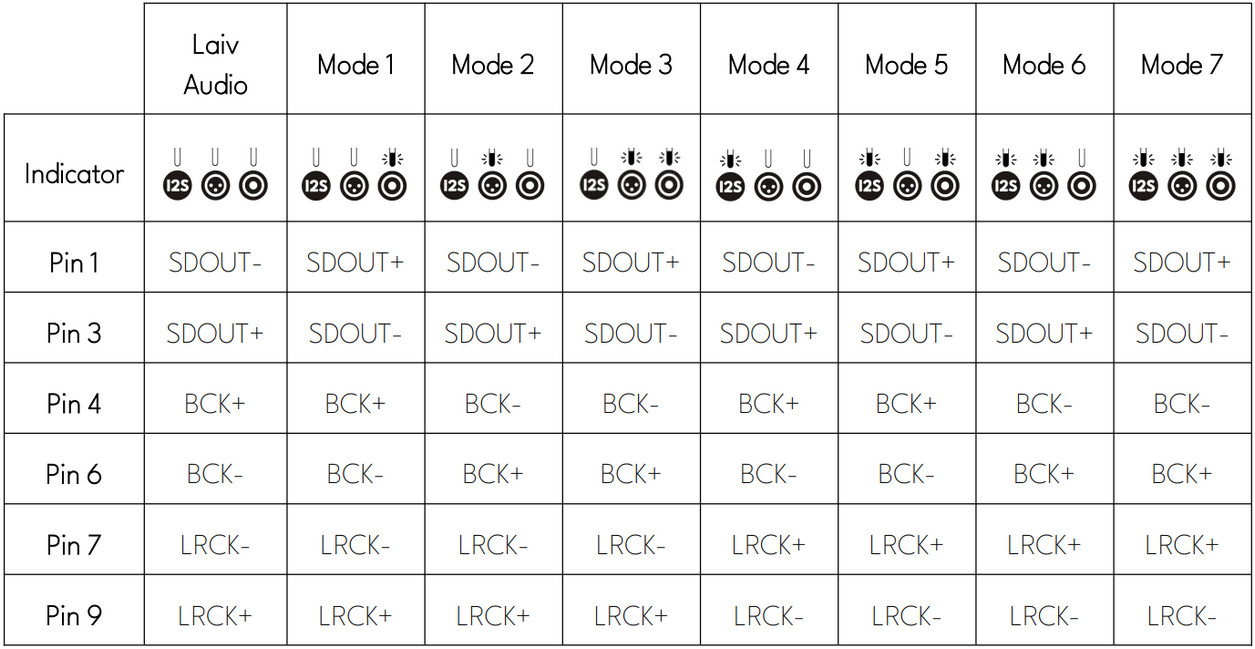
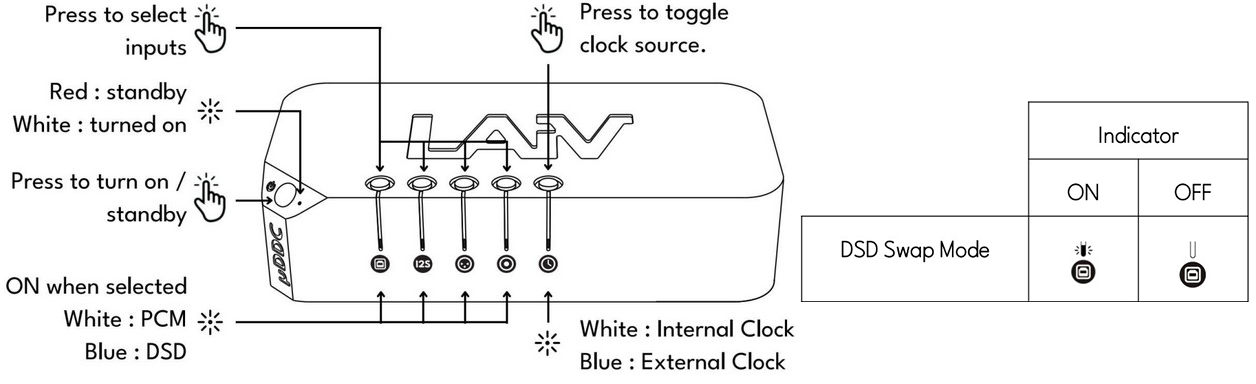
Yet the owner's manual has no better advice than trying out the above modes by ear. If nothing works, it's refund time. Because Micro lacks a display, visual confirmation is by LED pattern as shown, access to this and the DSD swap mode via a long button press then light colour change on the I²S or USB input selector. We do this once then never again unless our DAC changes. This certainly wouldn't justify a display, menu access and their associated extra costs. Wiring Micro into Laiv's Harmony DAC creates an automatic I²S handshake, no mode trials required. With Harmony my only current DAC in use which sports I²S over HDMI, I enjoyed an automatic perfect lock.