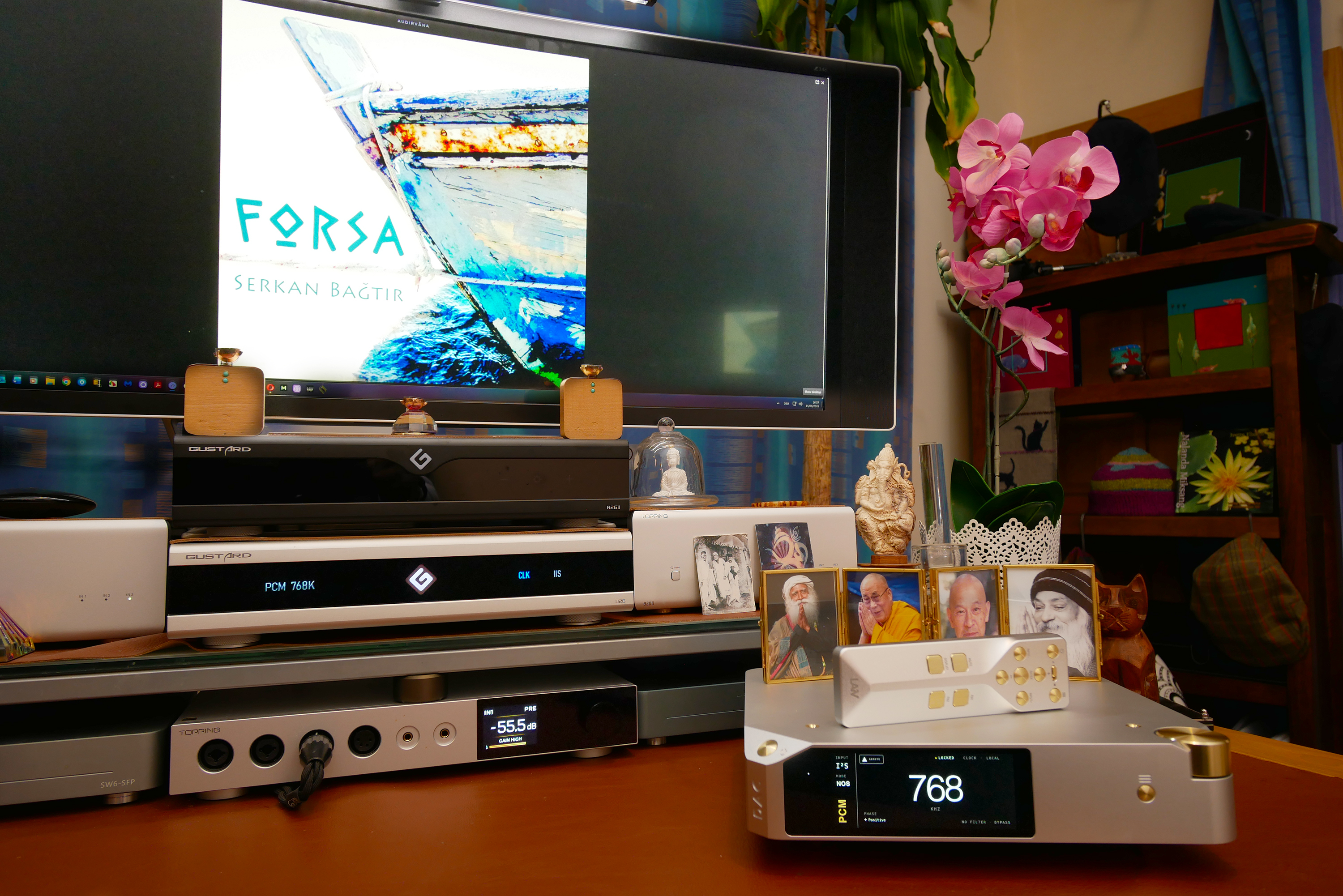
Here's my desktop's PCM768/DSD512 pipeline supplying DAC2 with premium high-octane unleaded; no Hormuz choke in sight. I tried with/out external 10MHz master clock but couldn't tell a difference. Not so for with/out DDC which made an obvious sonic change. Likewise for letting Audirvana's r8brain algorithm perform maximal power-of-two upsampling into the DAC2's NOS mode; vs LAiV's own OS. This was a small cluster of gnats; not imaginary but still very minor. It's something one plays with when all the bigger stuff is sorted. I gave my PC-powered math the edge. That's how SRC comparisons tend to go for me. As to my selfish question vis-à-vis the resident Gustard twins, they did live a resolution floor up from the Gustard/LAiV combo enjoying lunch. It called my office system done for now. But that wasn't today's focus. Back on whether to DDC the DAC2. Without a Harmony µDDC I can't comment specifically on it but with the same-priced U26, the answer was a clear yes. Despite my 34" curved monitor screen apparently a solid barrier, the visual cues which define depth perception and image separation sharpened up with the external I²S generator or USB bridge in play. Specificity of the virtual stage and the contrast ratio or 'pop' of sonic actors occupying it notched up. Removing the U26 softened the same contours and lowered contrast in what the direct comparison might nearly call a fine haze. It wasn't apparent by itself but clearly registered in its removal. I thought of the U26 action like power-hosing a deep-relief sculpture. Its shape and textures are already crystal. Yet once the pressurized water assault removes accrued gunk in tiny crevices and crannies and build-up on edges and contour breaks, the same shape and surface details reveal greater relief and distinctiveness. The USB bridge had this effect on the entirety of the sonic scenery. At 1/4th the DAC2's tariff plus €59 for a 1m AudioQuest Forest HDMI cable, the U26 plainly earned its keep. I'm certain LAiV would say the same about their µDDC.
Noteworthy too is how intuitive LAiV have built their GUI. Without the wand, we select inputs with the rotary then push it to confirm our selection. A push on the frontal button enters the menu then turns the rotary to scroll down, pushes to enter an option, rotates to a sub selection, pushes again to confirm, then uses the menu button to return to the previous screen. Simple as pie. Ditto by remote which even has two configurable direct-access controls for our most-used commands. For example, F1 could change the display mode, F2 switch between OS/SRC/NOS. I still would have liked to see a Muses 72320 ladder-on-a-chip variable option when all my resident DACs—Sonnet Pasithea, COS D10, Cen.Grand DSDAC 1.0 Deluxe, Gustard R26II—implement analog volume but LAiV explained why they decided against it. They know their clientele. Fair play. Ditto for no native DSD.











LAiV's Harmony DAC was an impressive find when I crossed its path two Easter ago. It's why I acquired my review sample and still use it. DAC2 adds what John Darko calls audiophile catnip. That's not by way of I²S which it already had; but a 50Ω/10MHz port for fans of external master clocks and their BNC cables. LAiV seem to be working on a Harmony range clock of their own. In the next breath DAC2 flips a stiff Johnny Cash salute at ladder-direct audiophile puritans with a new and toasty class A output buffer to lower output Ω by well more than a magnitude. To my mind that rethink must be the sonically decisive advance over the predecessor though it's not the only change. A side benefit is being able to now drive XLR and RCA outputs concurrently. The black or silver dress code with goldish detailing remains.
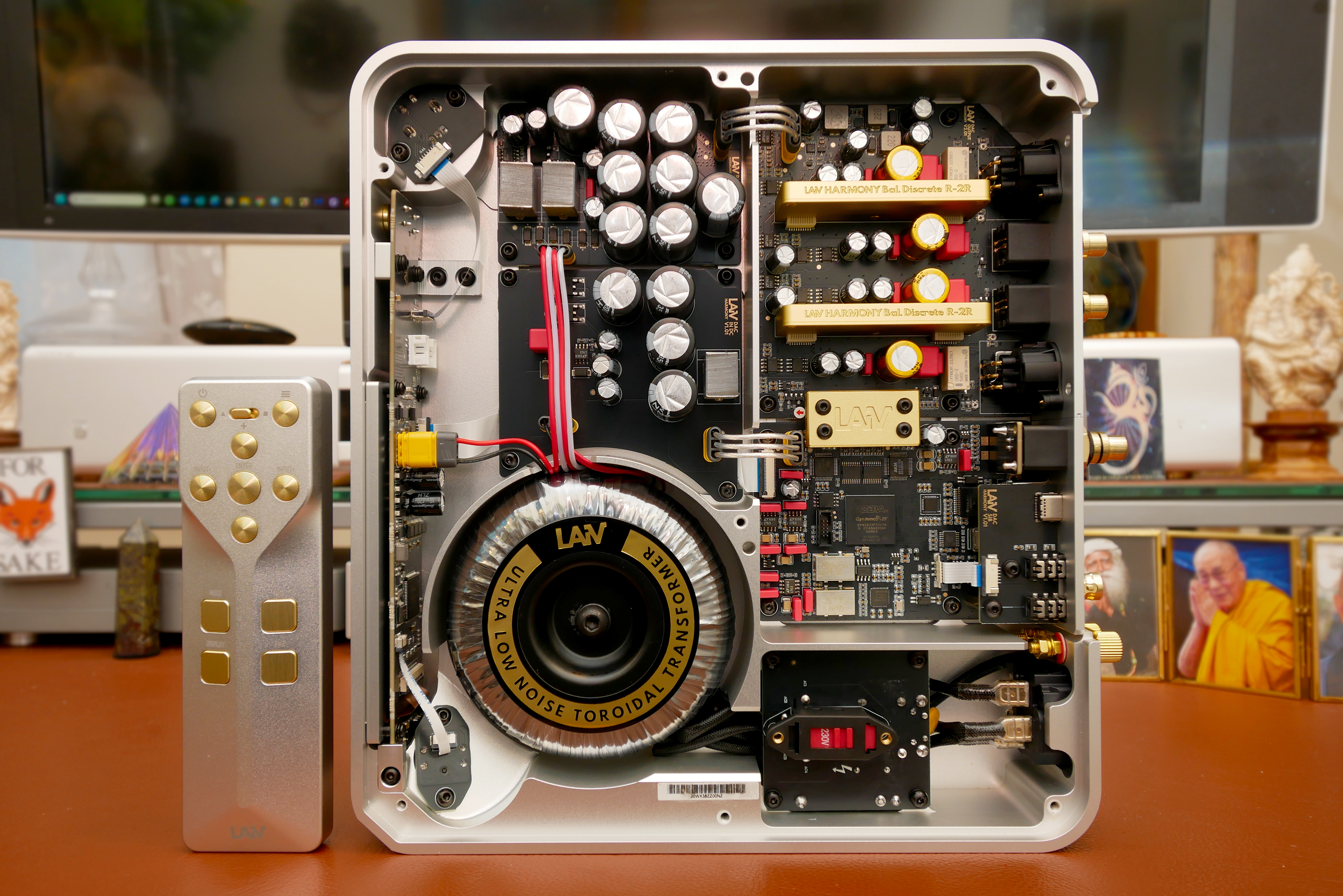
If you get most freaky over extreme resolution, a quad-paralleled ESS Sabre DAC or endlessly-tapped Chord would probably be your preferred poison. LAiV's DAC2 is far from slouchy on the matter—just not freakish. Its priorities are tone and timing, the latter not tense or anxious but in a flow state. Its climate isn't dry but comfortably humid. Tone isn't ripe like deep triode but fragrantly moist. NOS, OS and SRC mode plus local, I²S or external clocking offer some subtle tuning options for those who love to fuss'n'futz. For everyone else it's a set'n'forget piece which remains the sharp looker it was when it first dropped but which refreshed its display with more modern bi-colour graphics; and in two themes. Since the original Harmony DAC followed the prospectors at Denafrips and Holo in the gold rush of discrete R2R from the Middle Kingdom, at FiiO & Co. now such machines start below €200. Discrete R2R even crops up in portable players and dongles. LAiV too have gone downmarket to $849, shaving off a mighty 2/3rd from their firstborn. As the new range topper in this portfolio, DAC2 moved in the other direction to add 50% over the predecessor. Blame wars, AI and toxic Trumpian tariffs. But LAiV clearly laboured over paralleling the economic necessity of a price increase with new features and, most vital for our sector, sonic gains. An already good thing was made even better. How to argue with that; especially when leaner wallets have two smaller DACs in this catalogue? As Jimmy McGill would say, s'all good…