
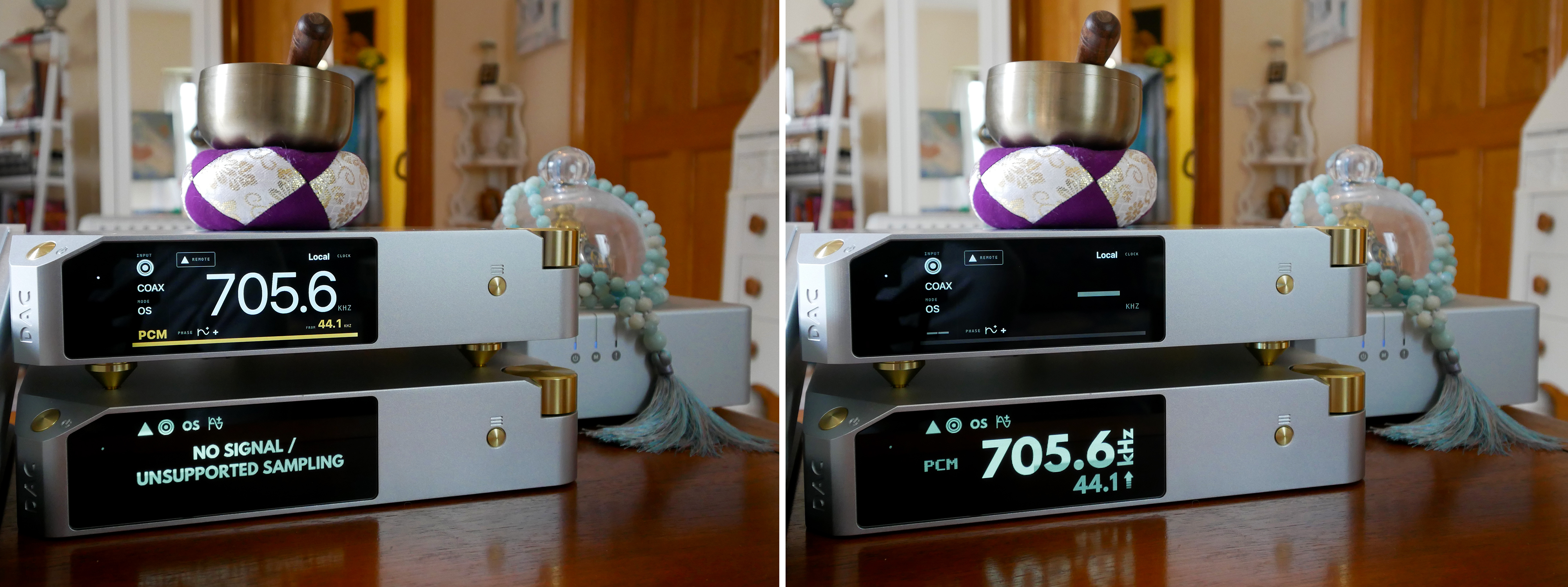
 Sonic displays. Below we see DAC2's alternate display mode; and how it shows sans signal versus the original. Where the new readout looks crisper, more sorted and elegant, the sonic changes mirror it. They obviously aren't massive—but like the overhauled display, sufficient to matter. DAC2 sounds shinier, more elegant as well as more present and focused. That makes its imaging and staging even more sorted. Like the readout so the sound. Display sonics! Going in we knew that LAiV's new range-topping converter is no longer the same deal the original was. The last two years have been brutal on global economics. Irish farmers months back caused serious traffic disruptions by blocking major thoroughfares with heavy equipment crawling at 2km/hr. They hoped to pressure the suits at Revenue into lowering gas prices since they could no longer afford to operate their equipment and work the land. No farming, no food. So DAC2 had to cost more. LAiV figured out how to add enough aural value so this scale wouldn't bottom out. DAC1 owners will stick with what they have and love. Preceding their deck with the µDDC—or even more elevating, a U26—does more than upgrading with the next-gen version. Of course DAC2 benefits equally from being fronted by a USB bridge or I²S generator. For that we'll return to my office.
First, more on the new elegance by its lonesome. Taking its pulse included my bijou smsl CD transport via its I²S connection. On a Tania Saleh track for example, DAC2 captured the immediate proximity halo of tiny mouth actions. These precede venue reflections; and the DAC1 diminished them. That nano-thin tissue around tones, of air and harmonic gloss just before the onset of reverberant bloom, gave the DAC2's reading a greater sense of tonal sophistication and sheen. This obviously was contingent on sufficiently close microphone placement. Even a front-row listener in an acoustic Tania Saleh concert wouldn't have heard this. Call it virtual lip gloss, micro spittle, tongue-against-teeth cues. Once we key into this action then pick alert recordings, it repeats with how clear a guitar's on-string fingering becomes with its own noises; a woodwind's key clacks; a piano's pedal work. Measured on a weight scale, it'd be very light stuff. Yet turning off this quasi spotlight on mechanical performer behaviour renders instrumental or vocal signatures a bit less emphatic, not quite as locked 'n' loaded—or simply less present. Energetically not on soundstage perspective, we sense a tad more distance. Textures shift from satin to matte; or gloss to satin. Hearing this is easy. 'Seeing' what caused it took me longer. Beirut's Tania Saleh provided my 'aha' moment. After that I knew exactly where to look. That with its new class A buffer DAC2 runs noticeably warm was just as crystal; to the physical not musical touch.
Onto SRC or OS, we get into the weeds trying to distinguish gnats from midges and no-see-ums. Just so I had a preference for the original 16 x code. That turns 44.1kHz straight to 705.6kHz, 96kHz to 768kHz; no intermediate options. Like the trigger ports, to me the SRC's addition as SRC was a non-feature. I can't speak to its signal-locking benefits. I never had issues with the original. Unless we sync multiple digital components to one shared master clock, I'm also not sold on 'upgrading' an internal OXCO with an external clock whilst adding impedance-critical BNC cable and two sockets with their own contact resistance. I thus suspect that MkII's true agent of sonic betterment is the new class A buffer. Given how global trends enforced a noticeable price hike, it's intuitive why LAiV's webpage slaps all changes on the table like a heavy hand of winning aces. Multiple bullet points read more impressive than one even if one causes the biggest change; or all of it. Perception rules. Psychology matters. 'Buy one, get one free' always pulls even if we have no need of two—sez the guy with two piggybacked LAiV DACs. And yes, the new dual-mode display does look obviously better to become a lovely value-added feature. To extend their life expectancy, I simply always turn my readouts off after I've made a selection or adjustment. Every argument can be countered. It's inherent in duality.










A reviewer not present at a studio session who calls its playback true to the recording is high on full-of-it. However, it is perfectly legit to frame playback whose precise content we can't ever know as feeling more realistic. We only claim a subjectively higher suspension of disbelief; a more convincing persuasive illusion. How close or not we come to the recorded data is immaterial. We acknowledge the trickery of artifice behind the illusion. Even a beginner's hifi won't mistake a violin for a cello. All basics are recognizable even if more sketchy than fully formed. The pursuit of better gear tends to fill out these first sketches. Bare outlines acquire colour hues and textures even if much restricts to two dimensions. Later the emptiness between shapes better separates them. Then this seeming emptiness begins to exhibit planktonic content of its own. Space becomes audible in performer halos and recorded reflections. We gain a clearer impression of the depth domain. We polish up dimensionally sorted soundstaging. Our eyes applaud. Hifi lingo for these aspects uses visual terms like focus, contrast ratio, imaging, location specificity, structural mapping, depth of field. Yet even at this more advanced stage we needn't have mastered yet the energetic realm. It's where playback expresses a higher electrical charge from superior timing. Now direct-coupled unfiltered widebanders can be advantageous. So can dipoles without time-smeared thru-cone reflections. Our audiophile vacation has many scenic attractions and rest stops. It's in the region of immediacy where DAC2 advances over the original; and switching to I²S kicks that up a notch. It's convenient that LAiV's default pin config adopts the PS Audio 'standard' since copied by many popular brands. I had instant channel-correct lock with my PL200T physical disc transport without first combing through various weirdness.
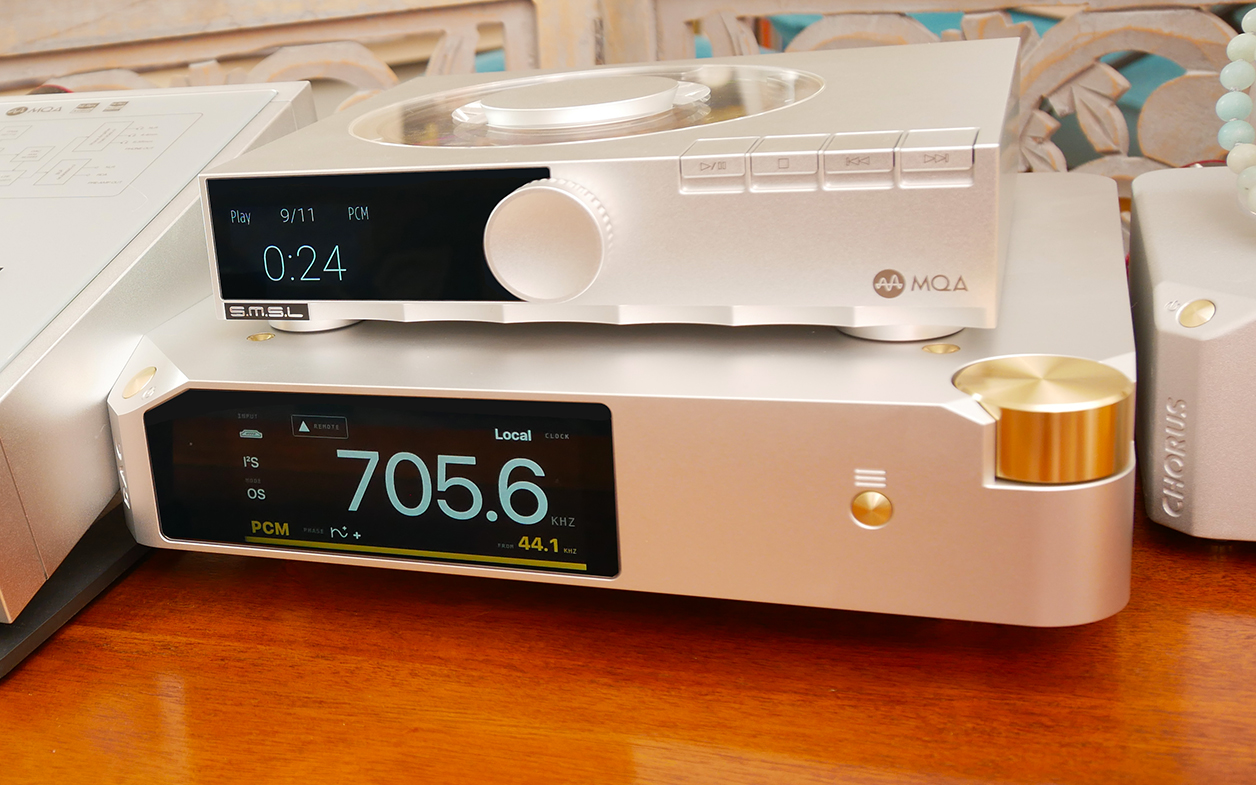
With MkI⇔II sorted, let's dig into digital-domain deeds with a preceding top-class DDC. As good as the DAC2 is on its own—the same goes for my desktop's Gustard R26II and the mere existence of LAiV's own $994 µDDC would agree—feed it 'conditioned' digital signal via I²S and squeeze obviously more vitamins. Like all other categories, DDC play in various performance leagues. Of those I've owned and used religiously, by far the best was and continues to be Gustard's €999 U26. These next sessions compared USB ⇒ DAC2 vs USB ⇒ U26 ⇒ I²S ⇒ DAC2. After confirming that DSD512 worked as advertised, I stopped the redundancy of converting PCM to DSD inside Audirvana only to force the DAC2 to reconvert back to PCM before its resistor ladders did their job. Incidentally, the new two-colour display changes its yellow bits for PCM to blue for DSD so the incoming format is recognizable by colour alone.