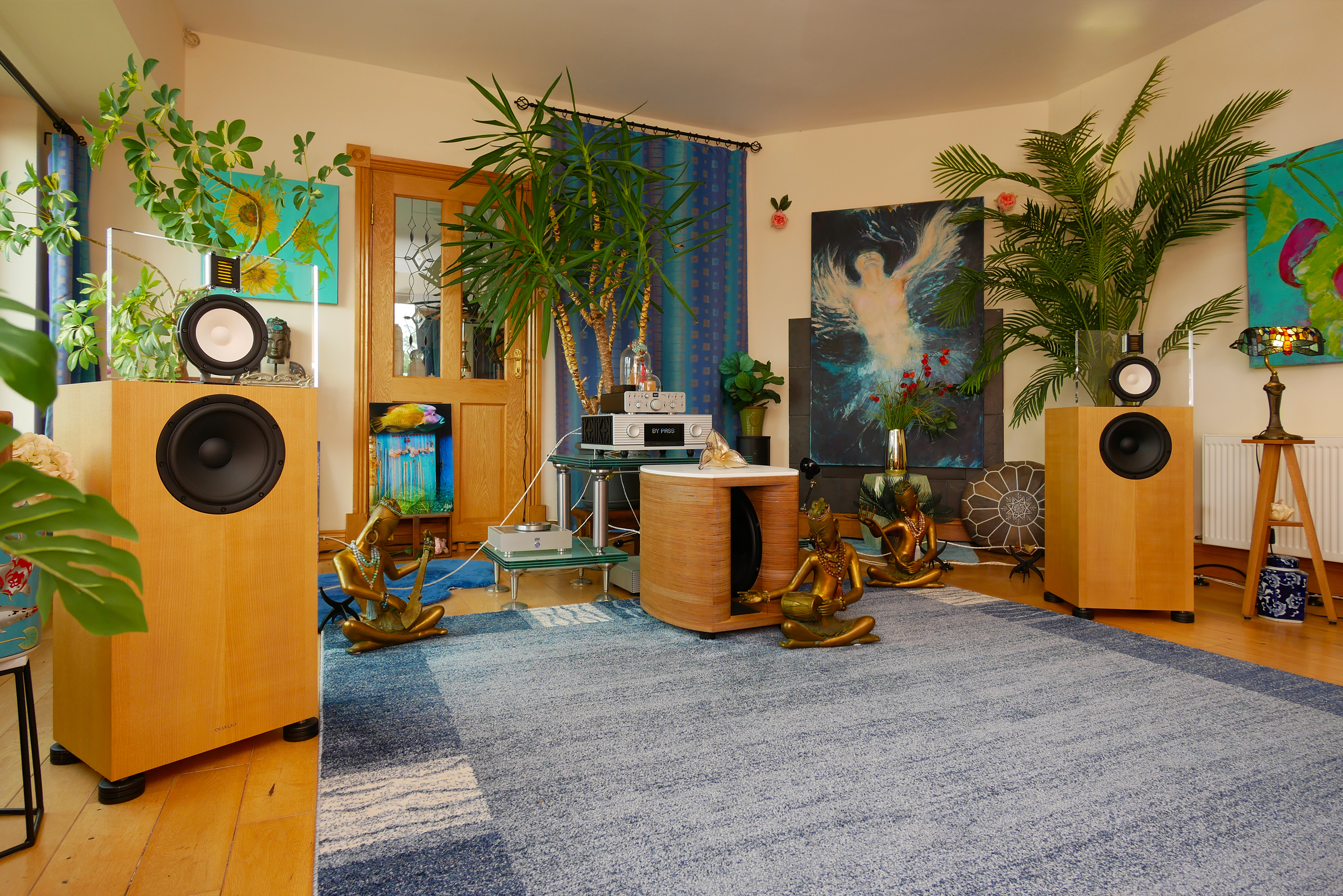
3 DACs, 4 scenarios. Moving the Cen.Grand show upstairs had the U26 make less difference. Was that because here I'm off-line to tap a 1TB SD card for local media via a sound-optimized OS absent all redundant computing threads? Less noise equals smaller benefits of noise stripping? So my mentally challenged math reckoned. For the greatest delta, the DSDAC 1.0 Deluxe returned to its usual Soundaware D300Ref mate so that the U26 could once again front Pasithea. Audirvana did its usual x 4 upsampling to 176.4/192kHz which the Sonnet received via AES/EBU reclocked and isolated. When we invoke higher low-level intel which lives in the least/less-significant bits, what exactly do we gain? Before we talk benefits, we must have correct conditions of minimal operational system noise floor; low ambient noise; uncompressed recordings; and attentive listening. Our room, system and hearing must all enable higher resolution. Even recordings we play should be of expanded dynamic range to give us a proper workout of the lesser bits. If recorded DR is 6dB or less, we have precious little to work with. To get a high-performance car to justify its engineering, we want the open Autobahn or a well-maintained race track. We won't tap its full potential on gravelly country lanes of poor conditions and freely roaming sheep. The same applies to high-res devices. How much or little do our conditions support their innate abilities? If they don't because our inner-city flat is never quiet enough, most our music belongs to the heavily compressed type whilst our mode of listening is casual not critical – why ever pursue more extreme resolution? But let's assume that we're a perfect hi-res target. Let's also assume that rather than sell our current <€2.5K DAC for 50 cents on the dollar to pursue a fabulous €5-10K DAC, we'd rather add a €1K component to elevate our existing DAC to perform as though far costlier. That's what Gustard's U26 does. If we already own a converter at or above €10K, I'd hope that it no longer makes an appreciable difference. But that's not where I play. And with the U26's next-level performance over my prior Singxer-bridge status, my stripes won't change. My best visual for the U26's action pilfers a PS Audio term: digital lens. The U26 replaces our digital picture-taker's stock lens with more premium glass and a larger sensor. The sensor lets in more light. The superior optics apply more granular resolving powers. Et presto, the same camera body and its mechanics—our existing DAC hardware—take better photos, instantly. There's no EQ trickery, no fish-eye, wide-angle or macro lens altering our capture ratio. We've only increased how much light we let in; and at what data density our sonic picture taker will perform its elite processing.
Our aural version of greater influx of light is less noise. This goes far past successful removal of humming transformers, ground loops, power-supply surf over tweeters or midranges or ambient noise from traffic, refrigerators, aircon and neighbours. It's a common fallacy to equate absence of obvious noises with absence of noise, period. Noise below audibility only becomes apparent in its removal, never by its presence. We infer a lower noise floor by what occupies the space which noise just relinquished. That occupant is new micro detail. Having studied classical clarinet at the conservatory—two of my siblings still perform in the opera orchestras of Hamburg and Wiesbaden—I'm sensitive to timbre modulations from artful manipulations of harmonic distribution. It's one dimension of artistic expression. It's how a performer makes one instrument sound like multiple versions by morphing its tone from mousy to mighty, from hooded and heavy to shiny even strident. I know how woodwinds manage that by altering embouchure, lip pressure, air speed, bodily connection and reed choice. Shifting the overtone spectrum is the performer mechanism. Ever lower noise is the playback equivalent by which the most minute of upper harmonics become audible. Such overtone veracity is very different from pleasant tube tone. The latter is just an overlay or patina which gunks up thus shrinks true recorded harmonic bandwidth. Overtone veracity isn't fat tone. It's maximal timbre variety. When in place, we hear more nuance and gradation. We get more values than the basic dark, bright, nasal and redolent. Here lack of phase shift and superior treble transducers are key to track this aspect. My 2.5MHz DC-coupled Kinki amp modelled on a Swiss Goldmund tuning playing into 6-inch dipole Satori mids and dipole Mundorf AMT do the business. With the U26, that harmonic dimension advanced. Tone expanded in enzymatic action. Lemony tartness gained sourness points. So did the pectin of Bramley apples, the spicy heat of dry-roasted chipotle chillies. Close-mic'd on-string brightness gained more notes. So did guttural hooded sounds and everything between. In short, by removing a sufficiently thick layer of digital-domain out-of-band noise to matter, the U26 allowed overtone cues previously obscured to inform the proceedings. Whilst calling it superior tone points in the right direction, it was actually about more variegated tones, plural. That was the first discipline where I noticed Gustard's difference delta over my trusty Singxer SU-6. This had naught doing with PCM⇒DSD chicane which Pasithea can't handle. Neither did it invoke sample rates beyond 192kHz. In short, the whole DSD2'048 and PCM1'536 bag bypassed entirely. Whilst my desktop and upstairs stations prove its validity where hi-rate native DSD support is in place, this A/B was about something more fundamental.










The 2nd aspect I keyed into after my primary fruitier tone notice was contrast ratio. That felt as though negative space had intensified. If a picture is worth more than words, this assemblage of the same Mughal-inspired lattice superimposed on three different backgrounds visualizes contrast ratio's reliance on negative space. The lattice represents our musical fabric. We can easily see how a busy versus monotone backdrop influences its legibility; and how a dark monotone background still incr/eases our musical comprehension over a light one. This quality is more static than unpredictable tone modulations. Once pegged, it tends to disappear from notice quite easily. That's until we revert to the prior state to reactivate the direct difference. Our sector's insider lingo calls this quality image pop. It's probably related to microdynamics and implies that our sonic arrivals—in thin air as it were—feel more energized. They make splashier entrances if you will.

The 3rd aspect I clocked segues back at the virtual larger lens sensor which lets in more light. Rather than by seemingly external source like an array of ceiling lights often associated with the top-down effect of a treble that's been turned up, this greater sense of illumination came from within the soundstage – a bit like a back-lit Apple Retina display behind gorilla glass. It presents different than a plastic screen with weaker backlighting. This sense of higher luminosity worked just like non-directional even illumination banishes shadows to reveal more. It made for a still more stepped-out presentation. In my context, this was true next-level performance. And it did not veer into any terrain of the darker, softer or lusher kind as various LessLoss noise-attenuating products do which embody a different aesthetic. Rather, the U26 had more in common with the unexpected broadband effects of a superior super tweeter like Elac's 4pi omni ribbon.

Chasing the dragon. That's percentages and I; mythical. Unlike a tidy cash register receipt, my ear/brain won't spit out convenient performance %. Just so, punters contemplating purchases rightfully hope for some expectation indicator. Here then goes my best attempt. On the desktop so into a €1'499 Gustard R26II discrete 25-bit R2R DAC with native DSD512, I'll call the difference 'dead obvious' and ~40%. Likewise in my main system into a €5'990 Cen.Grand DSDAC 1.0 Deluxe/POW so FPGA-based DSD1'024 DAC. In my upstairs system, the same DAC running microSD files whilst the U26 replaced a ~€2.4K Soundaware D300Ref bridge, the improvement shrank to 10%. in my main system fronting the €5'900 Sonnet Pasithea R2R DAC with split-level processing, the difference delta sat in-between so ~25%. Were my office not under the influence of occasional USB jitters, that's where the U26 would go for my biggest ROI. Until I can sort out that strange on/off behaviour however, I'll instead run the R26II over the LAN with its rock-steady RJ45 port. Hence the U26 will hunker down in the main system to replace the prior Singxer SU-6 bridge. Whilst here its net gain is smaller, the combo of bridge/DAC obviously trumps the Gustard/Gustard twins. That's it for my brief dragon-rider episode in the mythical realm of hard percentages. Inherent in today's tale pulses a simple heartbeat. In my lengthy experience with USB bridges—single USB in, multiple parallel digital outs like I²S, AES/EBU, BNC, coax—Gustard's U26 was the most potent. Where an external clock is hoped to boost it further still, my LHY wasn't sufficiently 'atomic'. I couldn't hear it do anything. Just seeing the U26's clock display change from 'internal' to 'external' surely wasn't enough. Looking at its €990 sticker and how that turbo-charged the companion R26II DAC by basic bolt-on mod, I suspect that on a genre-to-gain index tabulating component category vs excellence, the U26 sits very high in Gustard's catalogue. In today's market, fine DACs are a dime a dozen. Far less served are USB bridges; never mind truly ambitious ones which entail collaboration with USB-code experts Amanero. The general public doesn't understand their utility and hardwired PCfi has become more of a legacy convention replaced by mobile WiFi streaming. But digital dinosaurs like yours truly continue to thrive even if our numbers are down. If you belong to our greying herd of PCfi adherents, the U26 is the very best fire-breathing solution I've yet tried to interface a computer's USB output with a DAC's preferably I²S input. If your DAC accepts hi-rate DSD and your PC/Mac hosts a software player with powerful up/resampling engine, sonic personalization options expand. That's because this U26 can pass PCM1'536 and DSD2'048. My Audirvana install maxed out at DSD512 but online users have reported 2'048 success using the nerdy HQPlayer. I'll leave those investigations to more IT-savvy gumshoes. I'm pleased as punch already; and plenty pink…