To belabour the obvious, USB bridges from Singxer, Soundaware then LHY have been part of my component vocabulary for a long time. I initially brought to this category an attitude most foul. Why couldn't makers of costly DACs improve their built-in USB transceivers and render external better versions redundant? But eventually the Zen memo dropped. It is what it is. If the U26 tells us that to be effective mandates its real estate of parts, the R26II's identical chassis would need to grow twice as tall to house the resultant double-decker build. I don't know whether that's the actual takeaway. It's just how my mind rationalizes it. The flipside is audiophile hell of outboard everything. Now each stereo circuit module gets its own mono chassis with external power supply. At its most extreme, a premium DAC from the likes of CH Precision or Wadax could end up in 16 mono boxes with external PSU. Add an external ground box with drain leads to each. The wiring rat's nest becomes farcical. If a music lover contemplates that path, it's no wonder that for many, a one-box FutureFi integrated with wireless networking looks irresistible. Here acceptance of a burgeoning box count ties to one's audiophile station. Availability of upgrade funds and whether one sells/buys or only buys factor too. To improve, do we add to what we already have? Do we replace it with something better and keep the box count in check?
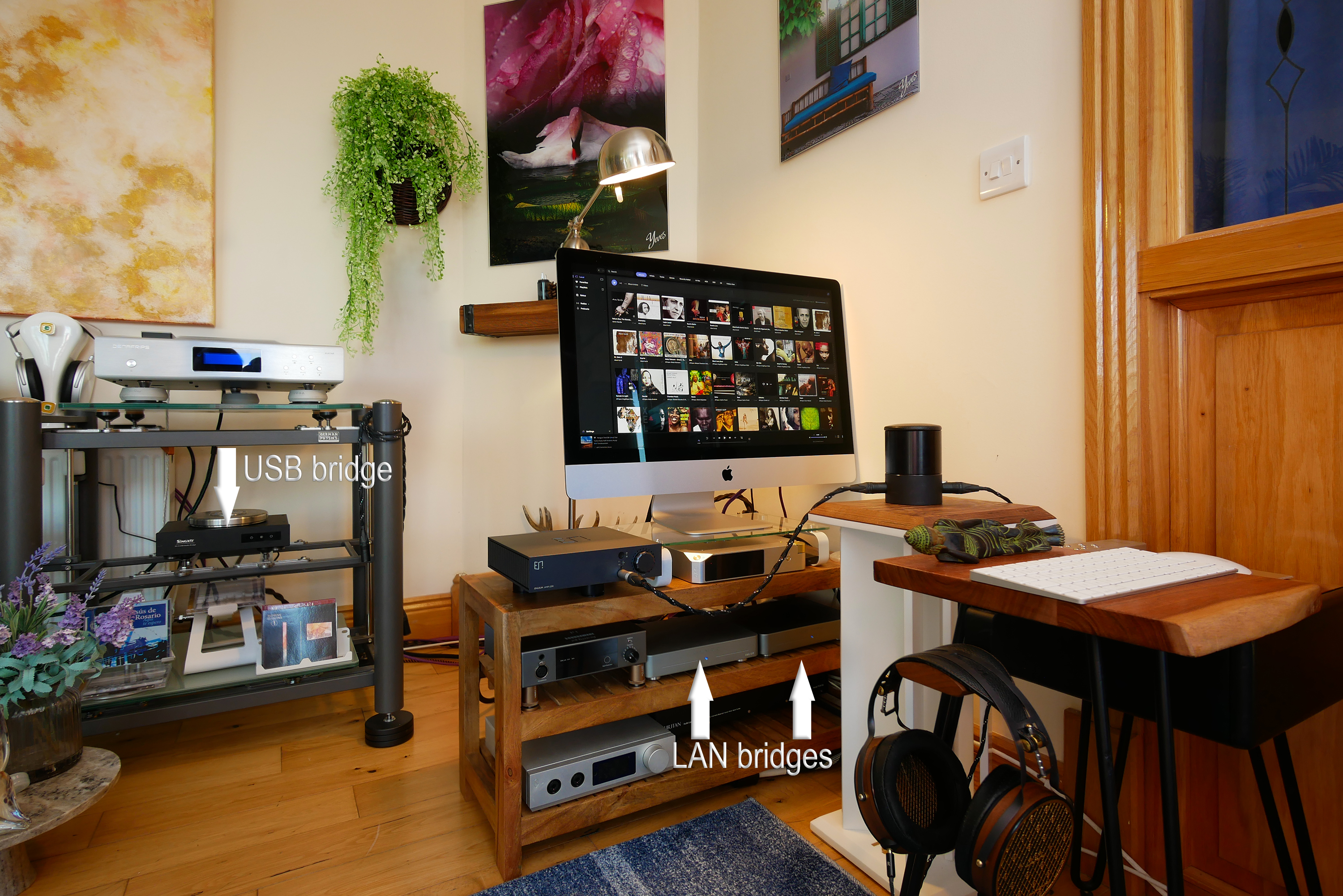 Pre-Mac are twinned LHY network switches at the end of 20m CAT8a off the router. Post-Mac is a Singxer SU-6 forwarding AES/EBU to a Sonnet Pasithea DAC. The iMac runs Audirvana Studio like my office PC.
Streaming hardwired cloud files, my main system too practices pre care on the LAN, post care on USB and audio-optimized player software on the iMac to bypass sound processing in the vendor's OS.
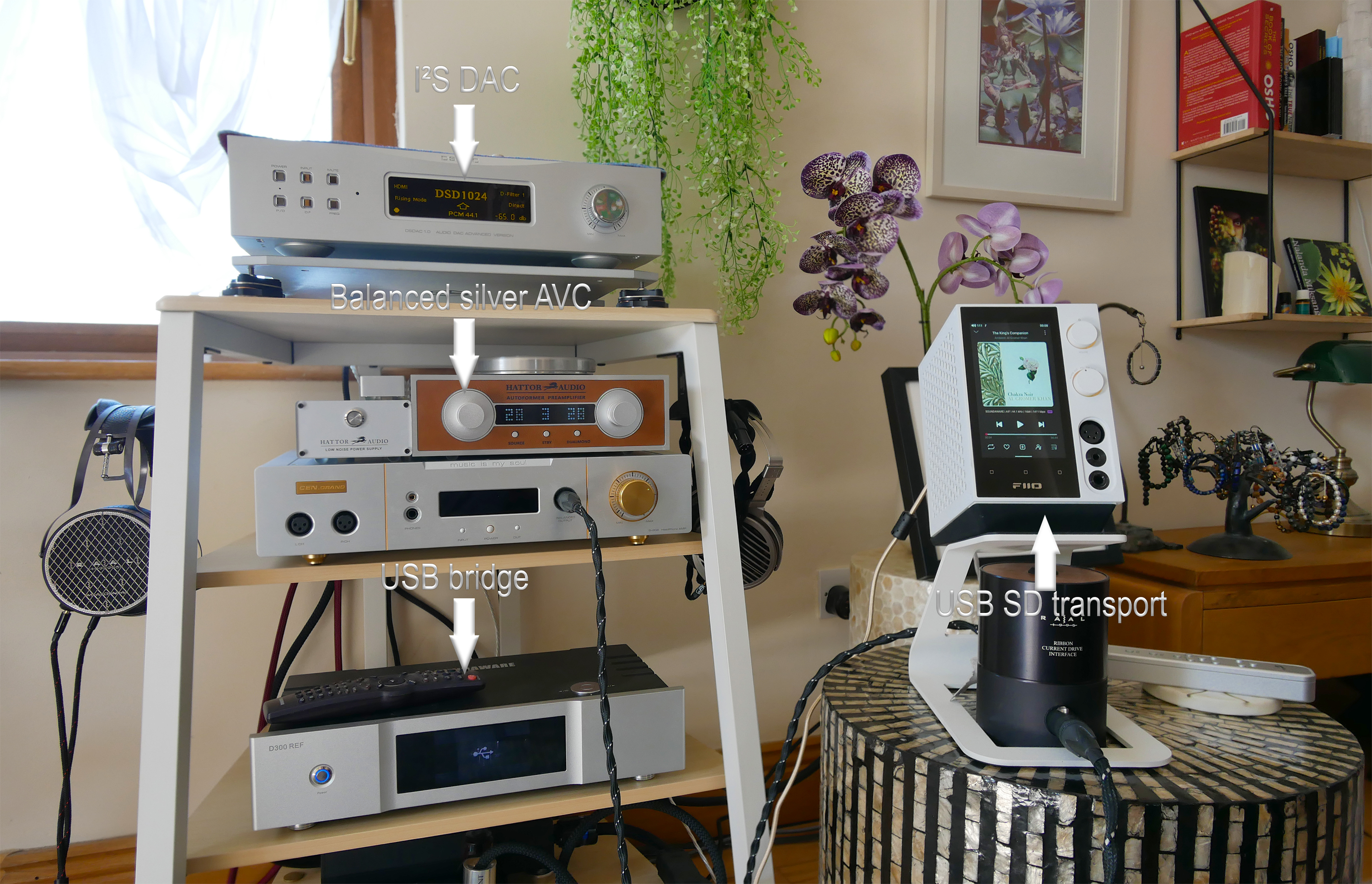
My adherence to this scheme doesn't let go with this upstairs system either. Without Internet–hardwiring would require ~50m Ethernet carefully dressed up a turning staircase then down a 5m corridor and across a room–the LAN half of my recipe isn't necessary. There's only post-transport care with an I²S-capable USB bridge powered by super capacitors. The FiiO R7 transport bypasses its internal SMPS with an external PSU. Now you've seen my three play stations for the U26. From Gustard R26II to Sonnet Pasithea to Cen.Grand DSDAC 1.0 Deluxe, the price ceiling for my converters hits ~€6K. Should the U26 do anything for a €20K streaming DAC? You know my thoughts on that. Would it on my lot? My domestic USB bridges improve all of them. Whilst the LHY UIP and Singxer SU-6 cost less than the Gustard, this Soundaware D300Ref was ~€2'850 when I got it 8 years ago. Context matters. For more, Sandu Vitalie of SoundNews reviewed the U26 on three different DACs: a ~€2K Eversolo Z10, a ~€3.5K Audiobyte Supervox and a €9.5K-26K Rockna Wavedream depending on version. In said sequence, he quantified his improvements with the Gustard as stepping from 40% to 20% to at best 5%. He also found the U26 superior to LAiV's DDC, the Musician and Denafrips Phoenix and Gaia and wildly superior to my Singxer SU6. Of the ~10 DDC he reviewed over the years, the Gustard struck him as clearly the best and not by a small margin.









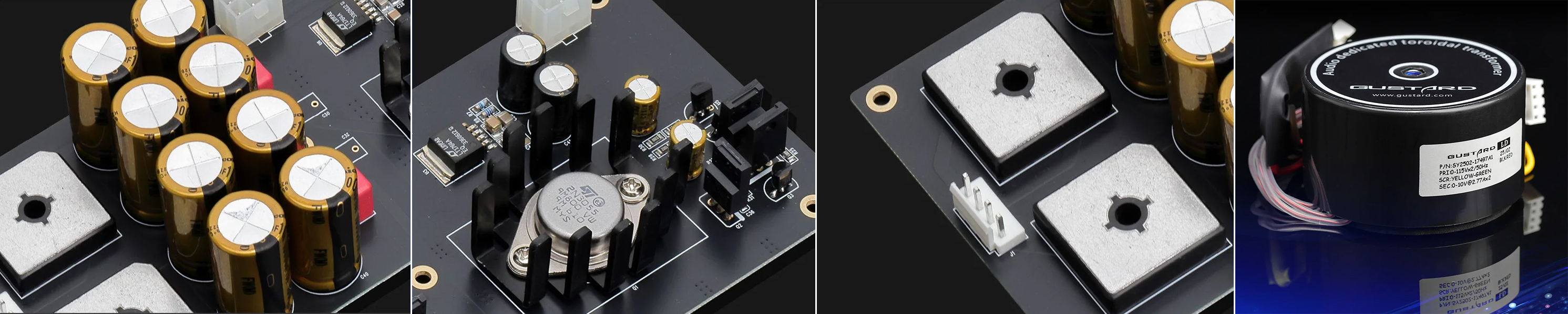
Here's the final tease: 80'000µF filter capacitance; twin TO-3 metal-encased 60V/15A transistors as voltage regs; twin metal-enclosed rectifier bridges capable of 800V reverse voltage, 25A rectified current and 400A surge capability; and a 50W toroidal power transformer with 10V/2.7A secondaries. It reads like serious ammunition for USB isolation and reclocking. About their K2 PLL, Gustard say that "it effectively decouples the decoding process from the source clock to suppress the negative impact of high-jitter sources. It synthesizes the required master clock from either the onboard OCXO or an external 10MHz clock. It generates dual low-phase-noise clock signals at 98.3040MHz and 90.3168MHz with extremely low loss to ensure precise timing for various audio sample rates." Via I²S, our DAC needn't extract a clock from a multiplexed S/PDIF stream because it transmits on its own dedicated line. Now for the mental block which disputes that digital-domain processing not up/resampling can do anything audible. The most common reason given is more effective noise stripping. That presents our downstream D/A conversion with a cleaner signal for superior results. It's the less and least significant bits which get most compromised by noise. Hence we'd expect the main benefit to be better low-level resolution. That tends to transmit as superior ambiance retrieval; more timbre differentiation in the faintest upper harmonics; clearer depth cues for better layer articulation; and more microdynamic contrast. In short, improvements in dimensionality, tone, soundstage sorting and expressivity. We also recall the early days when CD players split in twain. Then we learnt that overbuilt transports from Esoteric and CEC made noticeable differences despite protests that the format's error correction should render that impossible. Today's digital transports and DDC continue the tradition. This stuff is far more finicky hence responsive to extra care than common sense credits.
To personalize things, once my U26 from Audiophonics.fr hopped onto the white delivery van, I'd already lived two instances of LAN-x-USB superiority. The first was with Gustard's R26II DAC. To me it sounds best over its RJ45 input where native DSD512 mode exploits Audirvana's embedded r8brain up/resampler. The second was with a COS D10Mk4 streaming DAC which to the same UPnP route added fibre optics. In its case, LAN too won out despite being capped at 24/192 whilst USB could process 32/768. Whilst in both cases my ears favoured LAN streaming to isolated USB, I hated the implications of constant Big Brother surveillance and, for local files, the inane dependence on the Internet. I find it irrational to route a local library hosted on SSD over a noisy local area network when an isolated USB connection can bypass it completely. Hence I was keenly curious whether the U26's advertised noise isolation and jitter stripping plus extreme sample-rate support could cancel Ethernet's sonic advantage, perhaps even surpass it. I'd much rather restrict my music routing of local and cloud files to fully isolated and regenerated USB and for cloud files only use the LAN in inbound never outbound mode. With two residential DACs from Cen.Grand and iFi capable of on-the-fly resampling to DSD1'024, I'd never yet used Audirvana to generate DSD1'024/2'048 or PCM1'536 data from standard 16/44.1kHz files. I tapped out at DSD512 and 768kHz PCM. Would going beyond just play to the silly number's wars whilst unnecessarily pushing the MCU with intense real-time processing to run hotter? Would it even come off without clicks or drop-outs? If so, should one expect audible gains from pushing upsampling to DSD's current 90.3168MHz limit? In a brief Audiowise post, Hong Kong user Leung H. reports smooth sailing with Gustard's R30 and Holo's May DAC and found 32 x DSD an improvement over DSD1'024 using a Win10 PC with HQPlayer 4 as resampler. Now we have the bones for today's story. Let's find out what kind of meat actual listening would hang on them.
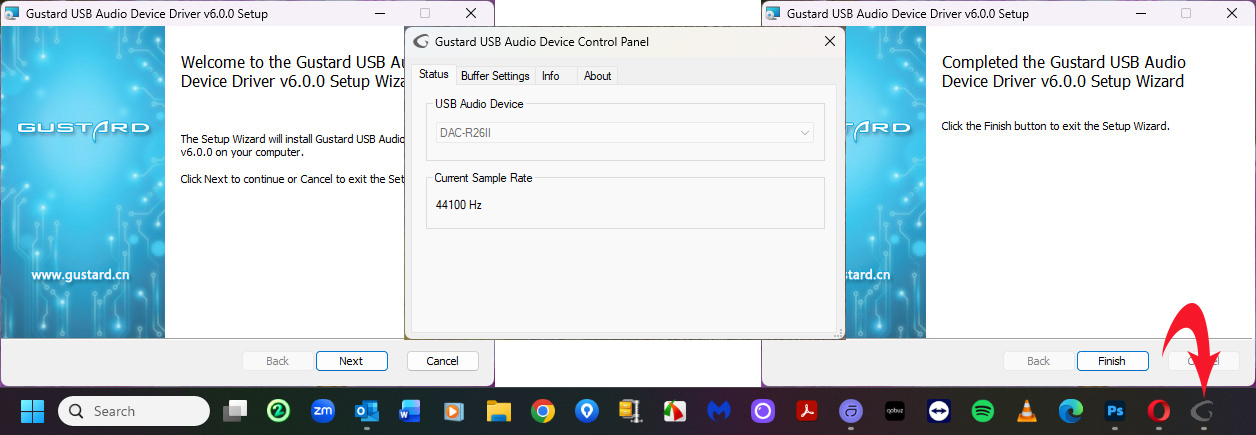
For properly crunchy numbers, I'd already installed Gustard's most current USB driver for Windows. The vital I²S connection transmitting hi-rate PCM/DSD would be an 8K-10K AudioQuest Forest HDMI cable. USB from Win11/64 PC to U26 would run down my trusty flat USB 3.0 iFi Audio cable. I terminate it with their inline Silencer which then suits standard USB 2.0 sockets. Could this become my hardwired replacement for feeding the R26II via CAT7a Ethernet off a network switch between router and PC? In which case, good riddance to networked audio.