The FT7's tuning. Take 1. First sonic impressions were of a light quick linear technical voicing with minor treble elevation and true sub bass extension on the other end. Blessedly the latter involved no goosing or annoying resonances which popular lingo calls warmth or softness. In my mind that simply reframes bloomy wooliness in dishonest prettiness. I find timing blur and overall vagueness quite common for entry-level planars. Then I much prefer a cheaper dynamic like FiiO's own 32Ω FT3. At lesser budgets that ultra-mature tech is far easier to get right. Or to flip that observation, very good HeadFi sound is more affordable with dynamic than planar variants. On my own audio path, Susvara eventually demonstrated that planars tweaked for ultra-low mass and optimal airflow perform much closer to electrostatic precision and resolution than Audeze's early dipped-in-chocolate LCD-2. Today's FiiO instantly looked in Susvara's general direction. This beautifully cleared my budget-planar hurdle. Clear too was great lateral extension for broad light-filled airy staging. That refused to cat-litter clump when compositional lines multiplied and intertwined. Though capable of tracking synth pedals at 25Hz, FiiO wisely opted against the ponderous bass heaviness of my original Final D8000 which I had to tame with an aftermarket harness. Other immediate standouts were high dynamic range with real crest factor; and apparently low distortion because I could listen at unusually high SPL without stress reminders. Given my quick first take, it felt shockingly appropriate to jump the line and start comparisons by juxtaposing Susvara on my Cen.Grand Silver Fox amplifier to assure uncompromised drive for all. For a true delta-force moment, play something then cover both FT7 grills with your hands. The more stifled and strangulated an open headphone now behaves, the more effective and foundational its overall venting. Suffice it to say that this planar really chokes when asked to behave close-backed. In a roundabout way it underlines just how spacious and airy it sounds when operating open-backed. If there were degrees to open, the FT7 sounds like a very open design despite those prison bars across its cheeks.
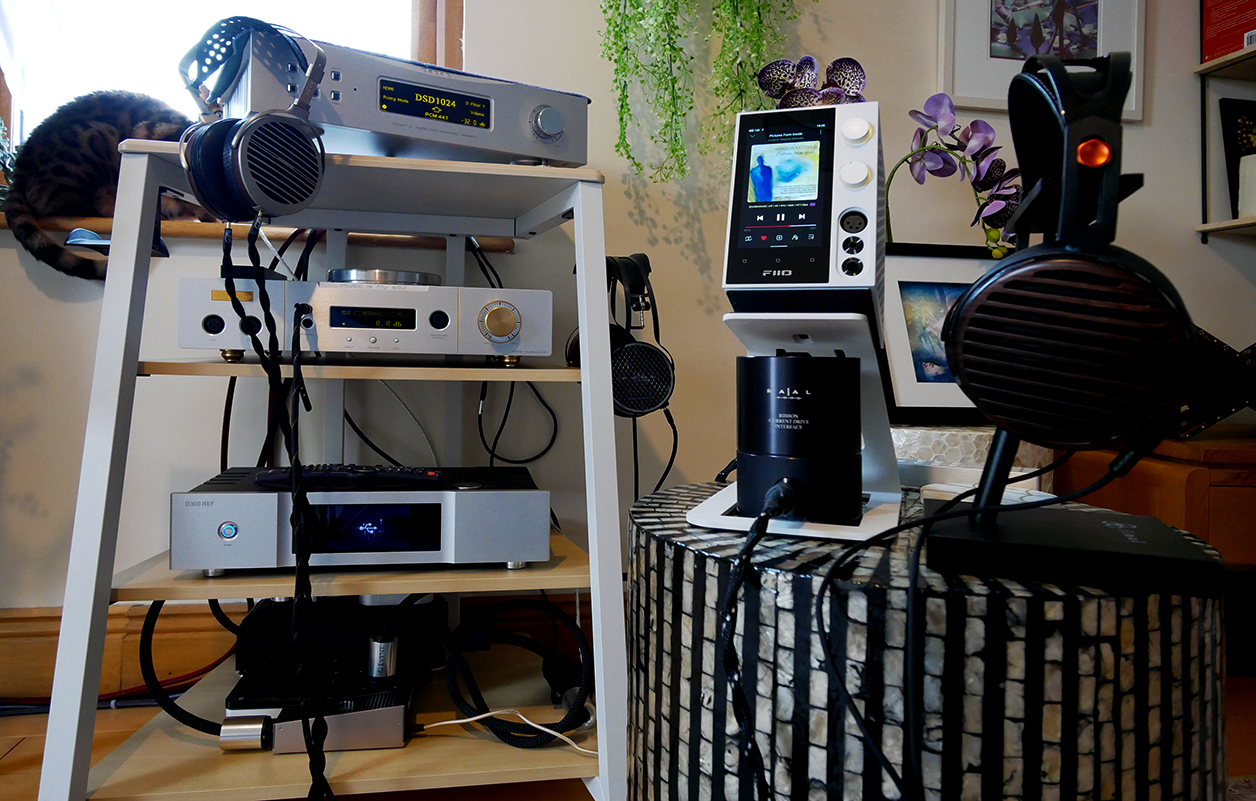 FiiO R7 with iFi power supply ⇒ USB ⇒ Soundaware D300Ref ⇒ I²S/HDMI ⇒ Cen.Grand DSDAC 1.0 Deluxe w. POW ⇒ Cen.Grand Silver Fox
As chance would have it, a downstairs session with a just landed aune N7 amp briefly saw the FT7 next to Immanis to check on available gain from this discrete 6wpc class A amp. I was playing Alquimia by Swedish flamenco guitarist Robert 'Robi' Svärd and his solea por bulerías "Bajo la Luna" with El Potito aka Antonio Vargas on wailing male vocals. His strained upper range happened to coincide precisely with the FT7's hotspots. His lower harmonics singed like refracting sunlight does way in the distance when hitting a window at just the right angle. Without any roll-off whatsoever, the ridiculously pricier ribbons sailed right through the same passages without triggering FiiO's minor lower-treble misbehaviour on the leather pads. It's important to remember that amidst the following praise. It's a peccadillo pepper which will flash its heat only on the right (wrong?) music. If you're allergic to its occasional sightings, naught else matters. Of course the fabric pads alleviate it whilst also 'dumbing down' the more technical leanings. A more portly softly tuned amp too might mellow the rise more generally as could a specially tuned darker cable harness. Or digital EQ common in many modern servers and DAP even software players could tweak that range most surgically. If it were a car, at a certain RPM and on rain grooves the FT7 in its leather-clad persona betrays a particular small 'rattle' where a heavier pricier sports car's cabin would remain entirely unperturbed. To keep that rubber on the road, remember how Immanis demands more than 10 times FiiO's ask. It resolutely closes the book on further comparative comments. Suvsara too should be out of bounds were it not for it being the original planarmagnetic with gold traces; my example of that tech's most extreme implementation¹; and a domestic reference FiiO clearly were aware of when you peruse the FT7 marketing materials. So here goes my encounter of the Susvara kind before we rebook greater sanity with Final's D8000 planar.
_________________________
¹ That's a most conditional statement. Since discovering the first Raal ribbons then upgrading to Raal 1995 variants, I've not investigated flagship planars. I'm not hip to the current state of affairs and which model from Abyss, HifiMan, Kennerton, Nur, T+A & Bros. is considered king or queen, knight or knave.











"What's the rush?" the FT7 seemed to ask. With its build quality having already outshone the HifiMan, FiiO clearly weren't about to concede second-fiddle chair on sonics just because the price chasm said so. Beyond the gross efficiency deficiency of Susvara necessitating far higher volume settings for equal loudness, the primary most immediate sonic offset lived somewhere next to 2nd/3rd-harmonic dominant THD precedents. That's where low/no-feedback amplifier circuits tune for either sweeter richer even-order octave doubling or more pungent odd-order open-fifth overtone backing. This duality can also be found in many triode/pentode and SE/push-pull juxtapositions. Across the bandwidth, Susvara's handling of tonal beginnings was smoother and mellower. That was reminiscent of minor 2nd-harmonic distortion. The FT7 assumed the fresher and sharper 3rd-harmonic counterpoint. This foreground quality tracked regardless of tunes. So it factored as my biggest differentiator. To be sure, I'm not claiming that this difference was from such THD profiles. It simply sounded similar enough to make a useful descriptor for those who possess the reference. Reaching past this quality, the two lower octaves—over an amp patently powerful enough to properly drive Susvara—still had the FT7 in the lead. FiiO's go-big motto had paid off. With the leather pads, the FT7's lower treble was more forward than Susvara. Here subsequent desktop sessions between aune's new N7 and earlier S17 Evo amps showed that the 15°C hotter class A bias of the bigger version with the linear power supply played better to that narrow-band glint than the smaller cooler-running class A amp with the cheap switching wall wart [see below]. On capacious staging, I thought Susvara and F17 equally wide. Though it reads all wrong given price position and brand cachet, in my estimation the FT7 really is a legitimate Susvara alternative. It's not the automatic step down common sense predicts. Meanwhile ease of drive and quality of build are very clearly superior. Intrinsic in easier drive is a virtual guarantee. Even without a burly amp we'll tap the FT7. With Susvara, we need a bruiser amp.