
Country of Origin

 Reviewer: Srajan Ebaen
Financial interests: click here
Main system: Sources: Retina 5K 27" iMac (i5, 256GB SSD, 40GB RAM, Sonoma 14), 4TB external SSD with Thunderbolt 3, Audirvana Studio, Qobuz Sublime, Singxer SU-6 USB bridge, LHY Audio SW-8 & SW-6 switch, Sonnet Pasithea, COS Engineering D1, Laiv Audio Harmony; Active filter: Lifesaver Audio Gradient Box 2; Power amplifiers: Kinki Studio EX-B7 monos & Gold Note monos on subwoofer; Headamp: Enleum AMP-23R; Phones: Raal 1995 Immanis; Loudspeakers: Qualio IQ [on loan] Cables: Exact Express Flame, Furutech; Power delivery: 2 x Kinki/Vinshine Tai Hang on amps and source stack, Furutech DPS-4.1 between wall and conditioners; Equipment rack: Artesanía Audio Exoteryc double-wide 3-tier with optional glass shelves, Exoteryc amp stands; Sundry accessories: Acoustic System resonators, AudioQuest FogLifters; Room: 6 x 8m with open door behind listening seat; Room treatment: 2 x PSI Audio AVAA C214 active bass traps
2nd system: Source: FiiO R7 into Soundaware D300Ref SD transport to Cen.Grand DSDAC 1.0 Deluxe with POW; Preamp/filter: Lifesaver Audio Gradient Box 2; Amplifier: Kinki Studio EX-M7; Loudspeakers: ModalAkustik MusikBoxx + Dynaudio S18 sub; Cable loom: Exact Express Earth; Power delivery: Vibex Granada/Alhambra, Akiko Audio Corelli Corundum & Castello Solo; Equipment rack: Hifistay Mythology Transform X-Frame [on extended loan]; Sundry accessories: Furutech cable lifts, Furutech NFC Clear Lines; Room: ~3.5 x 8m
2nd headfi system: DAC: Cen.Grand DSDAC 1.0 Deluxe with POW; Headamp: Cen.Grand Silver Fox; Headphones: Raal 1995 Magna, HifiMan Susvara
Desktop system: Source: HP Z2 work station Win11/64; USB bridge: Singxer SU-2; DAC/headamp: iFi iDSD Pro Signature; Speakers: DMAX P61 Headphones: Final D-8000, aune SR7000
Upstairs headfi system: FiiO R7; Headphones: Meze 109 Pro, Fiio FT3
2-channel video system: Source: Oppo BDP-105; All-in-One: Gold Note IS-1000 Deluxe; Loudspeakers: Zu Soul VI; Subwoofer: Zu Submission; Power delivery: Furutech eTP-8, Room: ~6x4m
Review component retail: €749
 Use mouse-over loupe or open in new window at full size.
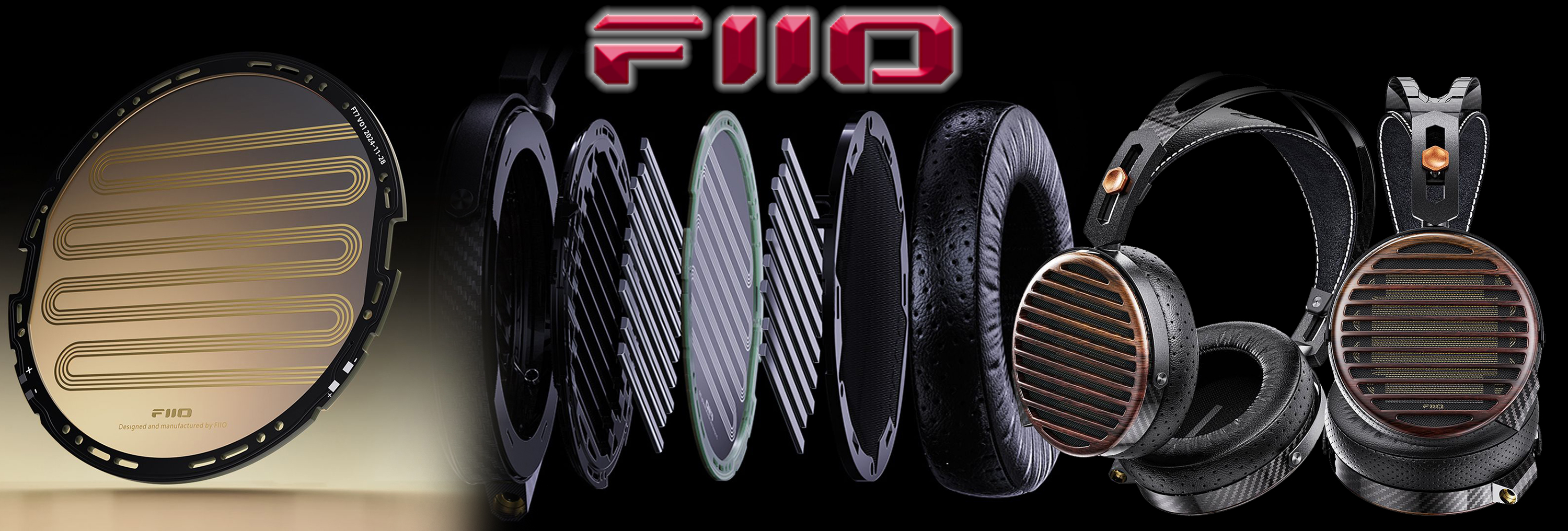
 Fidelity to 1s and 0s. I believe that's what the name FiiO abbreviates. If so, this very productive Chinese brand initially saw itself as provider of affordable digital solutions. But just as the website Digital Audio Review morphed into Darko.Audio to game the gamut, so did FiiO branch out; both on component categories covered and prices positioned. What the two letters in FT7 signify I do not know. If it were fat or fit, they'd both suit. At €749 in the EU and endowed with an enormous 106mm planarmagnetic 1µm-thin membrane, it's a fat catch. At 427g managed by stripping weight with carbon-fibre parts whilst a total of eighteen bevelled N52 neodymium slugs provide 1.5T of magnetic field strength from either side, it also promises to be fit. Add silver/gold-layered serpentine conductive traces atop the PET carrier film. Cap off with stylish lacquered window-shutter Zebrawood grills for extra class. This is not a budgetarian effort to be worn in the sweaty gym off a six-year old dumbphone.
Incidentally, domestic competitor Fosi's first headphone is the €549 i5 planarmagnetic. It uses a slightly smaller 97mm diaphragm yet with its metal grills weighs considerably more at 550g. Its 2µm diaphragm is twice as thick and for its voice coil applies a triple 1.3µm layer of nickel, cobalt and silver. Its headband/bridge assembly looks undeniably HifiMan derivative. But clearly the Middle Kingdom's output of planarmagnetic contenders is heating up. Also think Dunu, Moondrop, Sivga/Sendy and Thieaudio.
Now back on FiiO for whom the FT7 is already the third of this breed after the FT5 and FT1Pro if we don't count models like the FP3, their in-ear with a 14.5mm 1µm planar diaphragm.

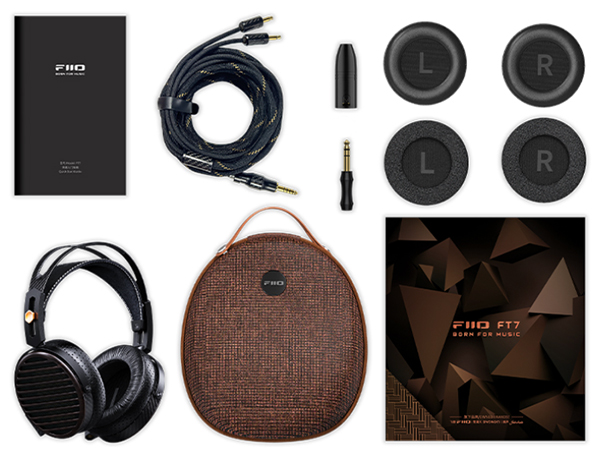 Even their 3-metre 6N monocrystal copper leash terminated in 4.4mm balanced on the amp side and dual 3.5mm on the cup ends isn't a run-of-the-mill job. Instead it underwent lengthy cryogenic treatment to improve conductivity as we know it from premium cable providers like Furutech and Oyaide. XLR4 and 6.3mm adapters include. So do two pairs of differently tuned snap-on ear pads, one in perforated lamb's leather, the other in breathable cloth; and this stylish hard carrying case.
The FT7 is a clear attempt to propel FiiO's HeadFi game into the next league. Hence I was curious to take its temperature. Would my ears get red and toasty? John Darko had a live contact at the Sino factory. I reached out. Apparently my press credentials hadn't been revoked yet. So here we are.
Regular readers know. I'm an enthusiastic user of FiiO's R7 player as an offline 1TB SD-card USB transport. One fronts my upstairs system. The other sits in reserve as long-term backup. I really love this little deck with its portrait-mode touch screen right next to my chair. It's a superb source to front a serious system. I built mine around a Soundaware D300Ref USB bridge, Cen.Grand DSDAC 1.0 Deluxe DAC at DSD 1'024 and Kinki EX-M7 stereo amp. The R7's XLR4 headphone output in high gain has plenty of juice to drive even my Raal 1995 Immanis if I don't want to pork out and use my big Cen.Grand Silver Fox. See below. In short, FiiO and I have form; of the excellent not incarcerated type.
As an observer of the brand from a reviewer's news-trawling distance, I happen to think that FiiO have brilliant form, period. They focus primarily on the affordable high-value sector but also issue the occasional very ambitious effort still without demanding a kidney in trade. As such chances sparkled that the FT7 would continue a value trend which I had sampled in their 32Ω FT3, a fantastic sub €400 performer in the open-backed dynamic class. Eagle-eyed observers already noted how the FT7's driver looks very similar to what's in HifiMan's €6'000 Susvara¹ whilst FiiO's overall build quality seems to exceed them. I obviously didn't expect the FT7 to compete with Susvara once plugged in. But having a pair of these infamous HifiMänner, I would learn just how much or little separates them.
___________________
¹ Apparently one factor pooling into its notorious inefficiency are the gold traces on its diaphragm. Gold is a poorer conductor than copper or silver so more resistive. The newer even costlier Susvara Unveiled has switched to silver traces. Meanwhile big proponents of silver/gold conductors are Siltech and Crystal Cable who explain that a small infusion of gold fills gaps in silver's molecular structure. Mundorf too have such a conductor which they sell off the spool and which recently appeared in the Vermillion cables by Virtual Hifi of Poland. Mundorf use the same recipe in their famous top-line capacitors.










For price-realistic drive I had the companion R7 all-in-one and two pure class A champs in aune's S17Evo and Soundaware's P10 10th Anniversary. For raising the rupee ruckus there was my desktop's iFi iDSD Pro Signature, Luxsin X9 and a COS H1, all three DAC/headfi combos. To trigger the stiff shekel stratosphere, the FT7 could jack into an Enleum AMP-23R or Cen.Grand Silver Fox. Comparator cans would be aune's SR7000, Meze's 109Pro, Final's D-8000, HifiMan's Susvara and Raal 1995's Immanis. Nobody in their left or right mind expects the FiiO to challenge the latter three. But it's always fun to check just how far a resourceful engineering team with China's ongoing labour advantage can push high value. Being pushy in that way isn't annoying but applause worthy.
 From a recent review of Akustika Eterna's €60K Lumen passive-magnetic volume controller.
Armed with just specs and photos, a key design focus of the FT7 seems to exploit the opposing forces of enormous diaphragm size and tiny mass. Hello maximal displacement and acceleration. Howdy minimal energy storage. The combination nets stable 25Ω impedance of just ±15% deviation and 94dB/1mW sensitivity. As dynamic cones and domes get larger and lighter, their propensity to deform into so-called break-up increases. It's why speaker brands from Børresen to Raidho, Canton to Monitor apply ever harder nano skins to stiffen their light hard membranes. Planarmagnetic thin films lack the classic dynamic suspension components of a flexible surround and spider attempting pistonic operation. Unlike long narrow conductive aluminium ribbons that affix on their narrow ends but flutter between magnets right next to their free edges, a planarmagnetic's edges clamp all around. Their excursion potential between close-proximity stave magnets involves stretching without ever touching the neodymium arrays. Greater distance between those arrays allows for higher stretch. As diaphragm diameters grow, strain on the moving elastic film and its attached conductive traces reduces. Simultaneously ever larger membranes become harder to wear whilst maintaining a good seal without undue clamping force. Meanwhile the window-shutter magnet arrays obscure half the sound-making diaphragm. That creates inevitable reflections and air turbulence. To minimize it a bit, the magnets round over where they face the thin film. Still, their obstruction remains.
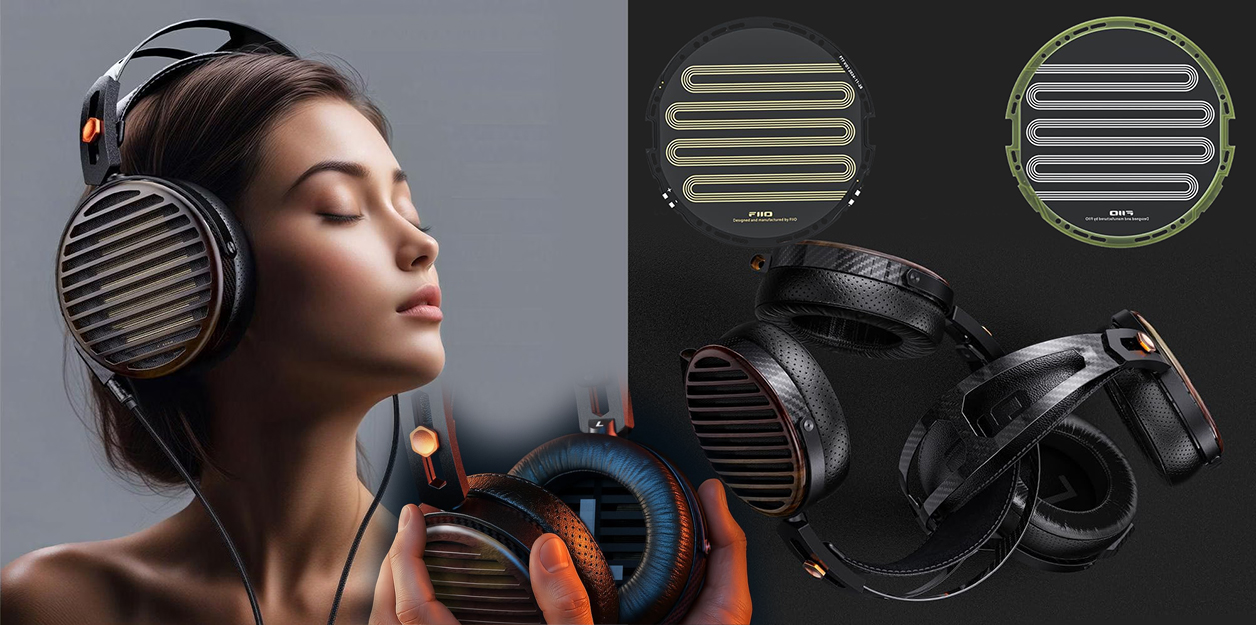 These are big headphones | the voice-coil traces facing out are gold, the ones facing in to aim at the ear are silver.
On the membrane itself, thicker conductive traces carry more current but add moving mass. We needn't be engineers to see how mutually conflicting factors enforce a sane middle ground to end up with a realistic product. FiiO apparently tested their ultra-light large diaphragm over one full year of intense use to verify its reliability. Also, two-sided longer magnets increase sensitivity but add weight. To not end up with an original Audeze, Abyss or HEDD noggin nasty, FiiO reached for light but stiff carbon-fibre components to rein in the skull poundage. The FT7 still is no lightweight per se, just for its planar category. So a big question is wear comfort. That's down to even weight distribution without hotspot; and a non-slip properly adjustable fit without excess pressure. Given how head shapes and sizes vary, one critic's feedback on the matter is sorely insufficient. Prospective buyers should canvas all published reviews to triangulate that variable. After all, no matter how brilliant it sounds, if a headphone isn't comfortable on the head, measuring great, looking flash and sounding fab all come to naught like a chair not really made for sitting or a pair of shoes half a size too small.