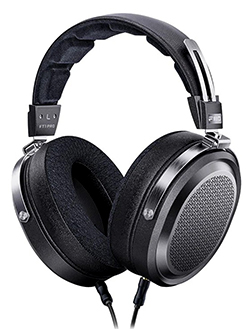
 For FiiO's correct size, since their 2007 launch as Guangzhou FiiO Electronics Technology Co. Ltd, the company now employs a staff of more than 300 and manages the trifecta of the FiiO, JadeAudio and Snowsky brands. "Our core team has nearly 30 years of R&D experience in audio product development including software, hardware, industrial design, structural and electro-acoustic engineering." Since 2022, FiiO operate out of an independent industrial park of 15'000m² which contains a 2'000m² R&D centre, matching 2'000m² marketing centre and 8'000m² for manufacture. Amongst their test gear is an ultra-expensive oscilloscope, B&K dummy head, two Audio Precision analysers, an over-the-air anechoic chamber and microwave shielding chamber with related kit worth a million RMB. "The new dust-free workshop and four two-way assembly production lines achieve an annual turnover of up to 2'000'000 units with expansion capacity to twice that." The firm's current headphone portfolio spans eight different series. FT7 development began after the launch of the FT5 with a dynamic and planar design in parallel. "The FT7 ultimately defined as a planarmagnetic largely due to our breakthrough in diaphragm materials. We advanced from the 6μm diaphragm of the FT5 to 1μm. The FT1 Pro [right] too stems from this R&D but launched earlier because we meant to push the FT7 to its limit. The dynamic driver design may implement in a future higher-end product. The FT7's 1μm PET substrate undergoes a combination of lamination, electroplating and laser engraving. In many cases, a conductive gold coil is created by applying gold foil to the substrate then etching away unwanted areas, leaving behind only conductive traces.
"But over time, the adhesive layer between foil and substrate tends to weaken and can fail. In contrast, our gold layer forms in a 6.6×10⁻³ Pa vacuum at 120°C where metals ionize and deposit directly onto the film. Hence our conductive gold coils show no wrinkles unlike foil-applied conductors and exhibit uniform thickness controlled by processing time and temperature. Why do gold-trace diaphragms sound warm and full-bodied? It's mainly due to gold's high internal resistance similar to tuning paper diaphragms where higher internal resistance contributes to a fuller midrange and more relaxed bass. Our 1μm PET base film is ultra light, hence the majority of moving mass comes from the metal traces. Gold has decent conductivity (41.0×10⁶ S/m) but high density (19.30g/cm³). A pure gold coating would require a very thin fragile layer to keep mass low, leading to higher impedance, lower sensitivity and harder load behaviour. Meanwhile silver has the best conductivity of all metals (62.9×10⁶ S/m) and much lower density (10.49g/cm³). By combining gold and silver in switch-back traces 2'240mm long, we reduce diaphragm mass, lower impedance and increase sensitivity for a friendlier load. To maximize our 7'123.3mm² exposed surface area, we even minimized frame obstructions by moving the cable socket to the side and refined the diaphragm-fixing PCB." FiiO's obvious pride in their high-tech vacuum-electroplate process mirrors far earlier comments from Camerton's Oleh Lizohub in Berlin on how important is the method whereby a planarmagnetic thin film gains its voice coil. It's not just about longevity from superior adhesion. It's about consistent impedance from layers of perfectly even thickness which reflects in a more even amplitude response. We also appreciate how the opposing requirements of treble and bass—ultra-low mass vs maximum air motion from moving surface x excursion—arrived the FT7 at its particular solution. The micro-thin ultra-light diaphragm is vital for the treble response of motions up to 20'000 times per second whilst the enormous surface is important for good bass when the safe stretch potential of a fully clamped diaphragm dwarfs the pistonic excursion of a dynamic driver.






My inflated head (75/8th hat size) required just one click down from max reach for a perfect fit. This adjustment is made off the head since it requires some force. As a result it won't slip like looser fixings can. Before doing the egg-noggin deed of actual wear, a new owner of course gives their new toy the thrice over. From the flawlessly glossy carbon-fibre bridge to the matte slider stem, the hexagonal copperish headband stoppers, the satin wood grill, perfectly finished lambskin pads installed by default to the substantial cable with soft cloth sleeve and matching carbon-fibre splitter and connector barrels, the FT7 is a symphony of textural and material contrasts. Those are far classier on hand than a written materials list could ever suggest. A word for it popular with YouTube reviewers is premium. This FiiO doesn't just pretend at its catalogue's top placement. It communicates its ambitions even in the context of my aforementioned original Susvara. That indeed can't tie FiiO's shoelaces on the premium score. Back on the head, the lightly angled pads' 6 o'clock position hit the point where my jawline meets the neck. That's low. Feeling around them backwards, the pads' outer edges only touched my neck very lightly. Yet the foam was plenty wide to secure a snug pressure fit regardless. Again, these are vertical discs of substantial diameter. Their flatness must shape itself to our curved skull surface via the foam filler's natural pliancy plus the cups' self-adjusting cant and swivel. My big head declared this stunt an unexpected success and one of both sterling comfort and zero slip. Head boppers and gyrating groovers, unite. With the boxes of premium fit 'n' finish and matching comfort ticked for this commentator, we're ready for the sum of it at and between my ears. The leather pads should more easily trigger toasty ears than the cloth alternates. Anyone who ever wore leather pants only to quickly return to jeans knows all about it.

On the topic of Lederhosen and sweat, the very easily swapped two pads—bravissimo for a simple clip system with reassuring click action and no extra mass of embedded magnets!—show that sonically it's really the cloth pads which play it warmer. They primarily do so by reducing output in the lower and mid treble, mellowing transient incision and fattening up the bass a bit. In the most basic of terms, the leather pads are for speed and resolution, the cloth pads for hygge or Gemütlichkeit. That's what cool Nordic Danes and Germans call comfort or coziness. The difference delta is far greater than most cable swaps. It's a quick way to customize the FT7's tuning without EQ. It will likely only take one AB to determine which flavour you favour. It's that obvious. Being older so less keen on top (treble not grey cells mind you) and inherently drawn to an energetic quick shiny balance over a thicker duller tuning, I went with the leather pads. That also reflects my reference headphones being Raal 1995's triple-ribbon Immanis. Likewise for going 4.4mm or XLR4 wherever my amps allow. I prefer balanced drive.
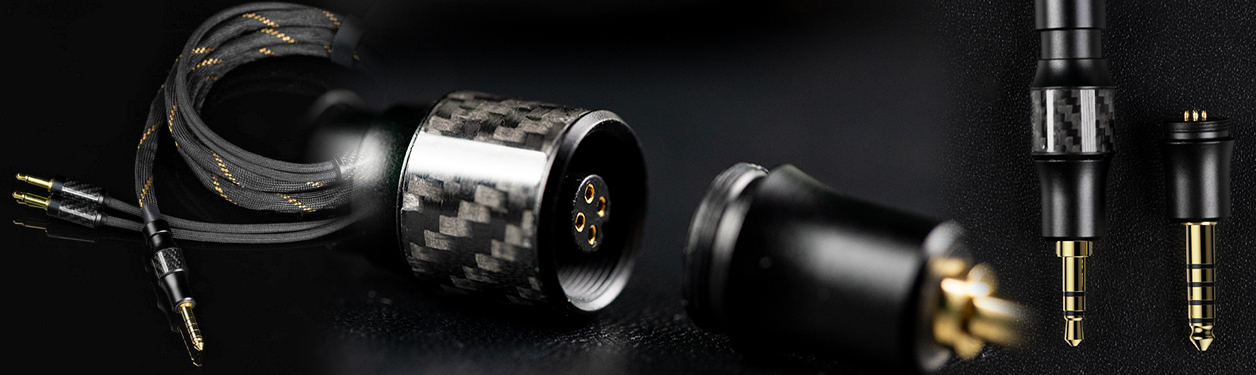 This shorter version features redesigned swappable 3.5/4.4mm ends secured via screw collar.
As a stationary listener I really appreciated FiiO's 3-metre cable. The mobile mob will obviously clamour for a shorter leash. The 3.5mm terminations on the cup sides make cable rolling a cinch. A Polish Forza AudioWorks leash in my inventory swapped right quick. And FiiO already have their own equivalent 1.5m version. With its super-open hence ultra-leaky construction, the FT7 simply isn't something anyone socially conscious would wear in public. Putting some break-in time on in a spare bedroom at the end of my upstairs hallway, I could hear sounds in the bedroom on the corridor's other end. Granted, it was too faint to make out which tune was playing. But in closer proximity, you easily do to become egregious noise pollution in company. Incidentally, I asked my factory contact about the cost of replacement pads. When this went to press, none were available yet.