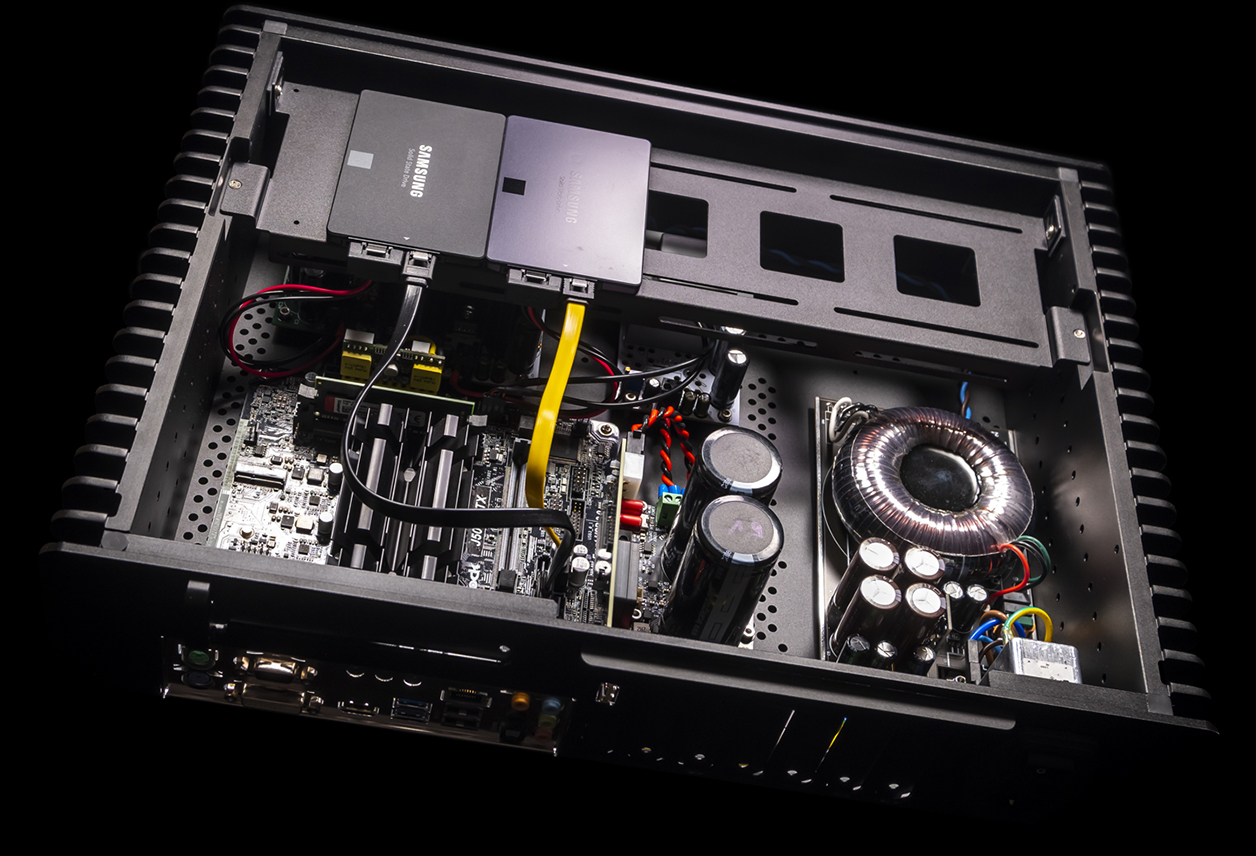
Then there's the matter of galvanic noise isolation and what Adam calls the virtual battery principle. In his view, a PC server environment is fundamentally hostile to audio due to contamination generated by processors, converters, SSD drives and every other electrically noisy subsystem doing computer things. At 225F capacitance the discharge time constant becomes so enormous that the supercapacitors effectively behave like an extremely powerful low-pass filter with a cut-off frequency approaching zero. This isolates the USB card from the instability and noise of the computer PSU, making the entire supply behave similar to a pure chemical galvanic cell, albeit without traditional battery drawbacks. The latter typically exhibit considerably higher output impedance. Clock jitter reduction represented another major design priority. Adam identified oscillators as the most sensitive components on any USB card because power supply noise translates directly into phase noise or jitter. By eliminating broadband contamination through his supercap implementation, clock generators can operate far closer to theoretical max precision. To the ear, such improvements usually manifest as inkier backgrounds, cleaner spatial separation and upper registers freer from residual glare. At one point Adam casually mentioned that with 5V and 3mΩ ESR, the theoretical peak current capability of the supercapacitor bank calculates to roughly 1'666A. Yes, one thousand six hundred and sixty-six amperes. Naturally real-world performance ends up lower due to PCB trace resistance and switching limitations elsewhere in the circuit but the figure still vividly illustrates the sheer speed and authority of this current source. Considering that the USB card itself typically draws less than one ampere even at peak demand, the available electrical headroom borders on the comical.
This right here is where Everest Base stops looking like just another PC in a fancy box and starts resembling a deeply obsessive engineering exercise conducted by someone who spent years thinking about digital audio behaviour far beyond the superficial level. Whether one agrees with Adam's design choices or not becomes secondary. While the amount of R&D poured into his first machine is impossible to miss and already impressive, the key feature is still ahead of us. While there are dozens of audiophile server manufacturers these days, to my knowledge only Taiko Audio, Pink Faun, SOtM and JCAT develop their own PCIe USB cards. The former two keep theirs exclusive to their own machines so those offered by the latter two remain among the only commercially available standalone options people can actually buy. Whether such hardware makes an audible difference is entirely beside the point. It's about the effort required to choose this route as a new business. By developing his own Everest USB One card, Adam joins a rather prestigious exceedingly niche club. Asked, he explained that he's familiar with competing designs and extensively experimented with those he managed to get his hands on. Eventually he decided to burn a rather substantial amount of cash on creating his own implementation exactly how he wanted. Knowing him, this feels less like a business decision and more like an inevitability he eventually had to face. While Adam is already busy developing higher-tier USB and LAN cards for future Everest models, the Everest USB One inside the Base already deserves special attention. The card utilizes an SC-cut oscillator selected specifically for extremely low phase noise. It resides inside a CNC-machined aluminium enclosure and is encapsulated in a dedicated microphony-reducing compound to maximize clock precision. Naturally I had to ask how exactly that helps. Here mechanical vibrations enter the equation. I was told that the quartz resonator inside every oscillator is fundamentally a piezoelectric element physically vibrating at a specific frequency. External vibrations superimpose themselves onto these natural oscillations and generate microphonics. In practice, clock frequency gets subtly modulated which directly translates into phase noise so jitter. The compound surrounding the oscillator acts as a highly effective mechanical absorber that dissipates the kinetic energy of these vibrations before they interfere with the crystal itself. The idea is to allow the quartz to operate in conditions approaching mechanical silence, drastically reducing vibration-induced jitter.







Enter EMI/RFI shielding. As outlined above, the interior of any computer server is effectively an electromagnetic war zone populated by high-frequency noise generators all screaming at each other simultaneously. Here the aluminium enclosure for Adam's oscillator of choice functions as a Faraday cage. It blocks EMI/RFI interference from penetrating the oscillator's delicate internal structures as well as its power and signal lines. In effect the part's output remains protected from induced broadband noise contamination originating elsewhere inside the machine. Thermal stability also played a major role in Adam's thinking. Every XO oscillator exhibits some degree of temperature dependency regardless of sophistication level. Even if we're not talking about a dedicated oven-controlled crystal oscillator, sudden thermal fluctuations inside a PC chassis—say during a temporary CPU load spike—can still introduce subtle frequency deviations known as thermal drift. The combination of aluminium enclosure and encapsulating compound creates substantial thermal inertia that effectively smoothes temperature spikes. The oscillator heats up and cools down very slowly and evenly, stabilizing its operating point in the process. The potted enclosure additionally isolates the oscillator from environmental influences such as humidity, which in extreme cases may alter tiny parasitic capacitances around the crystal itself. In addition, as a component soldered directly onto the USB card's PCB, the oscillator remains susceptible to resonances originating from the laminate and surrounding circuitry. Encasing it inside a rigid and relatively heavy aluminium cowl dramatically alters the resonant behaviour of the entire assembly, shifting it outside ranges potentially harmful to clock performance. The enclosure also damps self-generated resonances that the oscillator itself could transmit back into the PCB.
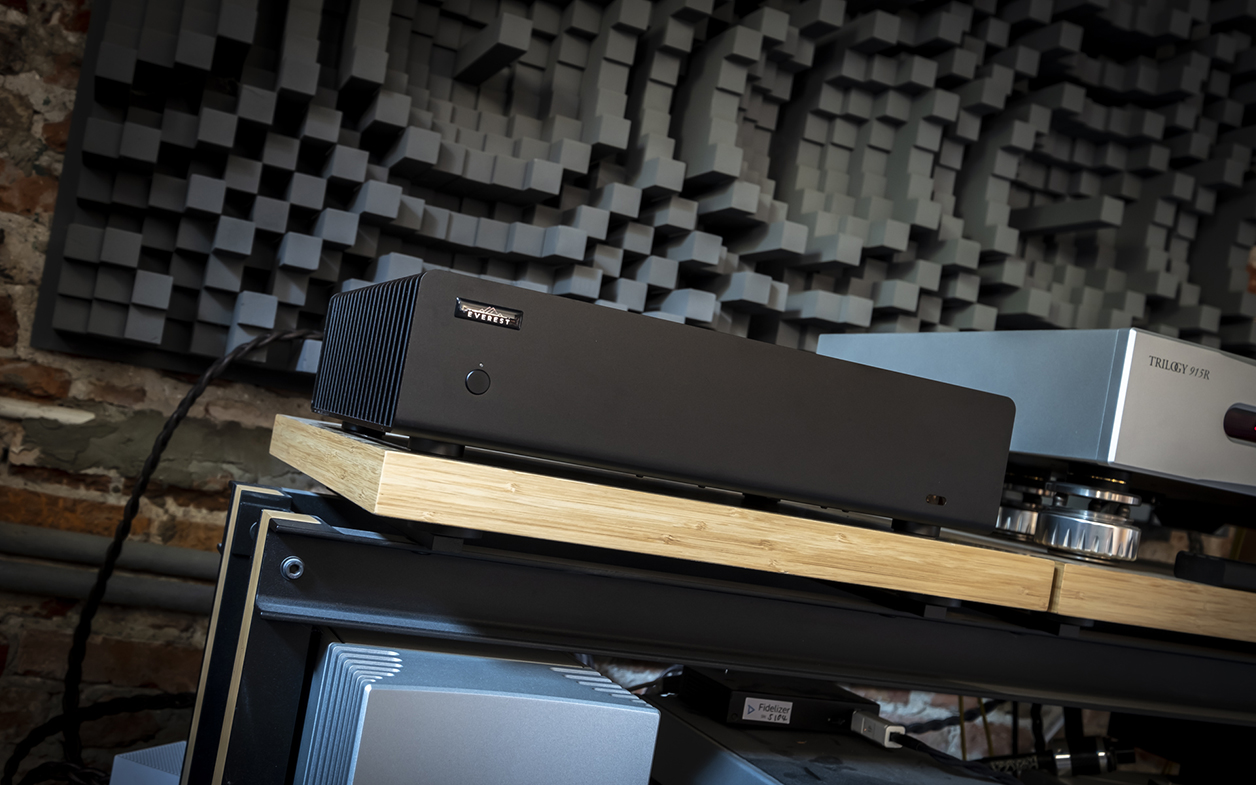
In practical terms, a clock isolated from vibration, electromagnetic interference and temperature fluctuations should achieve significantly more stable and precise time-domain reconstruction. To the ear that typically translates to superior spatial definition, fewer digital artifacts and a more analogue presentation. Adam's clock implementation is powered by a pair of parallel-connected LT3042 linear regulators. Their combined operation is made possible by a clever architecture based on a current source and voltage buffer. It further improves PSU performance in several meaningful ways. First, the already extremely low noise floor of these parts becomes even lower courtesy of an averaging effect. A single LT3042 posts an almost ludicrous output noise figure of 0.8µV RMS within the 10Hz-100kHz bandwidth. When two identical regulators operate in parallel, their internal random voltage noise partially correlates and cancels out. In practice, noise decreases according to the square root of the number of regulators involved. With two LT3042s in play, output noise drops by roughly 30% to around 0.56µV RMS. For the oscillator, this effectively creates a zone of near-perfect electrical silence. Second, the output impedance of the power source is significantly lowered. The principle here resembles connecting resistors in parallel so that the resultant impedance is effectively halved. The lower the PSU impedance, the faster and more effectively it suppresses reverse interference generated by the oscillator during logic switching events. The power supply becomes substantially stiffer in the process, maintaining highly stable voltage during the fractions of a nanosecond when the crystal suddenly demands current to sustain oscillation. Third, the circuit benefits from increased current capability and superior transient response. A single LT3042 can provide up to 200mA output current whereas two of them raise that to 400mA. Granted, an XO oscillator typically consumes relatively little current in steady-state operation, often merely several milliamps. However, during start-up and while generating the rising edges of square-wave signals, instantaneous demand can increase dramatically. The doubled current reserve and combined silicon muscle allow the power supply to react extremely quickly under such conditions.