Here's another fun fact. Back in his teenage years so 1995, Adam already worked as an audio reviewer for the local SAT magazine—print press, from the era before broadband Internet became a thing in Poland; and before today's algorithm-driven attention economy transformed everyone with a smartphone into a self-proclaimed expert. One year later he moved to the Audio magazine run by Andrzej Kisiel, a publication that still exists in print and online. Suffice to say, the man has been marinating in audio for an alarmingly long time. He may not look it but his track record is what it is. Getting back on track, Adam's first working prototype neither had a proper enclosure nor name yet I was still surprised by how accomplished it sounded. More importantly, it became immediately obvious just how substantial an influence the onboard oscillators had. We swapped several during that session and the differences were anything but subtle. The second time Adam visited, the project had evolved considerably. Crude DIY was no more but a proper chassis and actual identity attached. Yet the man's perfectionism kept delaying the finish line. Various small details required refinement. Tiny kinks needed ironing out. Naturally, most sane people would never have noticed any of them but Adam did. His most recent visit occurred after selling his main business so he finally had time to button up the design and prime it for commercial assault. Without further ado, it's my pleasure to introduce the Everest Base. While I generally couldn't care less about reviewer firsties and similar industry chest-thumping, in this particular case I'll gladly make an exception and mention that this story marks both the product's and brand's global debut.
With many audio-brand newcomers, not expecting fancy packaging is wise. Most simply funnel every available cent into the product and call it a day. That's frankly the sensible thing to do. While Adam didn't get particularly luxurious with his Everest Base either, he clearly paid attention to small things. The cardboard box sports a printed Everest logo and the internal foam liners were obviously cut specifically instead of shamelessly recycled from whatever happened to fit. No other extras were necessary. People shopping this market already own boutique LAN and power cables and usually know perfectly well what to do with them. To get basics out of the way, the Everest Base measures 435 x 319 x 100mm WxDxH and tips the scale at an easy 8kg so nothing here requires forklift certification or a standby chiropractor. For this model Adam chose the Streacom FC10 V2 case sans optical drive slot. The thing comprises rigid sandblasted and anodized black aluminium plates. Tolerances are reassuringly tight and the visual impression lands somewhere between minimalist and quietly purposeful, courtesy of large heatsinks on the sides. It's sleek without trying too hard, a minor miracle in today's audio landscape. It's also worth mentioning that several other high-profile server manufacturers rely on Streacom enclosures so Adam's decision feels practical not opportunistic. This isn't some lazy off-the-shelf compromise but a proven platform many established brands happily build upon. Besides, the Everest Base serves as his entry-level design priced at €4'999 so expectations should remain grounded accordingly. No luxury fluff here, just essentials and key ingredients that meaningfully set the design apart. That said, more ambitious custom-machined casework and increasingly elaborate internals are reserved for models positioned higher up. On that note, Everest Ascent already exists and two additional designs are in the pipeline though that's a story for another time. Server and streamer designs enjoy fairly miserable press on audio fora. That is hardly news. The crowded camp there remains convinced that such devices cannot possibly make even the faintest sonic difference while my own experience over the years suggests quite the opposite. Frankly, I've long since stopped trying to convince anyone. Life's too short, bandwidth too expensive. More interesting is another issue entirely, namely what these machines actually are and, perhaps more importantly, what they pack inside. Therein lies the rub.









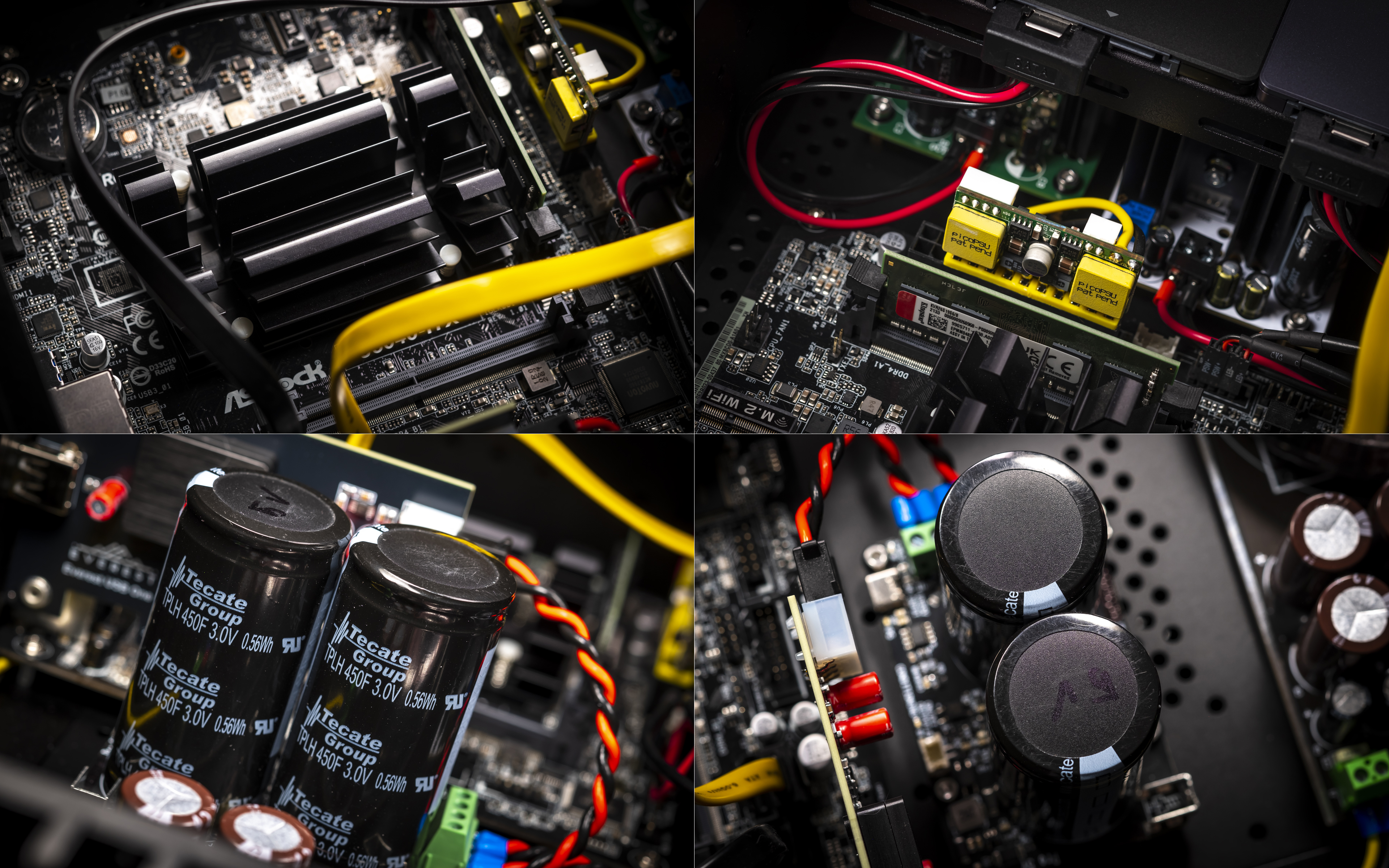
At the end of the day, server/streamer hardware revolves largely around familiar computer modules. Enclosures, motherboards, memory modules, CPU, SSD drives, power supplies. None of this sounds particularly exotic. Calculating the visible parts that make up Everest Base is hardly a chore. In fact, it's a breeze. I easily see forum pundits adding up retail PC hardware prices and immediately asking why this thing costs mid four figures. To properly address that, one needs to look well beyond commodity PC bits and focus on the extensive custom engineering Adam injected into his introductory device. He clearly didn't spare any effort. Upon inspecting Everest Base's interior, we encounter an ASRock J5040-ITX motherboard armed with a quad-core Intel J5040 CPU and 8GB of DDR4 RAM, expandable to twice that should we feel adventurous. CPU cooling falls onto a modest passive heatsink entirely sufficient for the task even under stress. Adam's motherboard choice isn't random either. Quite the opposite. This specific platform enjoys considerable popularity among digital audio manufacturers. For some perspective, the €14'500 432 EVO Master and €23'000 Ideon Absolute Stream META rely on the same board. There's another practical advantage. The beauty of a standard ITX platform lies in serviceability and future-proofing. Should the CPU eventually fail or one want more computing muscle years down the road, swapping the motherboard becomes refreshingly painless. ITX is a standard so dimensions and electrical connections remain consistent across countless compatible alternatives. Everest Base as reviewed also packs a dedicated 250GB Samsung SSD for system duties while separate Samsung drives from 1TB-8TB accommodate the music library itself. So far none of this sounds particularly extra-terrestrial. That changes the moment we reach Everest Base's power architecture. Now is a good time to brace yourself. Things are about to get properly heady.
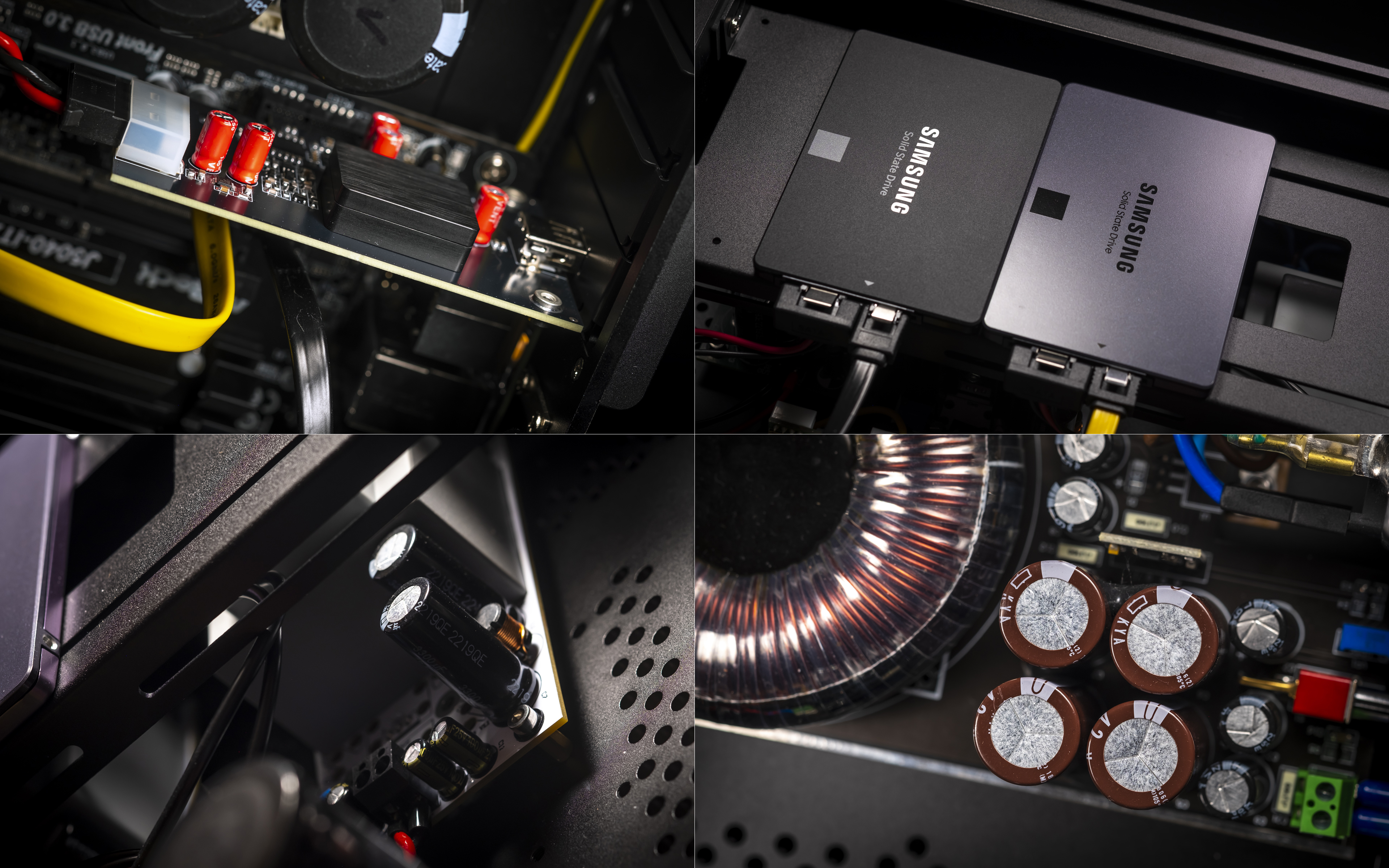
The machine packs four separate discrete linear power supplies that independently feed the motherboard, each SSD and a very special USB card we'll get to shortly. Each PSU is a custom-made circuit of ultra-low-noise voltage regulators while the supply dedicated to the USB card incorporates two 450F supercapacitors tasked not merely with voltage stabilization but with pushing output impedance down to a frankly absurd 3mΩ. Adding such a potent supercapacitor bank—two 450F units connected in series for an effective 225F/6V nominal— to power an audiophile USB card inside a server qualifies as fairly uncompromising. The combination of enormous capacitance and microscopic output impedance drastically alters the behaviour of the entire power line. Naturally I asked Adam to elaborate. Several recurring themes emerged, digital noise isolation being among the most important. He explained that digital circuits, especially processors on USB cards, clocks and various logic sections, do not draw power continuously. Their consumption behaves in rapid spike-like bursts synchronized with clock frequencies. To Adam, conventional switching supplies and even many linear regulators simply cannot react quick enough to these sudden demand fluctuations. The results are momentary voltage drops and high-frequency noise contamination which eventually manifest as jitter inside the audio signal. This is precisely where the supercapacitor bank enters the picture. Acting as a giant local energy reservoir with effectively zero inertia, it can respond almost instantaneously to current demand spikes. With ESR hovering around 3mΩ, the thing is capable of delivering enormous current in a fraction of a nanosecond, smoothing micro spikes directly at their source. In effect, the USB card stops modulating the server's main power line altogether. Extreme lowering of PSU impedance constituted another major design goal. The source's output impedance determines how stable voltage remains under dynamically changing load conditions. A 3mΩ reading paired with such massive capacitance effectively transforms the 5V rail into an electrical brick wall. Whether the USB controller transmits dense DSD streams or idles quietly in the background, the supply voltage simply refuses to fluctuate. For digital circuits, this creates ideal operating conditions and minimizes switching errors at gate level.