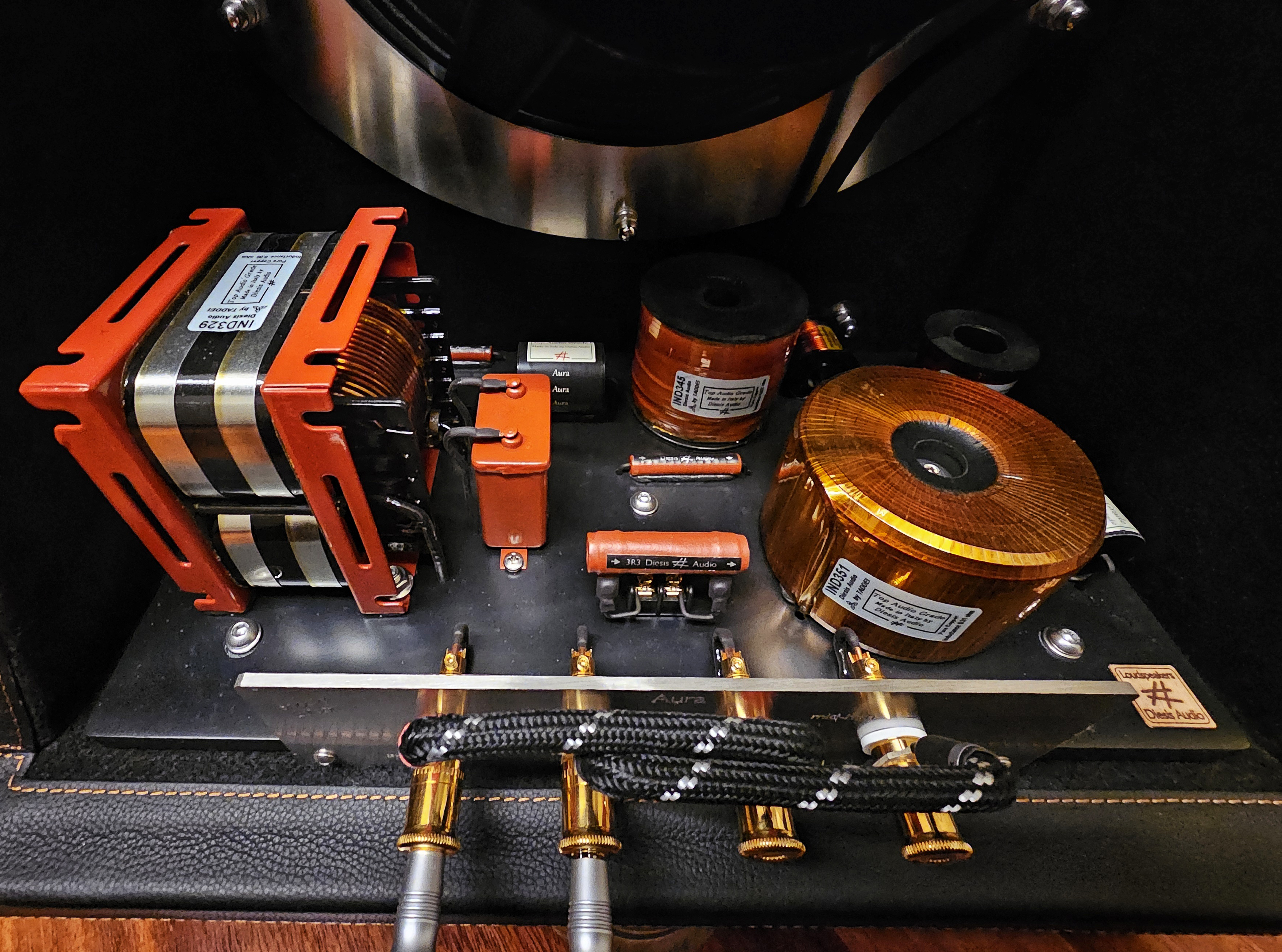
As explained, the ability of being driven by modest power is a primary objective for all Diesis speakers to facilitate SET amplification as favoured by Giuseppe. With an efficiency of 93dB/2.83V/1m and a nominal 6Ω impedance, Aura presents a manageable though not easiest load. Minimum recommended amplifier power is 20 watts. The bandwidth splits into a 3-way crossover whose design and component selection are crucial. This filter network is another astonishing example of attention to detail and extreme craftsmanship, featuring free-air point-to-point connections and big parts with no expense spared or limits imposed on size or material makeup. The 12" woofer enters below 200Hz, the 10" unit filters around 1'800Hz, leaving the horn-loaded compression driver significant bandwidth. Consequently horn geometry, material, manufacturing tolerances and final paint along with choice of driver are critical to the overall presentation. Diesis offer the option to customize the balance between horn driver and woofer section by providing a 47Ω resistor as an alternative to the default 33Ω. This adds attenuation.
The combination of horns and dipole drivers is an uncommon arrangement that poses mechanical, electrical and acoustic challenges to achieve a coherent sound field when dispersion patterns diverge notably. On the other hand, the horn supports high efficiency and a big, fast, highly dynamic character with beaming directivity to raise focus and definition otherwise not easily achieved with diffuse dipole tweeters. As we'll see, the effectiveness of this design is significantly influenced by room placement.







As I awaited Aura's arrival, my primary concerns were my compact room dimensions and low-power hybrid amp. When Mr. Gabbarini delivered Aura, I requested that he bring along their Evento 20-11 100wpc hybrid integrated. Should my AIC-10 fall short of unleashing Aura's true potential—he'd know—I'd have a proper backup. Giuseppe was kind enough to spend an afternoon at my home, assisting in optimal positioning and with a series of amplifier comparisons. At the end I was happy to hear that I could use my trusted amplifier. Yes, his Evento produced more authoritative sound with snappier transients but I love the tonal signature of the AIC-10 and its ability to make music breathe beyond the speaker. Furthermore, having owned it for nearly six years and conducted numerous pairing, I felt comfortable sticking with it to focus on just new speakers. As to room positioning, the first dipole rule usually is sufficient space with the front wall to mitigate the negative effects of too-early reflections smearing the direct sound in a time window where our ear/brain still sums them. A larger time window separates them to enhance the ambient feel of real venues. Moreover, Aura's size and driver arrangement suggest a listening distance of at least 2.5m. This enhances the soundstage, creates a sense of detachment from the speakers and ensures seamless cohesion from sides to centre. The overall coherence of the three drivers and stage height also improve with farther seating.
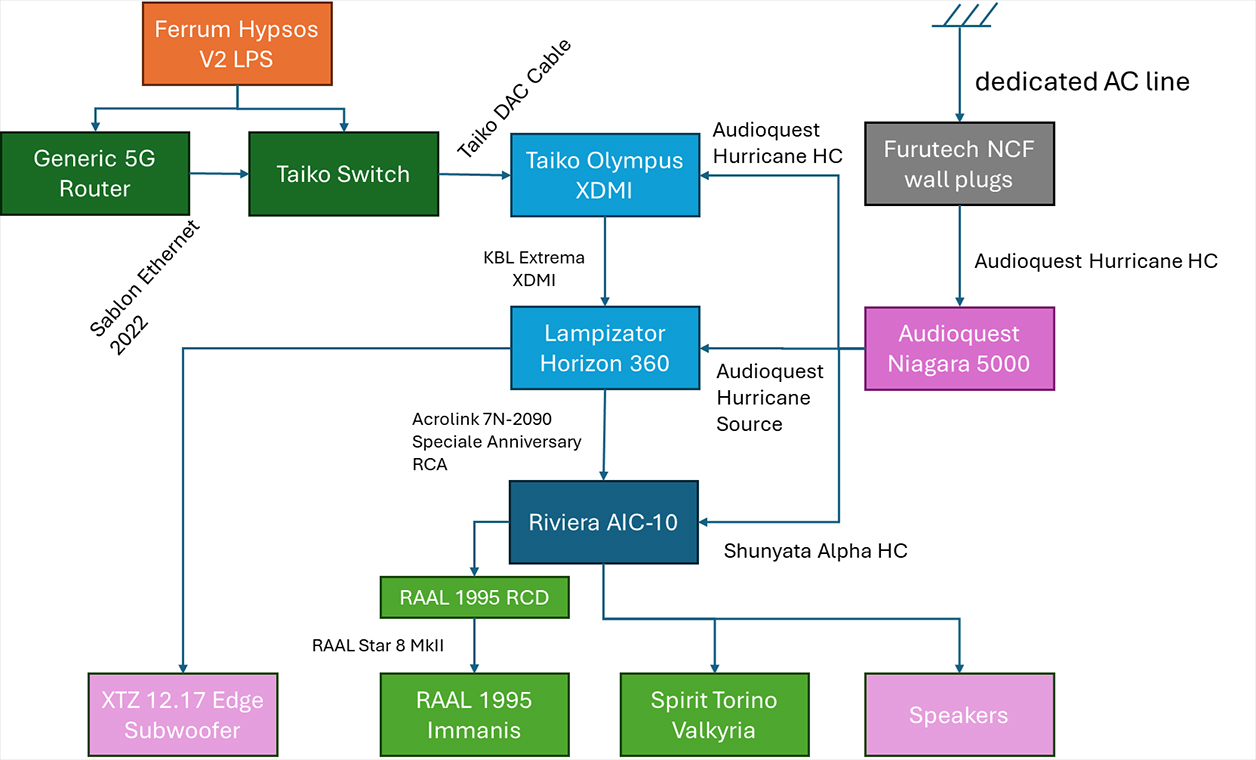
Given this, a larger environment than my 22m² living room is likely required to achieve the best but I found a quite satisfying layout with Aura about 1m into the room, ~2.3m apart and my seating distance at ~2.5m. Diesis recommend a toe-in of 20° max and 15° became my sweet spot between soundstage aperture, depth and image focus. This setup had the horn beam cross well behind my head, thus preventing potential harshness from direct ears-on aim. Side-wall distance usually less critical with a dipole's 'figure 8' cancellation was ~1.5m. As mentioned earlier, the Special Edition includes a custom footer set for additional fine-tuning. I was lucky enough to have at my disposal an upgraded kit usually provided with the Roma model. As the next page will get to, room-filling powers as one of the most engaging Aura traits further enhanced by tweaking the footer layers.