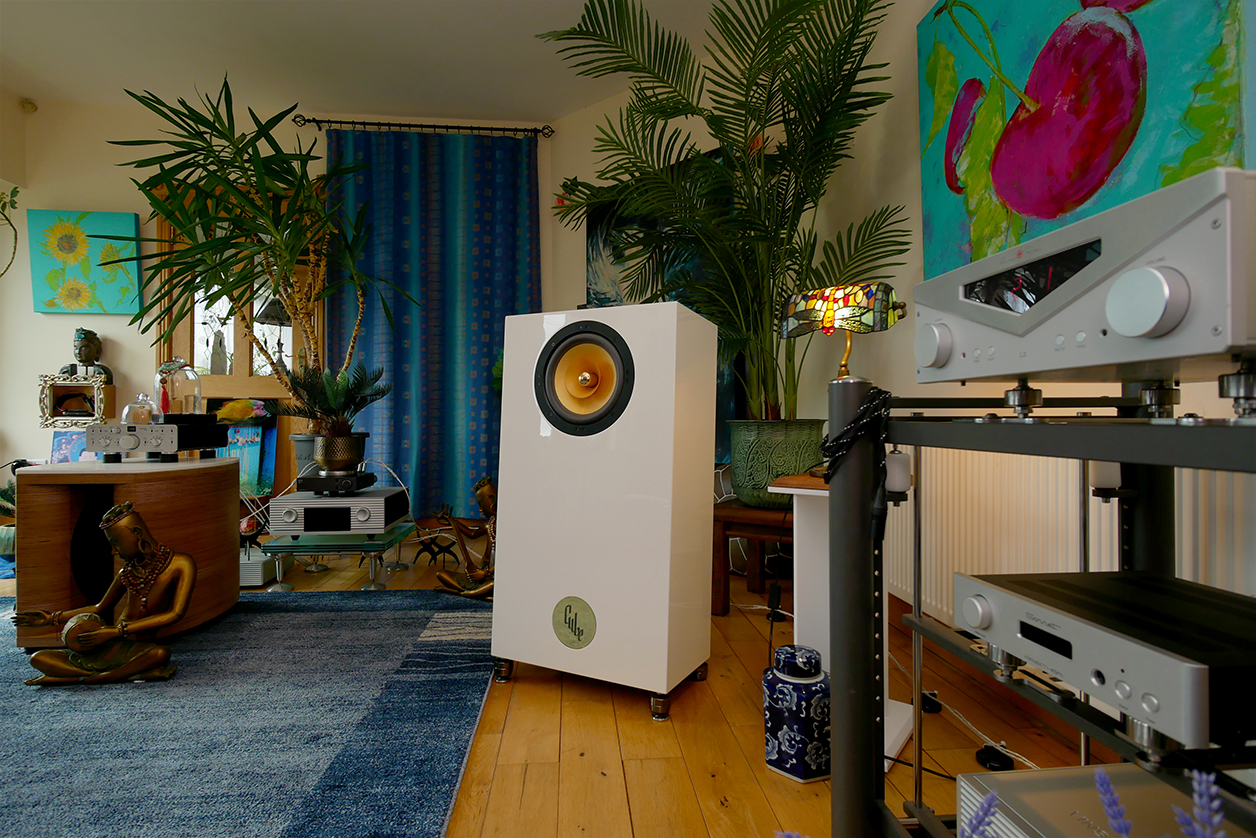
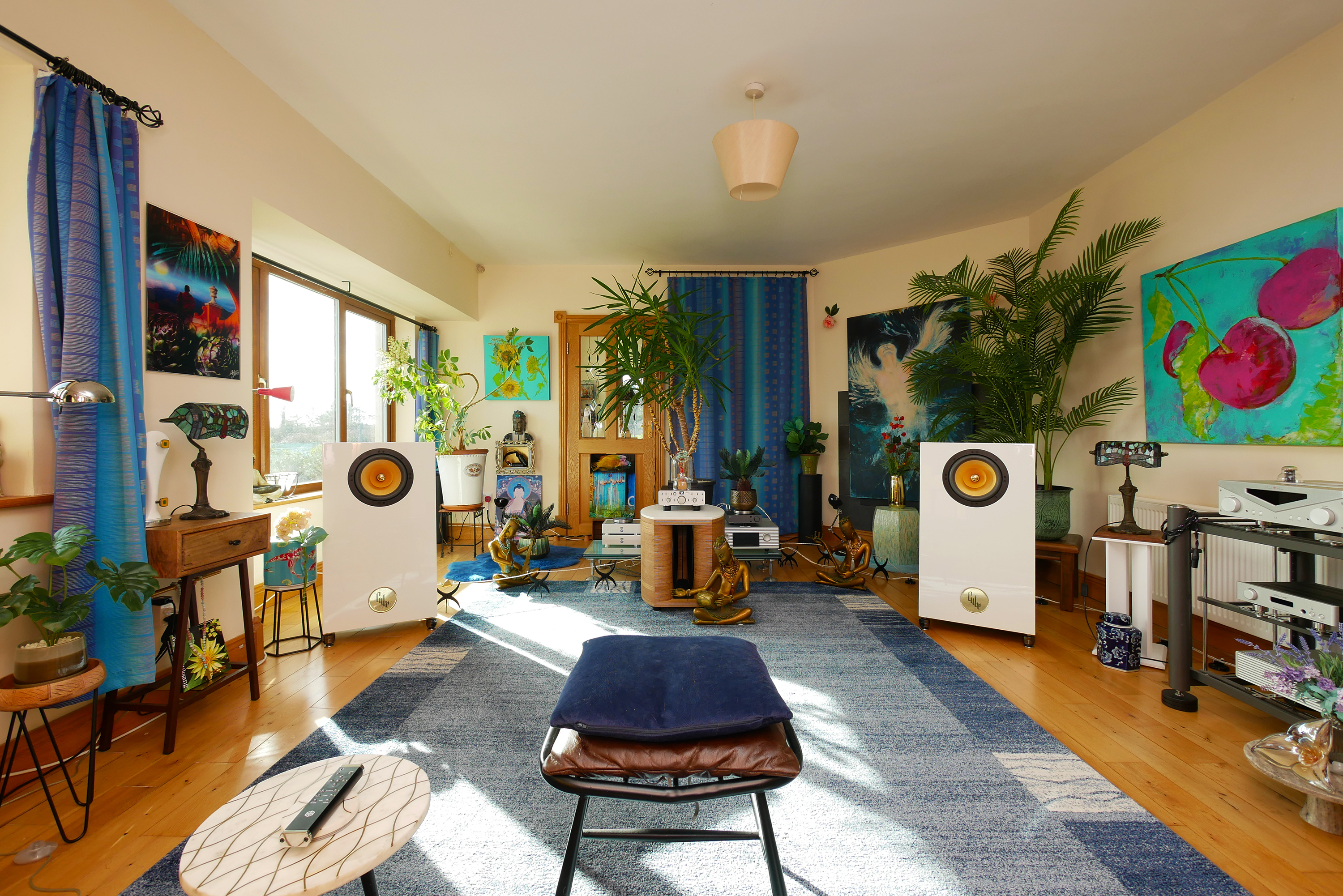
The extreme separation powers of purist widebanders can insert extra white space between images. Here Vinnie Rossi's 300B added very fine connective tissue to tie it all together. With that boutique glass from prior Western Electric production preceding the crossover engaged or bypassed whilst the AMP-23R handled speaker drive, my review setup locked in. Because my chair sits me high, I placed Track Audio spike shoes beneath Monet's frontal footers. That minor rake aimed the whizzers at ear level for best treble and stage height. It didn't take long to determine that a/, music's power region did indeed feel energetic and well nourished, simultaneously; b/, compared to my regular 2.1 tuning (cough!), the midbass gave up output and injected minor ringing. Its TQWT is a resonant affair after all. The bottom octave vanished in Irish fog. Before you cry wolf, this looser texture is precisely how ported bass from dedicated woofers telegraphs too compared to my active offboard alternative. Just so, memories of Nenuphar v2 called Monet's new driver/box unison more controlled. By not aiming as low, it reins in the sibling's more boisterous lingering bloom. In my book that was a less-is-more win. In 2.1 mode, I set the spl xover to 70Hz/4th-order with absolutely fabulous results. My blank canvas was stretched taut, my painting class with the French impressionist master afoot. Blank canvas? My foot. Mine is densely coloured with prior encounters of Bastanis/Zugspitz, Camerton, Cube, Lindemann, MonAcoustics, Rethm, sound|kaos, Virtual, Voxativ and Zu. Applying solid experience with the breed is the whole point of today's exercise when most reviewers pride themselves on having none since to them, the entire 1-way concept reeks of too much compromise to bother with.
 Across my event-horizon timeline on this breed, the best single-driver speakers have normalized over multiple generations. Now they can wholly rewrite early impressions from 20 years ago when those who heard them came to conclusions that may have stuck but by now are outdated. What remain are well-known virtues of other point sources: image specificity and highly developed depth of field with many-layered separation. To that add great responsiveness to small signal variations; and temporal gush and fluidity. What generally has exited stage right are overt ~1-6kHz response squiggles; the infamous Lowther shout; and a lightweight bottom to upshift the centre of gravity with its injection of too much white into the colour palette. Can one still get more bass extension, slam and welly elsewhere? Sure. Can one chase more upstairs air and shimmer? Ditto. Can one get more microdynamic expressiveness, time tracking or inside-out resolution? Far more difficult. If that bundle of qualities be our focus to happily trade slight reductions in other disciplines, Cube Audio since inception have been at the forefront of domesticating the single-driver breed. In parallel to Voxativ, this has rebooted its 21st century relevance. With Monet Cube's latest thinking on the matter, it's a perfect op to get current. That felt particularly relevant when my contrast agent was Qualio's IQ, a 3-way designed by the same team. Playing ping-pong across the audiophile table, IQ took it for airiness, shimmer and upper-harmonic elucidation. Monet took it for lower treble power and in-room bass balance. Here IQ's dedicated woofer with open port gets too bombastic for my space. With its port stuffed as I have it, IQ's LF textures have more grip than Monet's. Across the musical lion's share called midrange, the ping and pong exchanged furiously between two top-ranked players. Yet ultimately Monet dug even deeper into micro detail. On this Salar Aghili track for example, I suddenly saw the diaphragm technique which modulates his uniquely fragile-sounding 'shaky' lower register; where throat action takes over. This insight was new, spontaneous, instant and (duh!) entirely obvious—except it had never been so before. It's how we clock an increase in our system's magnification powers. Noted. Onto textural intelligence.
 Imagine a rich stew with whole pepper corns and other spicy flotsam. Steer it well. It all blends together. Or, let it sit undisturbed. Now all the heavier bobs sink to the bottom, the lightest bits float to the surface. Take a highly peppery track like "Loom" from the miles_gurtu collab. Monet increases our textural intelligence. With zero attentive effort from our end, all the many impeccably placed little clicks, tizzies and flutters separate out so clearly from bassier heavier stuff on the bottom that it seems like watching nocturnal fireworks whose contrast of rapid flashes against darkness is so keen. Being exceptionally quick on the transient uptake of even minuscule deeply embedded percussive noises then rendering them distinct and separate from lingering sustains is a Monet specialty. It sharpens our perception of textural resolution. Call it the difference gradient between ultra-dry staccato/pizzicato sounds, more languourous legato and all intermediary values. Like tone colour, recorded tone touch or texture spans a gamut which must pass the sieve of our transducers' separation powers. How much difference between hard/soft, short/long, bright/hollow etc remains because it won't get mixed up to dilute? On this score, heavier cones preceded by time-confused electrical filters are often less discerning. Though Monet's lone driver is large, it's very quick. Its whizzer too is rather larger than the ubiquitous 1-inch tweeter dome. That gives the 4-8kHz range unexpected dynamic vigour. On enunciation, Monet is most articulate. There's no lazy tongue, thick brogue, dropped vowels, half-swallowed words or all-the-same monotony. There's no modern method acting of actors mumbling under their breath so the audience misses half the dialogue without turning on subtitles. We could just call it higher resolution and be correct. Digging deeper, it's really about less trouble in the time domain. That makes it easier on our ear/brain to resurrect a layered well-sorted three-dimensional soundstage from mere stereo cues. From this observation springs forth the obvious upshot of superlative staging. If you love enormous evenly lit panoramas with no dark spots or soft focus, Monet is your man especially when set up in free space.









 If you come from multiple dipole Mundorf AMT as I do; or a Satori Beryllium dome—Monet's brush work gets less specific in treble's brilliance and air regions. Its whizzer flare compensates below the two top octaves with more weight and impact. And below the lower treble so presence band, Marek's driver offers more insight than an equivalent Zu which retaliates with more general shove and kick-drum violence. As put in a recent Zu review, the darker American tuning doesn't major on string quartets or Schubert lieder. Monet does. Fans of small-scale classical get premium service. Once they graduate to the two Richards of Strauß and Wagner for big orchestral, high-passing Monet pays dividends to unload this responsive transducer from low-down duties. With that in place, I quickly knew that I could just as easily live with Monet as I presently do with IQ. Whilst not identical and one running off 300wpc solid state, the other 25wpc transistors with added direct-coupled 300B, the presentations were close and romanced these same ears. Given my conservatory training and spending formative years in Western classical styles, I didn't grow up around Pop, Rock or heavy metal like my school mates. At heart I'm an ingrained acoustic instrumentalist not amplified type. In today's context that's an important qualifier. Where I do imbibe 'e' is with ambient and organic electronica. Here sub bass is a must, high SPL aren't. For that section of my music library, IQ's lower reach and dedicated woofer go farther. Once switched to 2.1 mode, those differences cancelled completely.
 Another narrower different strata popped up for dynamics. As hybrid dipoles with ported box bass beneath, IQ overtook Monet on the size of macrodynamic swells. On the shallow end of that pond called microdynamics, Monet's bigger possibly even quicker transducer had the advantage. Whilst the players on the musical field looked and acted the same, the mood or feel of their scenery shifted due to the presentational offsets between speakers. But with the 6-inch papyrus-cone Satori midrange of IQ already behaving as a quasi widebander, these speakers clearly were family; quite literally so given the same designer. We're back at Cube's normalization of the single-driver concept. If they did it like a symphony orchestra audition from behind a thin black curtain, haters of the genre would have no tell-tale giveaways to identify Monet's DNA. I've never reviewed classic Tannoy or their later Fyne offshoot to know how close an equivalent 10" 2-way dual-concentric concept from these UK brands would come to Monet's sonic aesthetic. I suspect similar soundstaging chops—already dual-concentric KEF do this very well—but a far thicker sound less illuminated from the inside out. Whilst this remains pure conjecture, it does peel out Monet's demonstrable quickness. This greased responsiveness has parallels with Raal ribbon and HifiMan's top Unveiled headphones. Extremist headfiers playing in their nose-bleed zone would naturally hope for a speaker system to present similarly just bigger and bolder. In Monet they'd recognize a soul mate. How do I know? I own Raal 1995 Immanis and Magna ribbons as well as the OG Susvara. If those transducers are your idea of premium sound which you want to experience outside your puny skull cave, this speaker set up properly and driven by a copasetic amp of suitably high output impedance will get you there. Now Monet is monetas; money in the bank.