 Losing two whizzers. "As you know, I like various speaker technologies. In my opinion there's no single best, only the most versatile. I'm referring to classic speakers equipped with a dome tweeter. Executed at a sufficiently high level, such systems can be impressive. Nonetheless, despite their operational maintenance good tube SET amplifiers still have a lot of charm and potential to play well. I don't like the word but there is a magic magnetism with a proper SET + widebander setup especially on music with acoustic instruments. Now you're waiting for me to explain that I got rid of the whizzers by just not adding them? I approached Monet from my perspective of designing all Cube Audio widebanders and classic speakers at Pylon. My goal was to create another Cube speaker with a new twist so more reminiscent of Nenuphar v1 but with the v2's soundstage. I also aimed for improved rhythm, transparency and smoothness. I started with a new magnetic circuit. I built several variants and looked at their impedance behaviour and power output using the existing F10Neo v2 diaphragm. I selected a circuit that simultaneously compensated the impedance curve and maintained power output. With it the F10Neo v2 driver did sound different than on the original circuit but this wasn't enough to justify calling the speaker new.
 "The next step involved a new diaphragm, lighter and stiffened at its edge and near the voice coil to maintain rigidity. Even without any whizzers this driver already produced a simply pleasant sound which bode well. Several prototypes later, I compared them to the F10Neo and each other. I resolved minor issues with a slight change to the diaphragm geometry. After the diaphragm correction I used one slightly adjusted whizzer and it worked well. The diaphragm mods had appeared in the right/favourable place. I tried another whizzer and again it was different, sometimes even weaker but not better even though I remember how with the F10Neo driver, adding whizzers improved its sound and off-axis response. Ultimately Monet measures better than the F10Neo which remains in the line-up as a raw driver and in Nenuphar v2. Monet represents a different approach to speaker design in a cabinet adapted to this approach." So Monet didn't need extra whizzers because it out-measured Nenuphar v2 with just one? "This whizzer does complete the bandwidth so was necessary. But in this project adding more just wouldn't have made sense." Dropping their extra weight shaved off more moving mass beyond going for a lighter main membrane. Now we have as much of Monet's theoretical measure as seems useful.
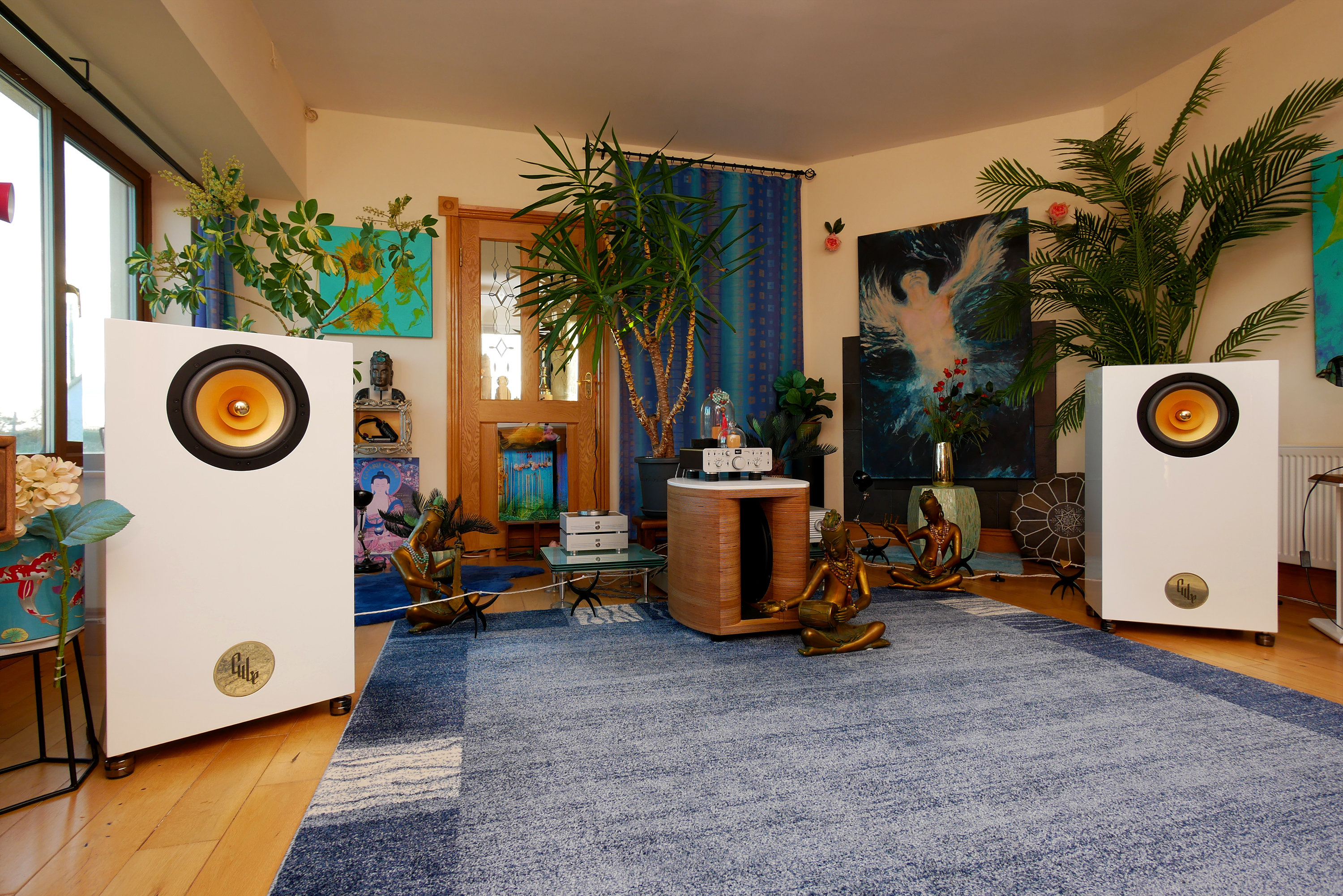
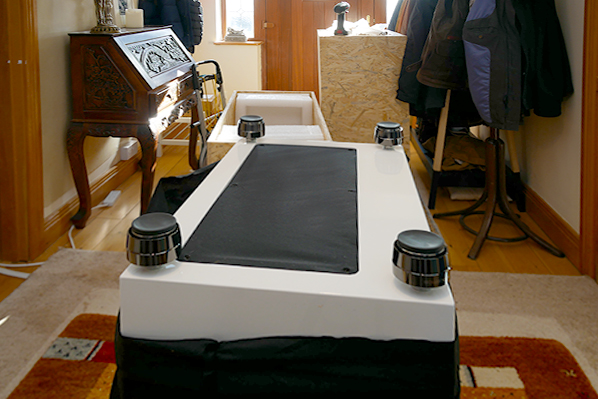 To avoid heavy Photoshop retouching—virtually mandatory with high-gloss black components photographed in situ by an amateur not blocked out in a professionally draped studio—I asked for white. Marek by then had already sent my nude cabs to the paint shop with an order for black. He promised to change his order unless they'd started spraying already. So I didn't know in what state my samples would emerge from their travelling coffins. Pale like hungry vampires waking from hibernation—like yours truly in short?
My tracker announced an inbound 80x120x110cm pallet weighing 160kg. Whatever their skin tone, these contents were clearly well fed. On the appointed day, my friendly Gavins' lorry driver acting as FedEx subcontractor pulled up to drop off two wooden crates. From them quickly emerged two white samples—hurray!—and a separate small box containing the isolation footers plus alternate spikes and floor protectors. These viscoelastic IsoAcoustic footers are directional. Per their instructions, the writing on them should face the listener. As you see, the big opening of the quarter-wave tapered guts covers with thin black grill cloth. This prevents spiders, ants and other critter colonies from setting up shop. What do you call a 100-year-old ant? An antique! No such petrification here.
Protective plates atop the widebanders use two of the driver mount screws to stay put in transit which we then must retighten with a hex key upon removal. Torquing up driver mount screws or bolts post transit is always good protocol. And what more would there be to unpacking a single-driver speaker? The answer is, nada; or rien if you're a Frenchman like Monet. How 'bout setup? If widebanders exhibit the breed's typical presence-region rise, facing them straight out to put our ears a bit off-axis is the standard recommendation. If their response is more linear, toe-in becomes an option to experiment between focus and soundstage width.










To warm up voice coils frosty from wintery transit, I—widebander sacrilege unless you're a Zu—first leashed Monet to my usual 300wpc Kinki Dazzle solid stater. It might just work better than expected. That required actual trying and certainly be serviceable for letting Monet settle in. My 25wpc Enleum rarely allowed on speakers these days stood by impatiently. Vinnie Rossi's 300B preamp played hopeful second fiddle. But first, a quick glance at the adjacent instrumental section, the cellos. Whilst a 10" cone looks most promising for their register, in widebander actuality the upper-bass power region of music rarely comes off as pert and snappy as with a heavier large-excursion conventional cone of that size. With rear-horn or quarter-wave loading, reach into the contra-bass range isn't the issue. It's the snap, crackle and shove above it. It's why Voxativ's 9.88 triple stack inserts a genre-defying dynamic upper-bass coupler between its widebander and active RiPol bass system. Monet remains the eternal bachelor; stubbornly single. Yet as we learnt from Marek, he too recognizes the relative power-region weakness of his driver type. Monet addresses it not with an extra cone but a new diaphragm, motor and broader baffle. Without Nenuphar v2 for direct comparison, I'd have to rely on gut instinct when judging advances on said score. That word choice was deliberate. It's our gut which registers and responds to kick-drum crack and e-bass pop. So—was Monet a guttural customer in skin inks and wicked facial hair; a Polish Zu so Pu? Not with Dazzle's low output Ω. It very obviously overdamped the driver to eliminate an octave's worth of reach and register a bit buttoned-up. Pooh. The AMP-23R's patience wouldn't be tested after all. In it went. Immediately the low end emerged from barely hinted at into the full light of day. The ±100Hz range came to life. A high-ish 0.8Ω Z-out completely changed the name of my gutsy game. Dazzle was in a frazzle, Enleum the required auxilium, Monet in hay. Done! To assess low-bass reach and control, I had my usual sound|kaos 2×15" RiPol sub sleeved in with the spl audio Crossover Mk². Turning off the sub's external twin Ncore-500 mono amps and setting the analogue filter to 'full-range' would contrast Monet's solo performance against being high-passed and bass augmented.
On that score, no passive speaker of a size and weight I can still handle will tie my sub integration's shoe laces for control and speed. The RiPol radiation pattern most recently exploited in Børresen's new M8 Gold flagship speaker not only goes beyond classic dipole's figure 8. It builds in extreme self damping from two large woofers firing at each in close proximity and phase. That geometry causes a significant lowering of the woofers' resonant frequency. This 0.1-channel superiority exerts itself also on my usual Qualio IQ's 9½" ported dedicated Satori woofer. In short, nobody should/would expect Monet to be an exception. In this system such a comparison is simply de rigueur because it constitutes the yardstick.