Tu.be or not? Without a classic SET on hand, I'd be hesitant to tango with Monet at his very best were it not for a tube hybrid option in my arsenal: Vinnie Rossi's original L2 Signature linestage with direct-coupled Western Electric 300B into Enleum's AMP-23R with suitably high 0.8Ω output impedance. From my hardware, this had the biggest promise written over it. Prior waltzes with Nenuphar v2 and Lotus 10 knew that this low-power transistor amp with Exicon lateral Mosfets is a good silicon compromise. Preceding it with direct-heated triodes with no traditional coupling caps or output transformers would elevate this context to the next level. So I felt comfortable accepting this assignment particularly when my Warsaw contributor Dawid had recently combined a Thöress valve pre with the same Enleum for his review of the high-sensitivity Voxativ Alberich².

Cube recommend their Monet for rooms from 15-50m². At ~6x8m, mine falls right inside their recommended window. And I had another trick up my sleeve: actively high-passing Monet to let a folded open-baffle aka RiPol 2 x 15-inch sub handle the bassment. Voxativ are currently following up this idea as proposed in my own Alberich² review. Especially with complex dynamically broad material like classical symphonies, unloading a widebander of LF demands can have clear audible benefits. That it also bolts on extra bass reach and control is nearly secondary. That it also complicates a system by adding stuff and likely pummels purist preferences to a pugilist pulp goes without saying. So I won't focus on it, just reserve it for alternate sessions. My white canvas was stretched. Time to let Monet add colours. About that Oscar-Claude said, "I would like to paint the way a bird sings". He was obsessed with capturing the most fleeting of moments like constantly changing light alters the mood of the same scenery. That makes a suitable stand-in for Monet the loudspeaker promising uncommon insight into the smallest of midrange fluctuations recreated by a low-mass point source without energy-storing filter parts. Because of it, listeners tuned deeply into time-domain performance fancy the immediacy and denuded reflexes of this speaker type whilst making rational allowances for some bandwidth limitations and minor amplitude deviations. Priorities. We all have them. The more defined and articulated ours get, the more strategically can we service them. SET fanciers who love to roll 45, 2A3, 300B, 211 or 845 bottles could find Monet a good testbed because anything a lot more efficient tends to magnify the self noise of many no-feedback DHT circuits.
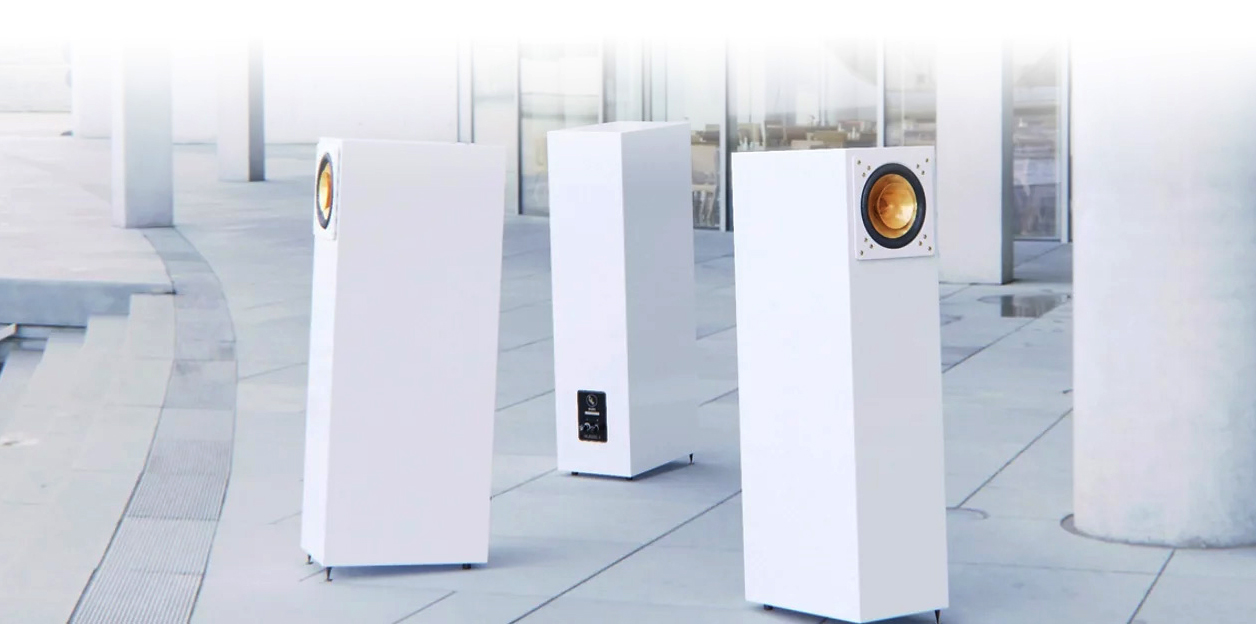 Cosmetic detailing from the pre-Monet era at Cube: narrower but deeper and with different driver integration. These cabs are open to the floor.






By January 8th so four months after Monet news first broke, Marek announced a ready sample pair. Time to learn what aside from higher efficiency has changed. If you have no Polish, turn on the English subtitles in YouTube's Settings. If you don't want to watch, Marek mentions a very different magnetic architecture with changed pole piece and Faraday ring whilst the membrane has lost Nenuphar's extra two whizzers to get lighter. Compared to Nenuphar v2, the sonic benefits are superior microdynamics and from the broader baffle, a much wider sweet spot and superior support of the lower midrange. We're reminded of the baffle step as a speaker's width which determines what wavelengths reflect off it for instant acoustic gain; and which wrap around it to be lost to the room as delayed reflections. Broadening Monet lowered this transition and strengthened the male voice and all instruments sharing its bandwidth. Hoping for extra details, I asked Marek what else he could share.
Meanwhile an early buyer coming from Nenuphar Mini v2 posted this on What's Best Forum: "…They are evidently more sensitive than Nenuphar and although I do seem to run the amp a click or two lower, their sensitivity is profoundly manifest in their freedom from dynamic constraints and not just volume alone. They are 'physical' speakers, both physically imposing but most importantly, also musically. Music played through these exhibits a physicality that just gets to you instantly. There's clear differentiation between release and attack of notes and as they swirl to get to the next one or sustain until they fade. I've never heard those in-between spaces so filled with information in my entire life! In comparison to Nenuphar the bass and lower midrange are more impactful but this added heft is not at the expense of overall vibrancy or treble presence. If I had to describe the Monet with one word, it'd have to be sonorous. These are—thank God for that—not laid-back speakers to listen to background music with. They are engaging and immersive, jump at you and demand your attention… Speaking of Nenuphar, I don't think they are rendered irrelevant since all their traits carry over. It's just that with Monet these traits are enriched in the most meaningful and natural way and taken towards a direction that prioritizes quality over quantity." No longer having Nenuphar v2 myself, this made for useful independent intel.
"This next-gen driver has similar magnetic field strength in the gap as Nenuphar's F10Neo but now incorporates a Faraday ring. The magnetic flux almost saturates the pole piece but there's still room to reduce nonlinear distortion which is clearly audible in transient response. The diaphragm is lighter and has fewer cut-outs—just one compared to the five in the F10Neo— but I took great care to maintain its stiffness. The paper used for the diaphragm and reinforcement is lighter, too. Thanks to less moving mass with similar magnetic power, I could wind the voice coil with smaller cross-sectional wire, further improving micro detail. The enclosure remains quarter-wave. The driver itself simply positions different and the wider front baffle increases sound pressure in the lower midrange. Monet features internal damping on the baffles and in critical areas. We offer the full RAL colour palette in satin or gloss plus virtually any premium automotive paint upon request. The wiring remains unchanged. Litz works perfectly and the terminals are WBT 0703 Cu as in all Cube/Qualio models. The speakers are equipped with Iso Acoustics Gaia II feet."