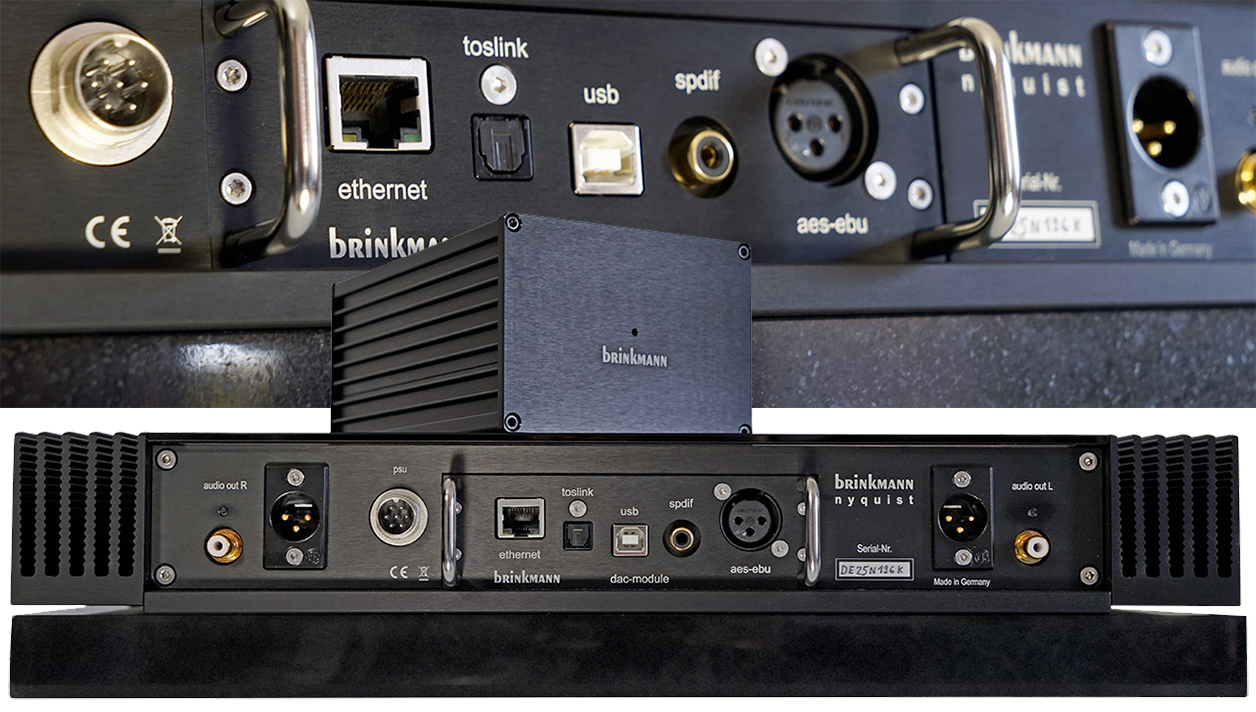
 This has happened to me more often of late. I browse through my playlists and familiar tracks during a test session. I note improvements or changes of sonic direction here and there. Little by little a picture emerges of what the component can do, its personality. Then I stumble across a song that throws my seasoned test routine off balance because now seemingly small gains don't add up marginally but to a whole new level of performance. Since I first heard Scout Niblett's "Gun" through the Brinkmann, my esteemed Rockna Wavelight certainly seemed a bit mundane and even costing less than a third didn't really console me. More on that later. First things first. The Brinkmann didn't change my usual tonality. Though the smaller Rockna adds a bit more bass and its much larger €26.5K Wavedream Reference Signature sibling even more, the Brinkmann's equivalent bandwidth was ruler flat. While neutrality isn't exactly unusual for a DAC, some high-end converters like to indulge in a bit more low-end punch. I'm thinking not just of the two Rocknas but the ~€15K Aqua Formula xHD Rev. 2 and especially the €9.9K Ideon Audio Eos which all exhibit a slightly more pronounced bass response. The Brinkmann does not. Does that equal a killjoy? Au contraire. Firstly, neutral doesn't mean lean. The Nyquist One can really pack a punch when needed. Secondly, it possesses such superb bass quality as to guarantee broad grins in the audience. Inspired by my colleague Salmutter, I played Halestorm's "Everest". The opening attack with electric guitar and powerful drums made clear that the Brinkmann's bass dynamics leave many others—even those of the Rockna Wavelight—far behind. While it may come across with slightly less global punch, it was still harder and more sudden and the low guitar riffs now sounded considerably more structured and informative.
 The same held true for Just Mustard's "Pollyanna". The deep nasty feedback was clearly less muddy and compressed as though Brinkmann's LF vocabulary knew more words and could therefore differentiate across a broader bandwidth. Quality over quantity was the motto. This paid off even more with acoustic instruments like double bass and cello. Textures, oscillations and resonances didn't get lost in cozy warm bass hummus but rendered naturally which made the illusion of being closer to the music more effortless. Unfair comparison? Absolutely. That the Rockna Wavelight couldn't really compete was expected given the price difference. In fact, achieving so much for a third the ask was high praise for the little Romanian. However, I wouldn't know what the Wavedream Reference Signature at a third more offers in terms of more bass quality. Although Rockna's flagship is a bit more powerful, the Brinkmann is textbook. That's a matter of taste. Nothing gets emphasized, nothing overlooked. This same neutrality also prevails in the midrange and treble. The Nyquist One therefore is not about supposedly cleverly manipulated tonal ratios where it doesn't interfere but about qualitative gains in resolution, spatial representation and impulse response.












 Of course these aspects aren't always easily separated especially with so broad a term as resolution. It's difficult and naturally contingent on the musical programme and what as a result we pay more attention to and focus on. For example, the glockenspiel in Björk's "Frosti" felt somewhat clearer and more precise to me when the Brinkmann converted the signal. However, the more significant difference seemed to lie in the trails: the sustain/decay simply pursued for longer as if the very quietest signal components disappeared into the noise floor later. Or put another way, the background appeared darker which allowed small very subtle signals to stand out more clearly than with D/A converters less sophisticated and resolved. With piano music these sonic gains arose more evenly on both sides of the fence. Transients were more precise and in a positive sense harder which I took for superior microdynamics and impulse response. Meanwhile the decay of strings tracked more accurately whereby quiet beats and resonances articulated more clearly.
My first impression of the Brinkmann Nyquist One thus was that it essentially paints the familiar picture with a set of finer brushes. I was already used to good-quality brushes albeit of slightly broader stroke which, in hindsight, lost some detail along the way. The coarser the brush, the more our focus of attention shifts to the colour composition as a whole. With finer brushstrokes, we add the chance to more easily discern textures, details and subtleties. That's why I like components of high resolution. They let me perceive sound and music with greater nuance. After all, tonality is just one dimension. In any case, differentiated was the applicable word when I thought of the spatial representation. The Brinkmann sounded more expansive than I'm used to not in width but depth which now felt twice as rolled out. Furthermore, its rendering of voices and instruments was a/ more compact, b/ sharper at the edges and c/ of greater presence whereby individual sounds had a more 3D quality. The costlier Rockna Wavedream Reference Signature only slightly surpasses this. More notable in that juxtaposition is a soundstage somewhat closer to the listener which turns the front-to-back extension even more expansive. As with its tonality, the Brinkmann adhered to the pure doctrine, meaning it didn't inherently project forward but cast different aspects depending on the recording: spacious or chamber music-like, front row or laid back—the production decided, not the Brinkmann.