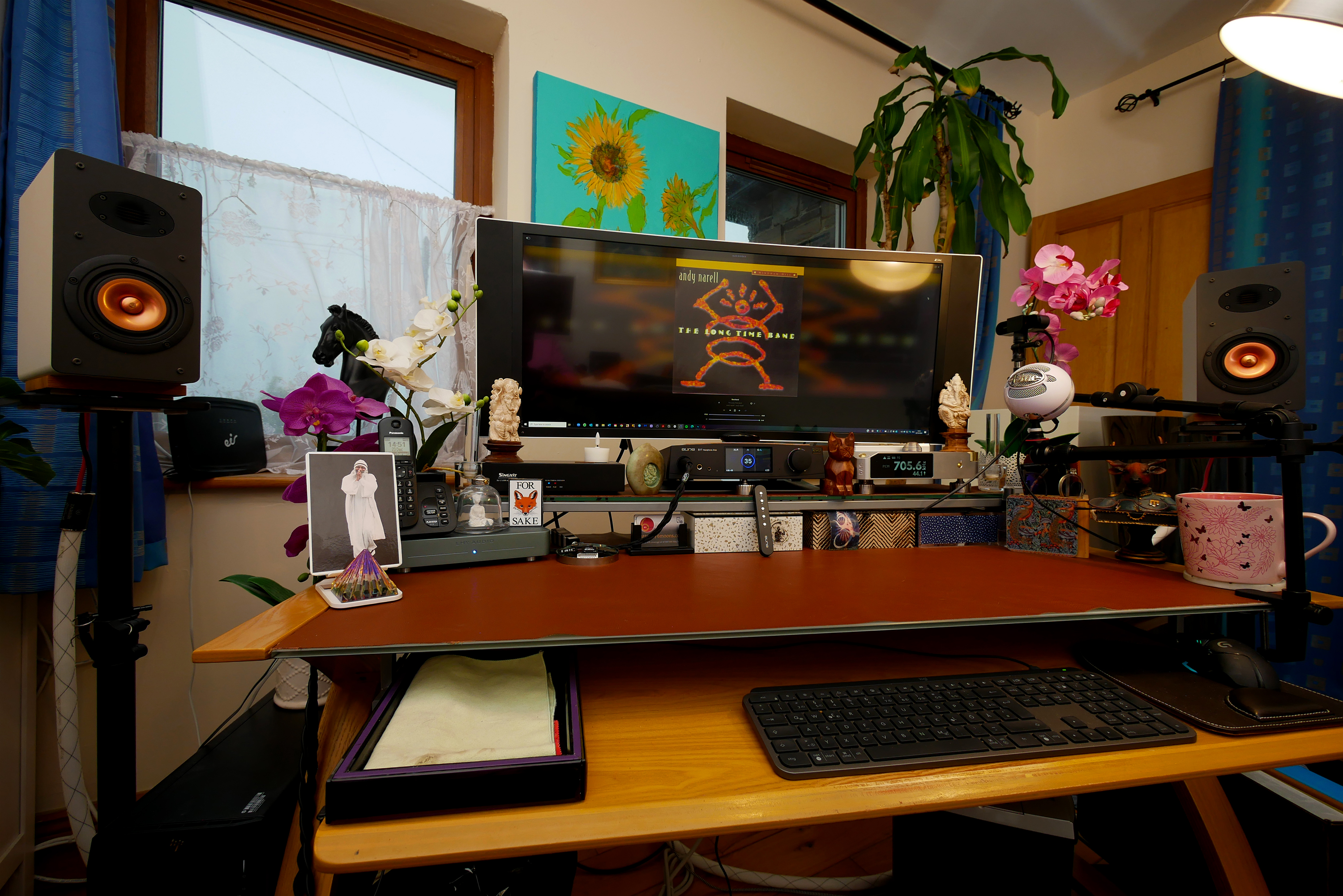
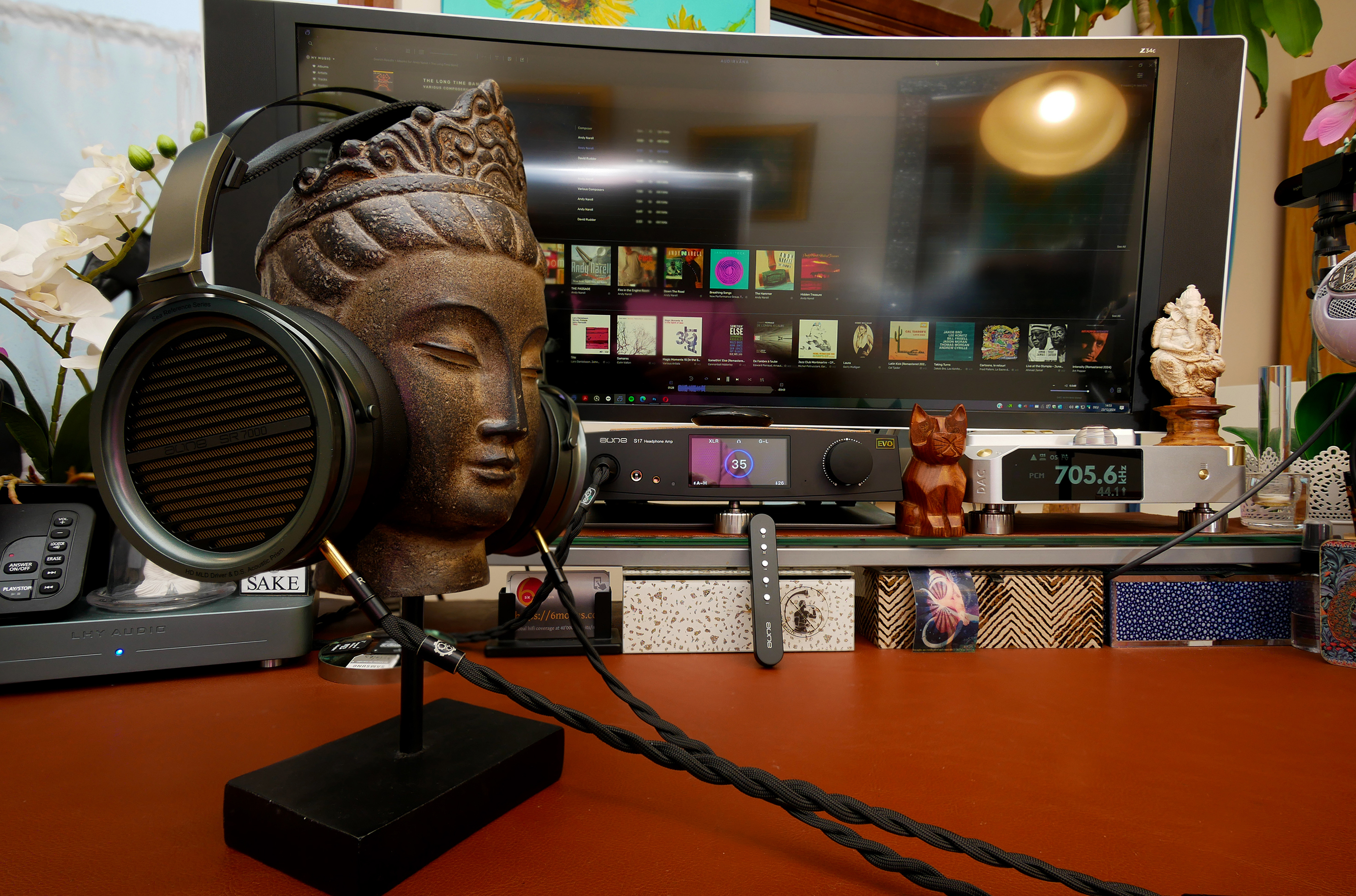
The landing place. The incoming aune bumped my resident Enleum AMP-23R off its central perch beneath my computer screen. The full signal path here is an HP Z2 Win10/64 work station with Audirvana Studio; an iFi USB 3.0 cable plus iFi inline noise filter; a Singxer SU-2 bridge reclocked by a LHY Audio masterclock; and a Laiv Harmony DAC in I²S source-clock mode. Audirvana operates in extreme hog and 176.4/192kHz upsampling modes whilst cloud files enter via my Qobuz Sublime subscription embedded in Audirvana; or off a separate SSD inside my workstation. My desktop's ear candy are Final's D8000 planars and aune's dynamic sealed SR7000. To test raw drive I'd also jack in HifiMan's Susvara and Raal's Immanis. Those expect ~3wpc/32Ω to light up. For amp comparators from the Middle Kingdom I had Kinki's THR-1 and Soundaware's P1x. All are petite enough to take the AMP-23's place with an XLR not just RCA feed from the DAC. As to class A head-amp competitors, Burson's might be the best known? Those do include slow-running fans unlike the passively cooled aune. With class A speaker amps, Pass Labs come to mind as one of the top brands. Lastly, aune's marketing promises tube-like sound. Like musicality, 'tube-like' can be far too vague even potentially misdirecting to manage expectations correctly. So we listen for ourselves. Now we're ready to check on Evo's sonic pulse, operational temps and whether its switchable bias equals noticeable tuning shifts or is too subtle to matter much.
Perhaps because Desktop Central had just hosted Lindemann's Woodnote Combo—a 25wpc nCore-based very lightweight class D streaming integrated—wider deeper Evo struck me as unexpectedly heavy. The lbs-for-£ crowd certainly won't feel shorted. Those expecting a club of a wand could when the actual remote fits along my extended pointy finger without making it to my thumb. It's a blessedly compact albeit full metal affair. It controls ± volume, H/L gain, H/L bias and input selection. Can't figure out how to do it with the multi-function rotary? Don't be a man. Read the quick-start guide. Learn about the single and double press, the long hold. With display off, a tiny red LED between screen and rotary confirms status. And that's it. Why should an all-analogue head/preamp be any more complicated? With class A bias always fully on, we of course expect no standby. aune's power mains meanwhile is on the rear where some installs could fumble to reach.
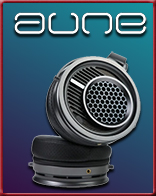





aune's reed-green SR7000 closed-back dynamic headphone sat at 35/63 in low 8.9dB gain for my customary SPL. From cold, the display showed 18°C. After a few very lengthy cuts of Andy Narell's swingé steel drums putting de boom-boom in me riddim, I had warmed to 49°C. Hitting 50° took a solid 9-minute track. Was I nearing the ceiling of my ambient temps and power draw? Another long track booked another degree, then flickered between 51° and 52° before settling on the higher value. The ramp-up had slowed to a crawl like a mountaineer battling for inches in the oxygen-starved proximity of a tall peak. Another 20 minutes and I levelled out at 56°C. To see whether I could peak higher still, I jacked in Raal's Immanis, a triple-ribbon flagship earspeaker. This wanted high 13.6dB gain and 43 on the dial to make Evo work harder. Another five tracks of Sal Mamudoski's gipsy clarinet added one lone degree. Apparently moderate Ireland in December made for a sub 60°C scenario. I could run higher class A bias without time limits regardless of load. But does high bias net anything worthwhile?
This whole concept warrants comment. Should a class A Pass amp overheat to shut itself down, we'd call its heatsinks insufficient. Period. Should Evo switch itself down to low bias, we call it what? If high bias equals aune's ideal target sonics, not maintaining them equals buyer disappointment. A feature becomes an anti feature though if low bias doesn't sound as good, it's no feature to begin with. Add the display thermometer. Class A's crass curse of extreme thermal inefficiency turns a strict anti feature into a feature. The heat that would be king? So I find aune's notion on features and benefits confused. My inner salesman would call fixed bias that works unconditionally so 24/7 far more reasonable. One sound for all. I'd also dispense with the temp display. It focuses on the wrong thing. But that's me. aune's views for the S17Pro Evo clearly diverge. How about my ears? Be it Susvara or Immanis, SR7000 or AR5000, high bias was so subtle as to be a virtual no-show on par with most but not all on-chip ESS digital filters. However higher bias affects the output transistors' load line and thus their THD behaviour seems to operate on a very marginal threshold. Perhaps that's because this isn't a single-ended but balanced circuit with its own distortion cancellation plus paralleled pairs not single parts. Unless we are hyper sensitive to certain performance facets—I'm thinking of listeners with synesthesia for example—or use loads whose resolution tracks such fine THD shifts, high bias is mostly immaterial. But that's wholly immaterial when Evo sounds terrific in low bias. That's the real takeaway, not whether a letter in the display's lower left-hand corner changes from H to L or back. When I paid really close attention to a well-recorded piano's upper right hand and applied Susvara/Immanis-league treble tracking, my ears told me that high bias shaves off some upper-harmonic brilliance; that perhaps front-to-back layering grows a bit more specific. If your ears are pointier or more golden, perhaps you'd hear more? Once listening relaxes to follow a tune in casual involvement mode, I'm back to thinking of Evo's switchable bias as a no-show. Now we can talk general sonics.