First a mini primer on class A. A single-ended circuit operates in class A by default. One solitary tube or transistor per channel handles the full signal. Paralleled single-ended adds output devices which still amplify both ± phase halves. These devices are always on hence conduct fully at idle. More of them simply add power. It's why even without playing music, a class A amp runs hot as soon as its heatsink surfaces saturate. In push/pull class A, each output rail only amplifies half the waveform but the opposite rail still doesn't turn off as it does in class B which thus dissipates less heat. Class AB operates in class A at low power levels—in the recently reviewed Singxer SA-90 monos, just for half a watt—before transitioning to class B. The theoretical advantage of class A single-ended is not needing a phase-splitter stage or perfectly matched twin rails to reconstitute the music signal from its +/- halves. The theoretical advantage for all pure class A circuits is avoiding the zero-crossing dead time between one rail switching on, the other off. Incidentally, lower dead-time distortion is the main allure of 800kHz-switching class D GaNfets over their slower silicon-based elders. Because they operate at far lower power, most quality preamps embrace class A for its claimed superior low-level resolution. So might input/driver stages in class AB power amplifiers. Versus class AB, class A tends to sound sweeter, lusher, warmer and more in a flow than attack state. It's why despite its affront at green energy usage, class A soldiers on. Should future legislature cap the power draw of entertainment appliances—remember filament versus more efficient cooler-running LED light bulbs?—preamps and headphones amps would fit themselves to new restrictions a lot easier than class A speaker amps. For now, efficiency dinosaurs still roam, no-compromise audiophiles still milk them. Common sense predicts that their days must be as numbered as petrol vehicles transition to at least hybrid if not full DC power. After all, even diehard naysayers have finally begun to acknowledge global warming.
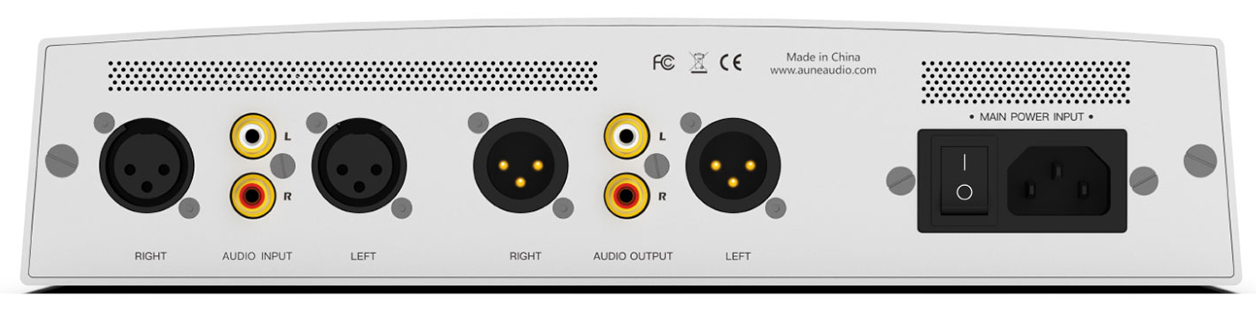
Christened S17Pro Evo, the new version clearly acknowledges just evolutionary refinements rather than a wholesale redesign. Just so, the number of total parts increased from 635 to 657 and now the headfi and preamp outputs can switch independently whilst the micro processor remembers our attenuation factor for each path so their volumes can be quite different. Display off is now merely optional so no longer auto enforced. The fully balanced volume control is a Muses R2R chip from JRC. Priced at €799, the Evo continues aune's sub €1'000 positioning.






As to the occasional overheating issue in high-bias mode, "the Evo has significantly improved its thermal performance over the previous model. Under normal circumstances so when not used in extremely hot climates in high-bias mode over prolonged periods, the temperature remains at a reasonable level. We also equipped this version with a brand-new wide-voltage power supply for a more silent background during listening. This can handle both 150/230V without adjustment. The earlier version was region specific." In short, aune have implemented both measurable performance improvements and tweaked functionality to better exploit the deck's dual purpose of headphone and speaker listening. It suggests lovely responsiveness to owner feedback for the previous version. I don't know about you but I find firms which take buyer comments decisively to heart most sympathetic. Here's actual feedback from a buyer: "I bought an S17 Pro which replaced a Cayin HA3A. It's well known that the S17 Pro got hot quickly to come out of 100mA mode. That and its fixed display were my only nits. Now I've bought two Evo and arrived in headfi heaven. The machine doesn't get remotely as hot as the predecessor. Since I tend not to listen for longer than two hours, I can't say how long it might take before the Evo reverts back to low bias. Compared to the original I find the overall sound still better but that's nuances. For me the Evo is the best headphone amp I've had in five years in the headfi hobby and some of the others cost up to €3'000. For me this is the absolute end-game solution for my Empyrean II, Liric 2 and 1000 Stealth."
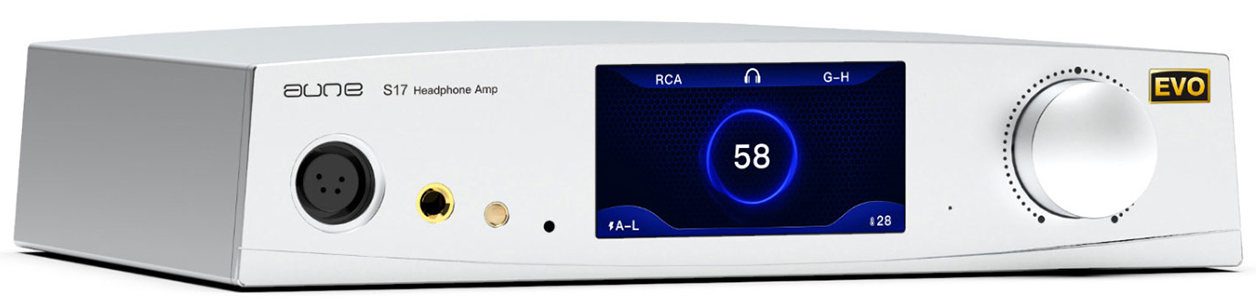 Display: RCA input, headphone mode, high gain, low class A bias, 28C°, volume of 58.
"Regarding the gradual temperature increase during use, many external factors influence actual test results like differences in ambient temperature, whether the device is placed in a spacious or confined area, if another heat-generating device is stacked on top etc. In our testing, we aimed to replicate typical user scenarios. At an ambient temperature of approximately 17°C with a decoder device placed on top of the Evo operating in low-gain and low-current modes, the temperature stabilized at roughly 49°C after running continuously for five hours. Under high-gain and high-current output modes, the temperature stabilized between 61-66°C after the same duration. Of course user environments may differ from our testing conditions so these figures are for reference only. It has been approximately one year since the release of the S17 Pro. This timeline isn't particularly long for a model iteration. In fact, we consider the Evo not so much a replacement model but optimized version. For this reason we have not changed the model designation or altered its appearance. We mainly focused on optimizing heat dissipation while maintaining the same output current levels. Additionally we made adjustments to improve compatibility with headphones of different impedance levels." Another buyer reports that "after two hours in A-H mode playing constant music, mine tops out at 57°C. The weather here is cool so I'm not sure how that translates to hotter climates." Yet another ran his for 4 hours on HifiMan's HE6se with 27°C room temps. After a constant four hours of play, his Evo showed 64°C which aune "consider an ideal value because pure Class A generates significant heat which sometimes isn't much lower than tube amplifiers but normal behaviour."
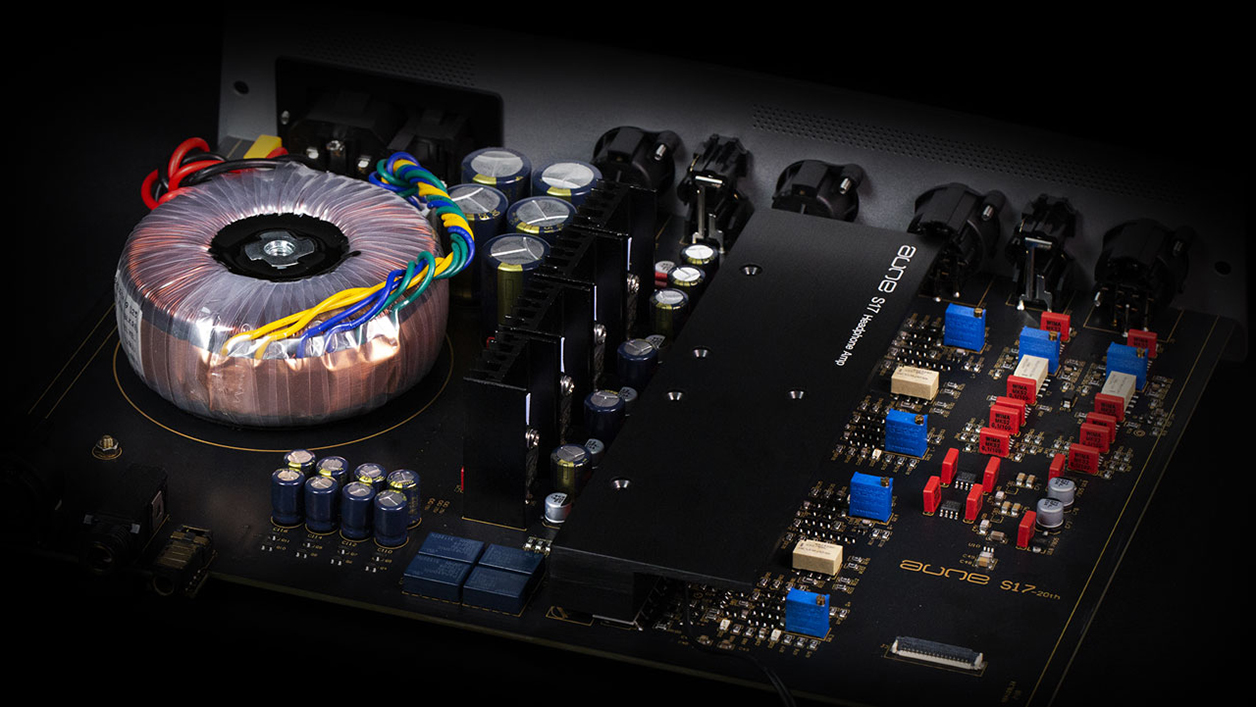 50-watt power toroid, 19'200µF capacitance, 4" display. Voltage regulators on chimney-style heatsinks, output transistors beneath winged dissipation block.
"Regarding the 100mA/200mA spec for the Evo, this doesn't refer to the values shown when switching current modes. The manually adjustable current output remains largely the same as in the previous generation. However, the Evo display now uses 'L' and 'H' instead of specific numerical values. During the initial design phase, we in fact defined high-current mode as overload mode much like an aircraft engine running in overdrive. It cannot operate indefinitely in this mode. While it is possible to extend the duration of this mode through circuit adjustments, this would require lowering the input current which we didn't intend. Instead we aimed to strike a balance between runtime and sound quality."