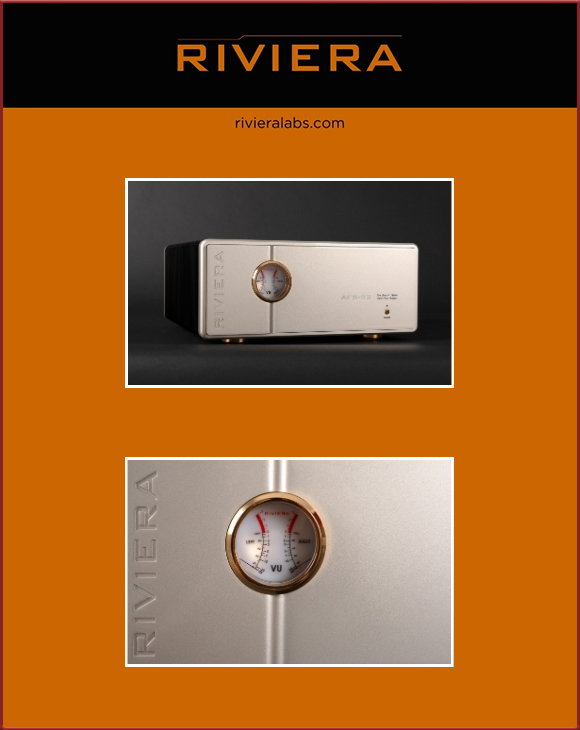
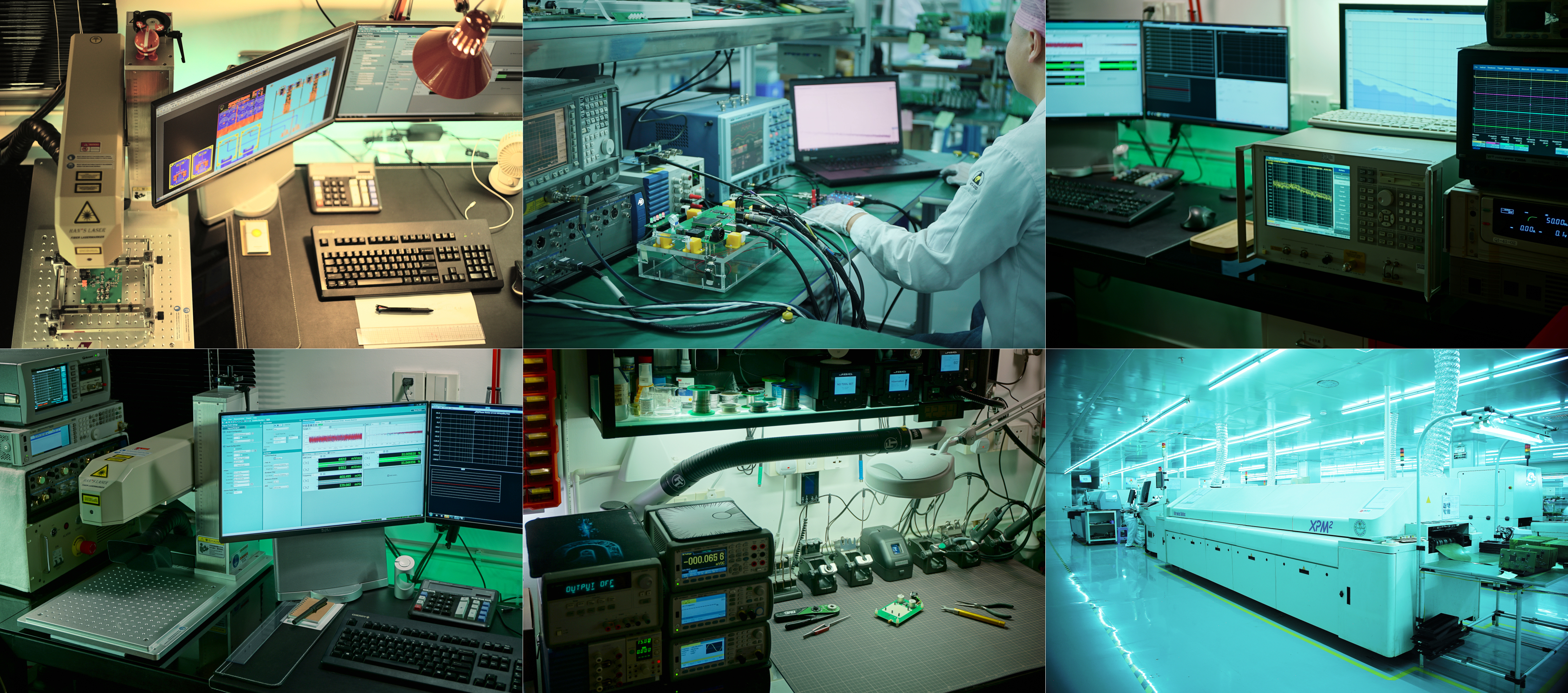
Teamwork over individuals. Since I couldn't find any on the interwebs, I asked my contact for some photos of facility and workforce. "We've always kept a relatively low profile to focus on our products rather than put particular individuals in the spotlight. We prefer to let our products speak for themselves and present aune as a unified brand. That said, we understand your intention to present aune in a better light and generate more interest in our brand. So we do have some photos for you. But they don't show headphones. Maybe in the future we will have more relevant photos. I'd also like to share the AR5000 video with you which includes the history of aune."
With the same email I received the following comments aimed at those who perhaps read too much into headfi measurements. "This applies to our aune AR/SR series headphones featuring angled drivers and offset earcup openings. These structural features can affect the acoustic coupling between headphones and the outer ear of the measurement fixture. Hence measurement positioning may influence results above 2kHz where our tests showed greater sensitivity to positioning for the SR7000 and AR9000's rigid diaphragms. To obtain measurements that better reflect actual wear conditions and perceived sound, we recommend the following. Align the earcup opening designed to accommodate the pinna with the pinna of the measurement fixture, positioning the pinna as close to the centre of the opening as possible. This more closely resembles the natural wear position on a listener. With this positioning, the headphones may sit slightly farther back relative to the centre reference mark on the dummy head. Avoid positioning the headphones mechanically according to the centre reference marks on the dummy head. With offset earcup openings, this approach may cause the openings to misalign with the pinna's centre, resulting in excessive pressure from the earcup structure on the pinna. This can create acoustic coupling conditions that differ from those encountered during actual use. Under such circumstances, the resulting frequency response may differ substantially from measurements obtained under actual wearing conditions and from the perceived sound. The following figures show frequency response curves measured at different wear positions. They demonstrate that even small adjustments in positioning can produce substantial changes in the high-frequency response."
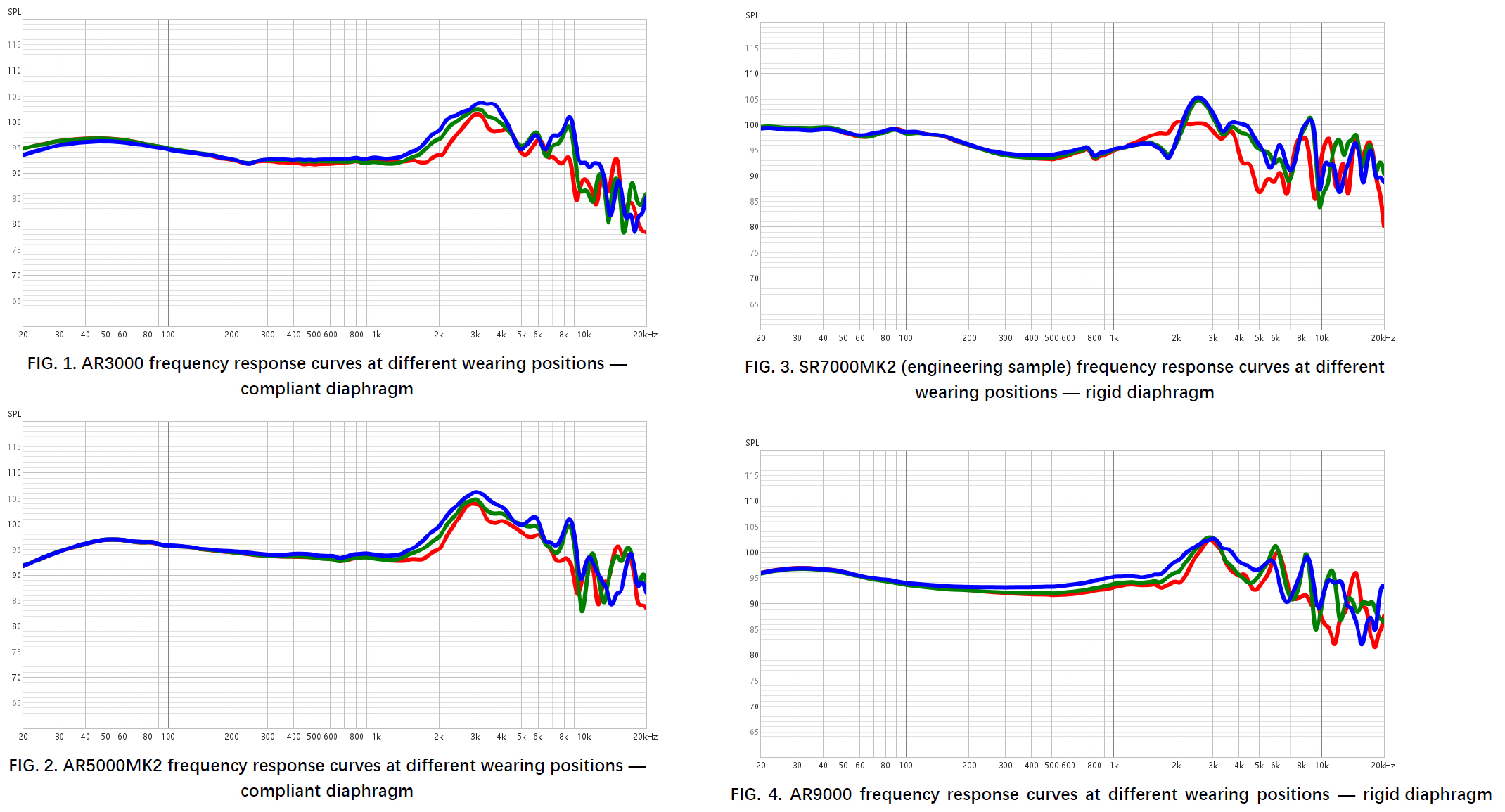
"Under certain measurement conditions using an artificial ear, these models may exhibit relatively pronounced narrow-band peaks and dips between 2kHz and 20kHz. The AR9000 which uses a rigid diaphragm is used here as an example for its dips near 4.5kHz, peak near 6kHz, dip near 7kHz and peak near 8.5kHz. Several verification methods were conducted to investigate these phenomena.
♦ After removing the artificial pinna, the previously observed peaks and dips disappeared. Although other local response variations may still exist, their frequencies do not correspond to the original peaks and dips.
♦ When the driver was mounted on a flat baffle and measured in free-field nearfield conditions, no corresponding high-Q peaks or dips appeared between 3kHz and 20kHz.
♦ Measurements performed on several open-back headphones showed significant differences in high-frequency peaks and dips when artificial pinnae installed. After removing the artificial pinna, the overall response tendencies became considerably more similar. These observations suggest that the measured narrow-band peaks and dips relate closely to the acoustic coupling between the headphone's soundfield and artificial pinna and therefore should not necessarily be interpreted as intrinsic characteristics of the headphone itself.
We also conducted a small-scale listening comparison to examine the relationship between measured features and subjective listening impressions. Approximately ten participants including hifi enthusiasts as well as music and audio students participated. The evaluation included both music playback and pure-tone signals at selected frequencies together with comparisons among dynamic, planarmagnetic and electrostatic headphones. The observations gathered indicated that:
♦ For some models, moving the headphones forward or back by just a few millimetres produced substantial changes in localized regions of the high-frequency response measured by the artificial ear. However, the corresponding changes in perceived sound were noticeably smaller and did not appear proportional to the magnitude of the measured response changes.
♦ Within the listening test sample, the distribution of local peaks and dips in artificial-ear frequency response curves did not show a strict or consistent correspondence with the peaks and dips perceived by listeners. Listeners could perceive variations in prominence or attenuation across different frequency ranges but their judgments differed. These subjective perceptions did not correspond exactly to the frequency positions or amplitudes of the local peaks and dips in the measured response curves.
These observations suggest that local variations in dummy-head frequency response and subjective listening perception do not have a simple one-to-one relationship. The magnitude of high-frequency peaks and dips or the differences between curves measured at different wear positions should not be used alone to determine the extent of changes in perceived sound. Our listening sample was limited in size. The findings are intended solely as observations of the phenomena and as a reference based on practical experience. They do not constitute statistically rigorous conclusions. Further research and validation are warranted and discussion based on different measurement systems and methodologies welcome. Also, the frequency, amplitude and Q-factor of these features may vary depending on the artificial ear system (GRAS, B&K, HMS etc.) and pinna model used."







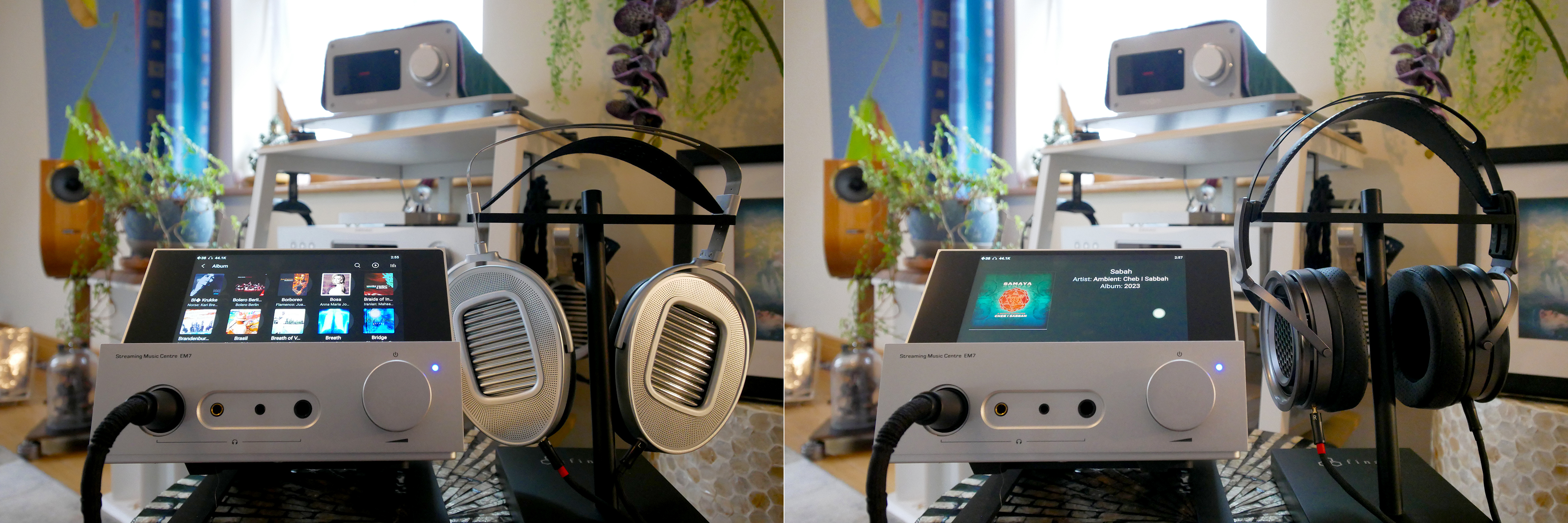
AR9000 x HE1000 Unveiled. At €1'690, Shanling's EM7 all-in-one with a 1TB microSD local library felt price appropriate. At 7wpc/32Ω balanced, it's sufficiently athletic even for Susvara and Raal 1995's Magna. At €2'399, this denuded version of the HE1000 of course rather eclipsed aune's ask. Did this park the HifiMan on a clearly higher floor? For penthouse ancillaries, this same listening station could still escalate to the Cen.Grand twins of DSDAC 1.0 Deluxe and SilverFox amp to check whether the AR9000 would escalate in lockstep. A €10K pack just isn't what most buyers will leash the AR9000 up to. Let's start off reasonable. That, alas, proved quickly harder done than said. Somewhat unreasonably, the aune levelled up—on its own path of ascent so on the far side of the mountain. The HifiMan played it more glossy, shiny and airy. Its staging felt wider, its separation even keener. Yet this same surface gloss, on the close-mic'd violins of Claude Chalhoub's first album for example, betrayed subtle undertones of glassiness; a faint pre-echo of minor stridency. Also, HifiMan's sonic substance clearly trailed aune's. Once my music selections added bass content and wider dynamics, the AR9000 played its other aces. Whilst its imaging seemed more intimate; whilst its textures were undeniably more matte or satin, its aeration lower—the aune's darker earthier ambiance was just as attractive as HifiMan's more exhibitionist brightness. At 20 grams less and decidedly smaller, even on wear the AR9000 ticked off boxes. The HE-1000 Unveiled's focus on resolution and detail was the more obvious, its perceived quickness semi electrostatic. It's a different aesthetic just as valid. It's lighter in both senses: less weighty, more illuminated. The aune turns up black values, heft, dynamic expression and tone density. One prioritizes spaciousness, the other incarnation factor. One is more suspended, the other more grounded. One idealizes chamber music in the nearfield, the other rocks out and delivers heavier more cracking punch. Regardless of your poison, you'll probably agree. Both trade off the same counter in the same upscale boutique. One simply costs quite a bit more; and wants extra care in its denuded state. With HifiMan's magnetized covers a bit of a faff, the AR9000 is clearly the more easy-going of the two.
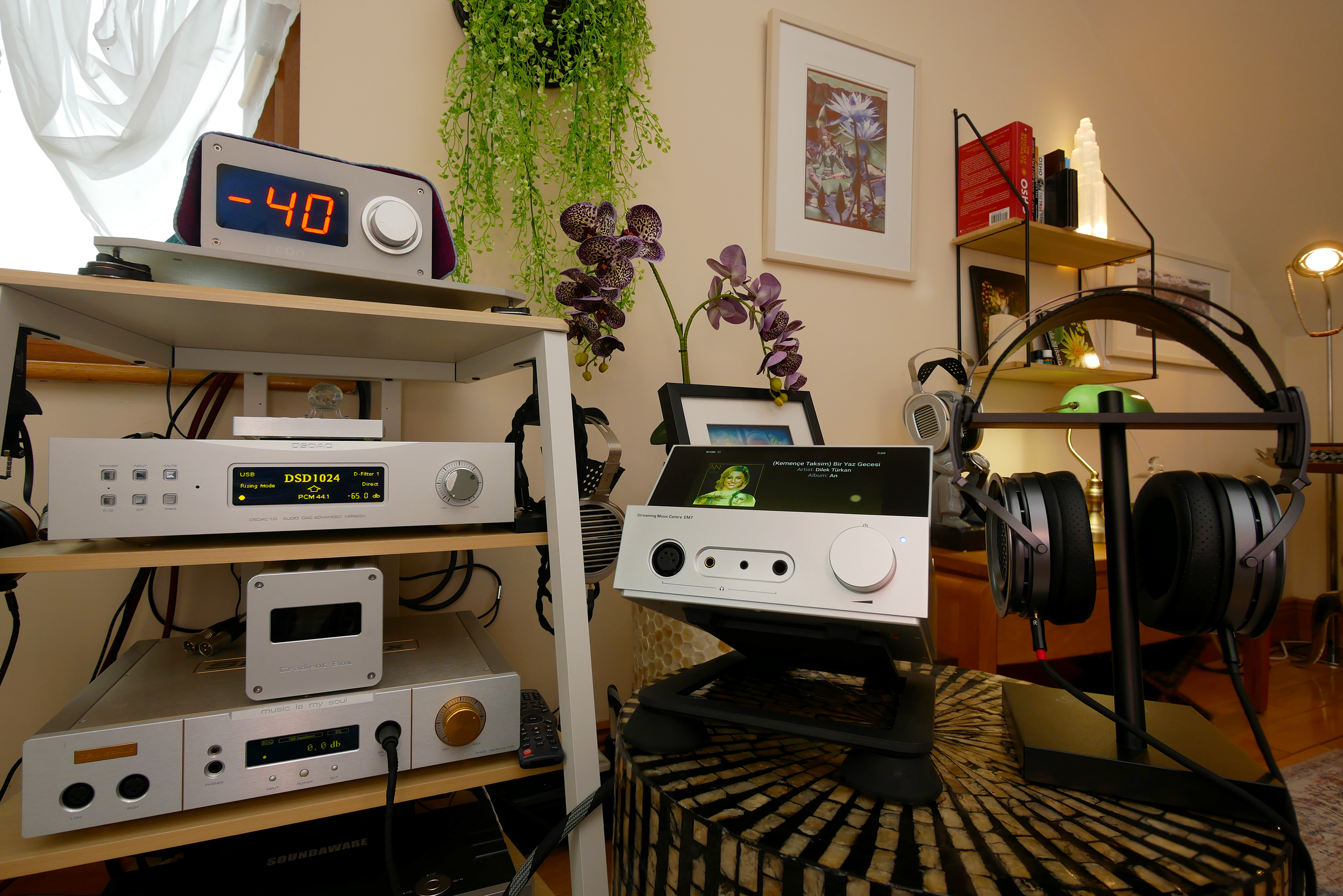
These observations used both sets of electronics. The far longer signal path below was Shanling ⇒ USB ⇒ DAC ⇒ balanced autoformer volume control with remote ⇒ amp. As shown, most my listening took place at 40dB down from the DAC's fixed 5Vrms XLR output. In practice the HE-1000 Unveiled needed a bit less signal voltage for the same SPL. Off the Shanling's turbo gain mode, the aune sat at ~30/100 on the dial. The step up in ancillaries influenced LF dynamics and resolution the most—just not proportionate to adding €10'000 without yet factoring extra cabling. Blinging out the AR9000 with gear well beyond its neighbourhood really isn't necessary to unleash the lion's share of its potential. It's a very different tale with my OG Susvara. Here too the aune goes easy. At €1'099, the ultra-spec Topping A900 of just the facts actually makes a fine aune partner. The amp's extremely low noise floor and high drive prioritize detail capture and damping whilst the AR9000 still managed to convert this drier diet to impressive body and materialistic immersion. This teamwork played to the attraction of opposites and on price remains realistically balanced.
What about tossing all coin caution to the cold wind of wickedness with Enleum's $6'500 AMP-23R and its 6¼wpc into 32Ω? For that I had to convert aune's cable to its 6.3mm termination. The Enleum is my collection's favourite and costliest headfi amp. This chain started with four series-connected network switches—two in the office plus another two at the tail end of the 20m CAT8a link connecting to this room—a maxed-out 27" iMac with Audirvana Studio, a LHY Audio USB isolator, a Sonnet Pasithea DAC and Hattor Audio ARP-S quad autoformer passive-magnetic preamp. With this hardware assemblage, would I hear anything from the aune I hadn't yet? Truth told, I didn't expect to.