Restrictions? To follow up my two discarnate entities, the flagship does mollycoddle our ears with the most plumptuous memory foam. However, pleather headbands, metal bridges, plastic covers over the slider mechs, metal yokes and plastic cups do share with the SR7000. Ditto internal protective grills across the drivers; size and geometry of the oval cut-outs of the pads; the stylish hard case shown next. This free-use approach extends to the AR3000; without case. It primarily feels cheaper because of its obviously lesser weight. It also comes on song far sooner on the volume scale. Enter a peculiar request. "As each of our headphones has its own positioning and design goals, we would prefer them not to be evaluated directly against each other. Of course comparisons with other brands are absolutely welcome." This hit my inbox once the shipment was in transit already. Had it arrived prior, I'd have rejected the request; or assignment. Prospective buyers will most certainly want to know how aune's very different price points communicate to the ears—especially when I had three at hand. Given timing, I simply thought it rude to accept the shipment then defy aune's request. Hence here my cross shopping stops. In 24 years on the lunar beat, this was a first. Going forward, I'll know to clarify the point. It never occurred to me that a maker wouldn't want such comparisons. I'll leave you to speculate on why.
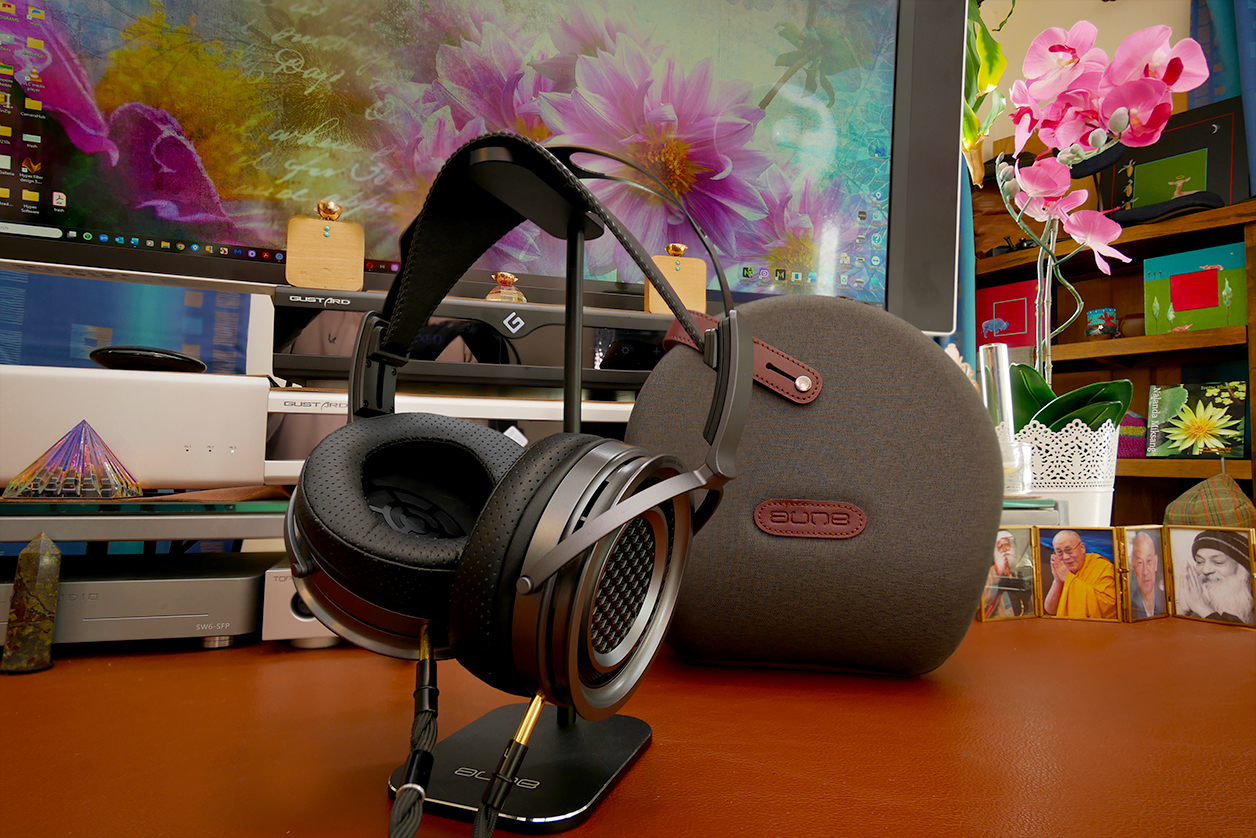
The AR9000's loosely sleeved cable proved slinky and non-microphonic. What FiiO include with their FT7 simply feels more upscale. aune's hot-swappable plugs changed easily. Small white markers show correct alignment before insertion and redoing the retainer. The AR9000's forward-angled cable entries create proper cable routing without going bizarrely horizontal like SJY's square Zeph. To limber things up after travelling halfway around the globe in a real hurry, I set a playlist on endless repeat. My desktop's Topping A900 and its 14wpc/32Ω sat in the driver's seat, high gain at -33dB down from a Gustard R26II's 5Vrms fixed XLR outputs. On my tall egg head, the perfect fit maxed out the sliders. Re: music's bass content, my main 2.1 speaker rig runs a 2×15" folded-dipole sub, the bigger of the upstairs systems a 2×12" version, the smaller one a 2×9½" sub, all of them via external analog hi/lo-pass integration. My 2.2 video system does two 15" subs. So-called sub bass and I are on intimate terms, no wishful thinking or braggadocio involved. There's good reason to mention this. First, let's separate being bassy vs subjectively linear into the sub bass. A lifted upper bass below which mid/low bass fall off rapidly registers as bassy. It's a protrusion; a portly belly on spindly legs; a snake's lunch. Yet if the response continues unkinked past the upper bass down to 25Hz whilst the entire sub-100Hz range sits on a small linear incline, things don't feel bassy. 80Hz to 160Hz content shows up on pretty much all music. There a bulge becomes omnipresent and with it, self-referential. Its constancy is that pebble in the shoe. Having acoustic fare hit 40Hz gets more occasional. Breaching the 1st octave in earnest takes more doing. If a transducer keeps up with the same articulation and stoppage as it handles the higher bands, it's all quality. Real bass presents only when music prompts it. It's no constant. There's no pebble. Though basic, this is a vital distinction between a bassy tuning created by a lack of true equally loud low bass; and a linear continuation. Now you appreciate how the AR9000 having subwoofer-type extension and power isn't synonymous with being a bass head. It only shows up when recorded. This qualitative divorce can't just be due to stroke-happy domed cone rigidity and patented magnetics. It must be avoidance of compression effects and their mud as secured by very effective airflow control. It's what most sealed headphones struggle with by degrees. Even open-backers less well vented than the AR9000 retain remnants of bloat, ringing and related darkness. The upshot is plain. Forget massively surfaced planarmagnetics as the end game of headfi bass. aune's far smaller pistonic cone that's no edge-clamped thin film stretching like a drum skin is more dynamic and controlled than most their kind. But it's no EDM excess or fattiness. It doesn't linger or boom. It's simply an aspirated bass pump that will displace properly dynamic LF airs when called upon.









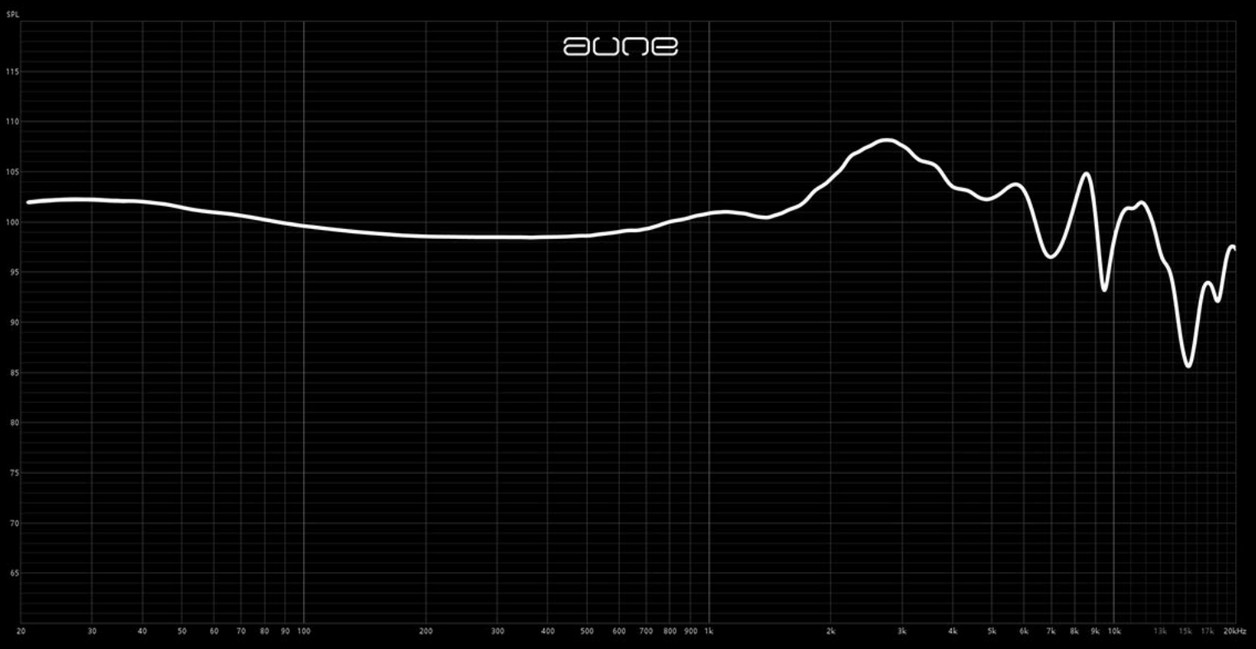
This makes all the difference on minimalist spacy electronica that rewards sub 30Hz reach with very faint synth pulses and pedals. Loud and obvious club beats à la Mercan Dede also known as DJ Arkin Allen are their own amusement. Minuscule but intelligible is different chicane; more difficult and sophisticated. I adore Al Gromer Khan's paisley music—true ambient fare around fractal heavily pitch-bending sitar, cross-panning effects, analog-sounding synths and deconstructed phrasing. I have 20-some of his albums in a shared folder run on random shuffle. It acts as quasi soundtrack for meditative watchfulness. Knowing it well from my big systems, I feel on firm ground calling the AR9000 a headfi equivalent of a good music sub integrated seamlessly. Again, that's very much not bassy or bottom-up; just unusually capable when occasions warrant it. Here writerly enthusiasm fails when supremacy phrasing gets misread to imply anything elephantine or mega. If recorded bass is bombastic, this headphone will do it bombastic. But it will also capture bass that's quick-witted, sharply subtle and mined as deep as only synths can go—then render it as recorded rather than made over at incorrect proportions. That would only play at bad subwoofer notions. And this does not. That's key. Time for a quickie detour. Abyss. Audeze. Dan Clark. Dunu. FiiO. Final. Fosi. HifiMan. Kennerton. Kiwi Ears. Meze. Monolith. Moondrop. Sendy. Shanling. Sivga. SJY. T+A. ZMF. All of them do planarmagnetics. That kind still rises on a renaissance arc with churning press cover. Reviews on the old dynamic guard of Audio-Technica, Beyer, Focal, Grado and Sennheiser seem less numerous. Like discrete R2R, once planars were exotics. Today they feel like the majority; or at least talk of the town. Wherever new headphone brands pop up along the dynamic route, it's rather less common to spot drivers that were in-house engineered from the ground up. Here aune are the exception. End of detour. Onto the peaks; subject to many comments in AR9000 YouTube reviews and their graphs. Unlike with speaker amplitude measurements, a headphone's on-ear treble response is supposed to look overtly non-linear given so-called ear gain. With in-room loudspeakers, our outer ear naturally boosts the presence region. Headphones bypass the room so dummy-head test rigs expect to see a ~10dB/3.2kHz boost to compensate an otherwise dull muffled sound. Ear gain tends to appear as a broad hill-shaped rise that starts at roughly 1kHz, peaks around 3kHz to 3.5kHz then tapers off. aune's own graph conforms then shows a small peak in the lower sibilance band of 5.8kHz, a larger one in the brilliance/air zone at 8.5kHz and another in the sheen band's 11kHz. We also see a small plateau around 1kHz which prevents vocals from sounding too distanced. With each person's pinna gain unique, often even differing left/right, the recognition of these +5kHz peaks and how they shape the sound is just as specific to each listener. That's before we rate their effects. An emphasis in isolation differs from a narrow emphasis counterbalancing an opposing trend. A gently elevated bass response for example might really want a corresponding lift in the upper air region to feel correctly illuminated rather than dark or heavy. It's all subject to our own biology and habitual preference. Hence today's headfi discourse is so full of convenient EQ. Variations on "once I pulled down 6kHz, lifted 10kHz then shelved up <60Hz, I could listen to X" are legion. How useful this is to buyers remains open. With that in mind, I'll give you my treble impression with model year 1962 receivers.
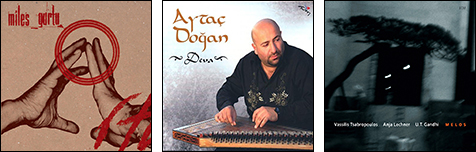 With the AR9000's prioritizing of tonal density and chunky chewiness from that small central midrange lift and ideally rising lower end, its first lower treble peak sat too low in frequency for me to trigger any annoying lispy sibilance. Instead it gave struck triangles and cymbal crashes fantastic brassy energy. It also maintained perfect visibility of the percussive micro ticks and nano zings which permeate the Robert Miles and Trilok Gurtu collab's "Soul Driven". Ditto the subdued brush work on the opener of Aytaç Doğan's Deva album; or the metallic flares on "Promenade" from the Vassilis Tsabropolous album Melos with cellist Anja Lechner. aune's generous tonality
  enfolded these elements in direct antithesis to explicitness or isolated hotspots. Yet these treble events were fully present and accounted for, just in nothing that resembled pornographic zoom. Likewise for the wider air region's fizziness peaks. Those gossamer energies simply prevented density clumping which this voicing might otherwise lean into. Stepping back for the full picture, my experience called it very craftily curated for surprisingly high just not overt resolution which sets in a slightly dark clearly earthy milieu capable of grand macro gestures. This ability to scale loud without any sonic or physical stress suggested unusually low distortion. Massed strings like the famed 25-strong ensemble from Istanbul which accompanies many Middle-Eastern productions evinced no wincing. Neither did the speedy fiddles, jubilant tin whistles and occasional Uilleann pipes on Hughes De Courson's O'stravaganza, a fabulous fantasy on Vivaldi and Celtic music from Ireland—and quite the hot audiophile trial. Try the eponymous opener for a full-bore taste of Irish jigs and reels with Baroque inflections like Matt Molloy meets James Galway; or Mairéad Ní Mhaonaigh hooks up with Giuliano Carmignola.
 An LF lift and matching small HF mirror image produce a smiley-face response often called a V tuning—two ends sitting higher than the centre. It recesses the midrange by degrees. The effect is extra spaciousness and the opposite of forwardness. aune's flagship profile is closer to a so-called W tuning. It restores the midband's relative recess of a V profile with its own small hillock for advantageous high ground on the musical battlefield. How the measured peaks of aune's graph may coincide with our own biology—or not!—is anyone's guess. Because headfi graphs look so jaggedly wrong in their upper third vs good loudspeaker graphs, it's easy to overestimate their on-head action and get all wigged out over wonky wiggles. But they do feed power-user debates. To the more casual bystander, those can seem super esoteric. To be fruitful, they depend on knowing the exact measured response of our own pinna gain. If we don't, we can't possibly translate what such a graph's treble region will actually sound like. If we buy into these raw peaky visuals, caveat emptor; or more likely, sales prevention 101. Incidentally, clear passage through the brisk high-energy O'stravaganza straits without torn sails was as true over my Shanling EM5/EM7 decks as it was for the leaner more matter-of-fact Topping A900. For brief aural respite before comparing hardware, may I recommend "Bekle" from Meral Azizoğlu's album Adres Defteri? It'll sound good on anything but makes a charming palate cleanser. For some Hungarian fire testing treble temps, try Meral's saucy-to-coquettish Gül Istanbul with string quartet and cymbalom compliments of the Gipsy Fire ensemble celebrating bygone times when the Orient Express took travellers to Istanbul's Pera Palace hotel and coffee-house musicians mixed up Turkish folklore with Tzigane influences for its glamorous guests.
 Germany's Phil Kullmann aka Dubbyric aka Raw Artistic Soul describes himself as a musician, percussionist, record producer, remixer, composer, Analog Modular Synthesizer lover and founding owner of Raw Artistic Productions. On the Flores Para Ti single, he teams up with Gelsenkirchen's sensational flamenco guitarist Rafael Cortes for a high-speed rumba with Jazzy vocalizing, driving bass line and Cuban-style percussion. Blatantly easy listening and dynamically compressed to within an inch of its life, it's an ace track to explore degrees of groovaceousness—how much locomotion and joie de vivre a track communicates via given hardware. Suffice to say, the AR9000's fun factor kicked into instant high gear. Combine its penchant for dynamic swagger with powerful properly damped bass and rich tone fed by a strongly propulsive groove. Et voilà, shameless grins on the far side of rarefied airs. Making so seamless a transition from neoclassical repertoire to deep house underwrites how the AR9000 was carefully tuned to be a practical omnivore rather than high-brow ascetic on a very limited diet. It reads normal; as though all transducers did it. In truth, many steer us toward certain music selections whilst staying clear of others. Meanwhile an Alleskönner—Germanic for do it all—is easily accused of lacking sophistication: jack of all trades, master of none. I rather thought the AR9000 a quite masterful Jack; or Jill to not be sexist. It also wore supremely comfy. But so already did the AR5000 and SR7000 before it.