Country of Origin

Reviewer: Simone Ragionieri
Source: Generic 5G router into Taiko Audio network switch (both powered by a ferrum Hypsos; Taiko Olympus XDMI Server; LampizatOr Horizon360 DAC
Headphone amplifier: Riviera Audio Labs AIC-10
Headphones: Spirit Torino Valkyria, Raal 1995 Immanis
Loudspeakers: Diesis Audio Aura SE
Cables: Digital – Sablon Ethernet; Amphenol DAC cable, KBL Extreme XDMI; Analog – Acrolink 7N-2090 Special Anniversary
Power delivery: Audioquest Niagara 5000 & Hurricane power cords, Shunyata Alpha HC power cord, Furutech NCF AC wall plugs on a dedicated spur
Room treatments: Eight ceiling diffusors, floor-to-ceiling acoustic curtains on sidewalls, Vicoustic Vic Totem Ultra VMT in front corners
Review component retail: €9'600 incl. VAT

Headphone soundstaging fascinated and frustrated me ever since I joined the audio fraternity a few decades ago. How a properly positioned pair of loudspeakers creates a highly persuasive soundscape of living musicians in front of me triggered my passion for hifi in the first place. When circumstances forced me, I gravitated toward headphones with a mix of curiosity—what could they offer as a complement to speakers—and scepticism. How satisfying or not of an experience shrunk down to a tiny volume of air set in motion around my ears might they produce? They obviously add portability. The model that made me take the plunge into 'serious' headfi were the Sennheiser HD800 around a decade ago which I heard on an SPL Phonitor X. I was shocked by how vast the soundstage was in all directions, by the image separation and, with the SPL Matrix system engaged, by the quite effective illusion of sound developing within a room rather than being beamed directly into my ears. It was the first time I could enjoy a symphonic work on headphones and triggered an instant purchase of the HD800. Since then I experimented with several types of on-ear sound spatialization effects with mixed results. As my system evolved, I always kept speaker emulation options on hand. Several years of progressive upgrades and addiction to critical listening over headphones brought me to a point where I could perceive in-head spatial cues very distinctly and in a satisfying way. However, after my recent comeback to the 2-channel world, loudspeakers have overtaken the lion's share of my time and the perceptual adjustment needed to switch over to headphones for late-night listening can be painful. Hence my renewed interest in state-of-the-art speaker emulation tech. I first came across Audma's Maestro HPA1 during my visit to the Munich High End show in May 2024 and was immediately intrigued by its ELISA technology. After a glimpse of what it could do in a noisy show setting, I wanted to know more so contacted Audma. Around September of last year they agreed to a review and from then on the company was very active at shows where the reception of the Maestro has been so enthusiastic that six months passed before a review unit ever materialized at my place. In the meantime, my curiosity increased further and so did my expectations.
Cesare Mattoli founded Audma—originally AudioMa subsequently changed due to a trademark constraint—in 2023 to formalize a multi-decade long idea which this avid music lover with an electronic engineering background had about improving headphones' spatial presentation. Being involved in audio design and prototype manufacturing since his youth, he discovered the beauty of headphones as a way to escape the space and noise inconveniences of speakers but was annoyed by how fastidious it became to listen to his beloved Genesis, Elton John, Bee Gees or Italian prog rock from the early 70's where channel separation could be extreme. He immediately started ruminating how to inject part of the right channel signal into the left and vice versa when he read the early crossfeed proposal by Siegfried Linkwitz in Italy's CQ Elettronica magazine. Creativity sparked and Mattoli's approach differs from Linkwitz's LCR network by being based on frequency-independent delay first implemented in a physical prototype in 1978. Although the technology and components available then did not achieve the desired results mainly due to noise and distortion, the outcome was encouraging. Mattoli's career evolved into his present principal business Hi-Tech Solutions, a company designing and manufacturing electronics for heavy-duty machinery, but the dream of an imaging enhancer for headphones remained alive. A second attempt followed in 1993 with the introduction of a digital delay line based on EG&G's Reticon chip and almost 30 years later took shape very close to the Maestro HPA1 of 2022. This prototype called HPA1P was already equipped with the ELISA circuit using a digital delay line from Panasonic customized by Mattoli who for two years refined and validated his approach with listening tests involving world-class musicians. Like the eponymous Roman emperor, Cesare uttered alea iacta est (the die is cast) and decided to give birth to Audma and its first model, the Maestro HPA1.








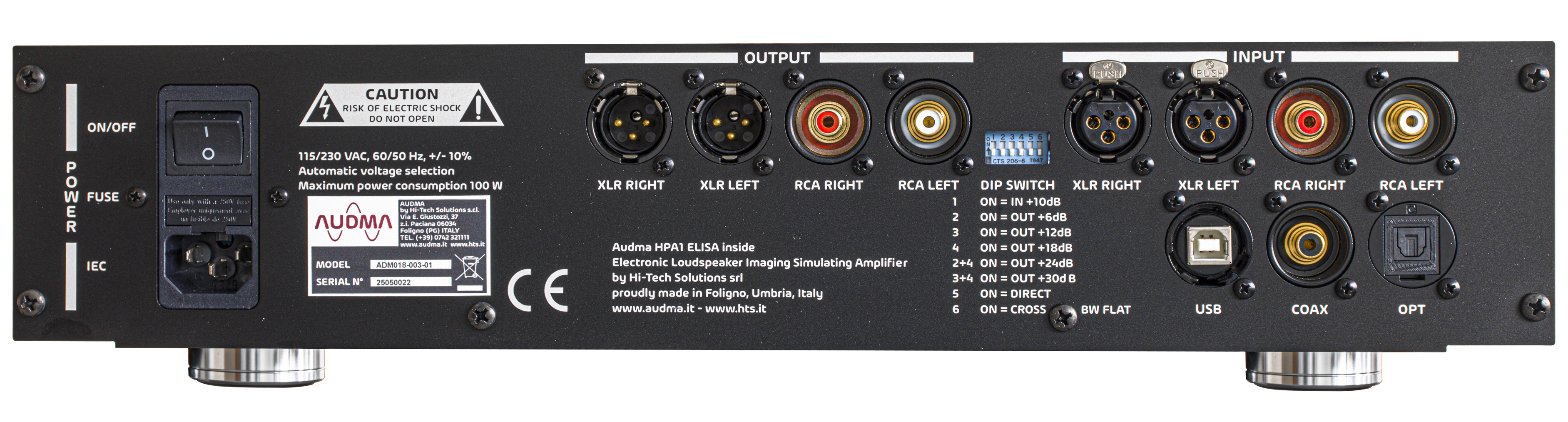
The Maestro arrived in well-made sturdy packaging, including a gorgeous aluminium remote, a USB charger and some cables. It is an 8.7kg 43 x 40 x 11cm WxDxH unit with charming vintage lab aesthetic especially when switched on to bring the amber backlight of the knobs and VU meter to life. The number of frontal controls is a bit overwhelming at first but being able to finely tweak the ELISA effect is at the very core of this concept. The most-used controls conveniently reflect on the remote so in use the Maestro is straightforward. The brushed fascia is dominated by the two beautiful VU meters with adjustable sensitivity where each channel displays the input and injected crossfeed signal. Headphone ports include 4.4mm, 6.3mm and XLR4 while the central volume knob is a click-less motorized Alps Alpine potentiometer. Moving to the left, we find an output selector (line out, headphones, mute), L/R balance, mono/stereo, phase and input selector whose options are USB, optical, coaxial, RCA and XLR. Finally, the ELISA controls can activate/deactivate the circuit and continuously tune its stage width and angle. The back panel contains the RCA/XLR analog i/o and digital inputs so the Maestro can be used as a preamplifier delivering, if desired, ELISA-shaped signal to an external amp. Lastly, six dip switches can increase input gain by 10dB and output gain by up to 30dB. Another pair of switches sets how the ELISA effect forwards to the line outputs and whether the pre-defined shaping of the ELISA crossfeed signal is to be used or a flat response (an option provided for testing purposes only).
 Automatic voltage change, dual mono power supply with custom transformers, AKM AK4490REQ DAC, Nichicon electrolytic capacitors, Wima Red capacitors, Alps Alpine motorized potentiometers, Alpha switches.
When looking inside, the industrial background of the company shows a thoroughly engineered layout and careful selection of audio-grade components including Texas Instrument OPA 1612A SoundPlus op-amps in the front end, Wima MKT and Nichicon caps, 1% metal-film resistors and the already mentioned Alps Alpine type for all motorized pots. Special care was put into the power supply with a dual-mono topology with custom transformers. The DAC runs an Asahi Kasei AKM AK4490REQ chip with Velvet Sound technology. I did some digging on it but all I could find was this AKM statement: "This technology realizes fine sound details with its low-distortion architecture in addition to 32-bit resolution digital filter processing". The machine can handle 32/768 PCM and DSD 256 with a 115dB S/NR.