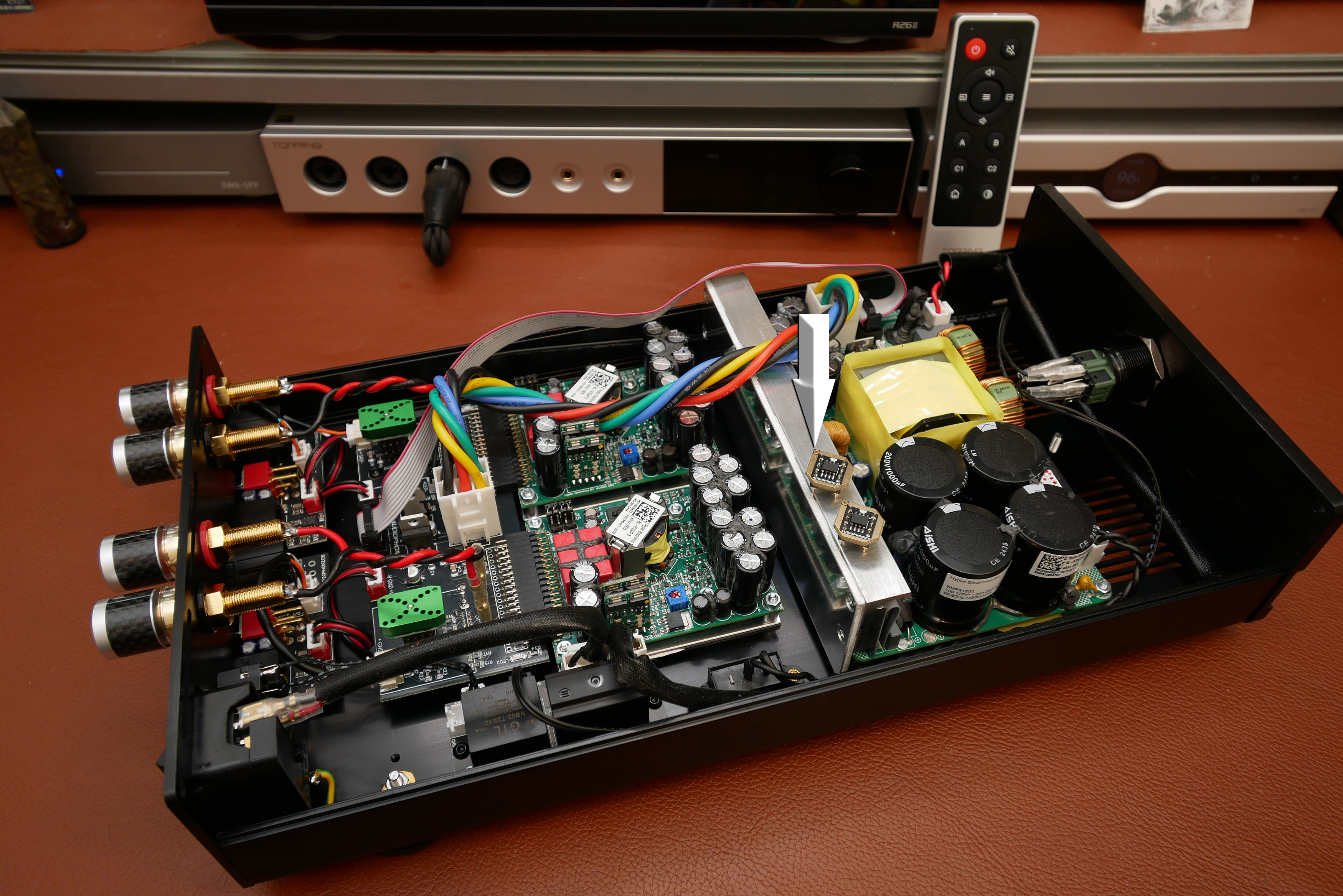
Directionality is critical. Dispute it for cables. Bully for you. But misinsert an opamp and your bull will draw blood. It's literal smoke you don't want. So look for the little crescent as either a printed marker or actual physical indent on the opamp and PCB. It'll tell you which end of the 8-legged critter is 'north'. Child's play if you know to do it. Silly mishap if you don't. Here we see Grzegorz's care package delivered in 3D-printed round pill boxes with lock tops. Those should subsequently find use for vitamins, daily meds, spices or powders. They're too nice to discard.
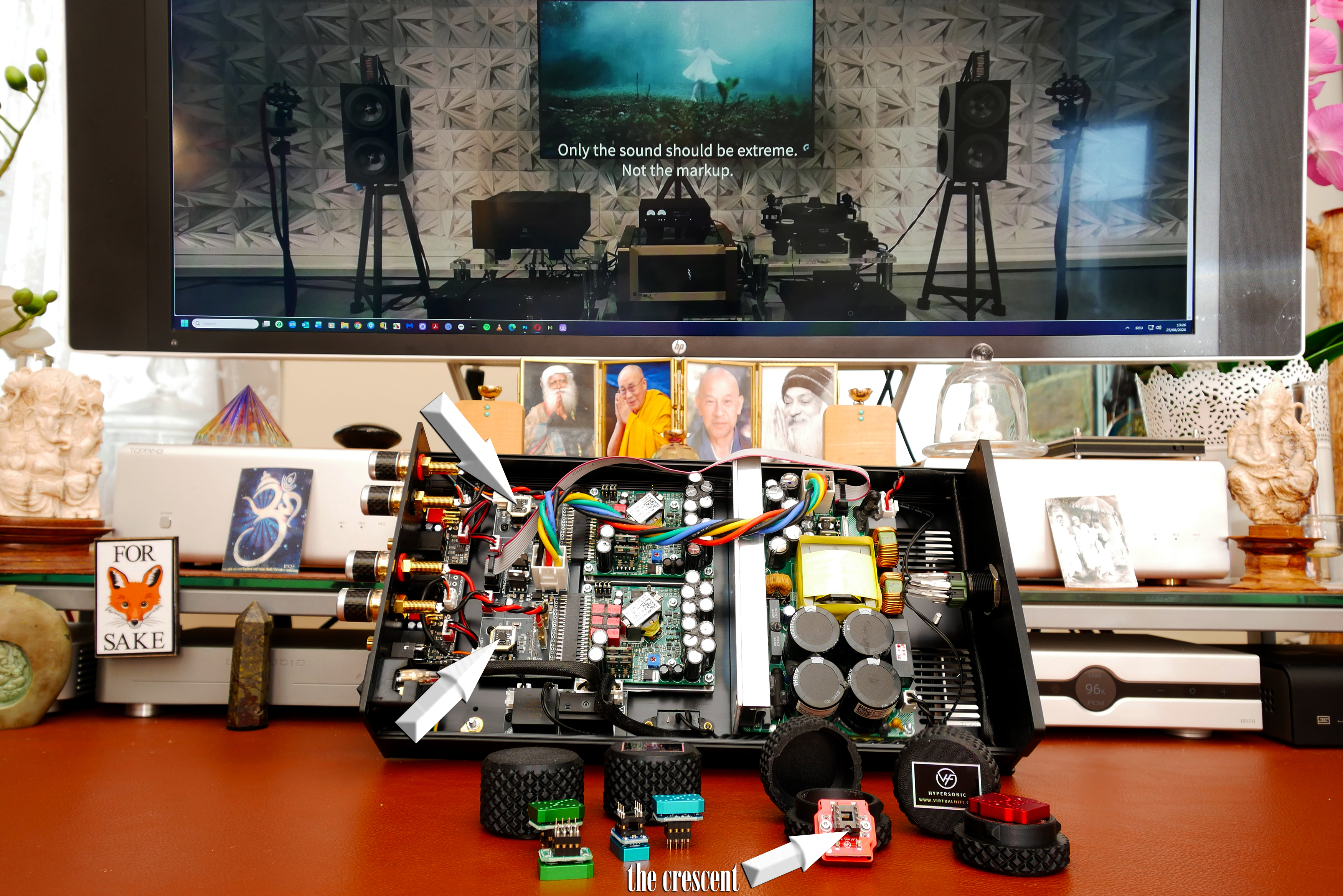 The twin arrows here and below point at Audiophonics' stock opamps.
Because already the receiver sockets sit proud of the board, installing the Virtual opamps parks them well above the PCB like mushrooms on stems. There's no worry over extra downward temps roasting the circuit board from undue proximity. Regarding the extra current draw from doubling or quadrupling opamp loads, check with Grzegorz about your component, which of his opamps you mean to use and how many your application needs! Below you see how the green-headed units sat a finger's width above my motherboard.












Opamptopia: Green for go? On the desktop for plug'n'play surgery in speaker not sub mode, going green immediately densified the sonic profile. Everything grew evenly and profoundly more chunky. This was no chocolate excess or baklava dripping in sugar syrup. All was proper grippy and taut but with an unapologetic clockwise twirl on an imaginary incarnation knob. Beam me down more, Scotty. After powering the amp off, swapping to blue caused an involuntary jerk. After just 10 minutes of use, the greenie tops were scalding. Lesson learnt. Needle-nose pliers to the rescue. Why wait for these shrooms to cool to finger fitness? Hot stuff! The blue chaps sounded decidedly different; more forward, more separated, with more top-end energy, lower density and less gravitational anchoring. They still fully overhauled the flatter greyer stock voicing but pursued more resolution and apartheid than team green. Between the two and in full-range mode, my proclivities favoured blue. Big Red then hunkered down roughly between the two. It dealt out equal hands for subjective resolution and weight but had even more teased-out refinement and presence than either. Personally most positive about my playful pliers was that no matter the colour, this entire Polish lot overwrote my original misgivings of dry overdamped stock parts. That I'd not expected. Whittling down to my favourite, green was out. My pick for a theoretical desktop resident was between blue and red. Plucking opamps was great fun whilst Volkan Konak's joy-filled vocals showed the way. Given my favouritism of teased-out treble, blue was the winner. But—this NCx500 wouldn't loiter around the office. For pure LF glory, would blue blood still take the crown? To decide, I cued up "Oriental Bass" from the earlier list. Set on endless repeat, hitting 'pause' plucked 'n' pinned opamps with those trusty pliers. Blue disqualified first, red next. For the main system, I'd play it Gaelic so green for proper whomp and circumstance. Truth told, I just needed extra assurance. With their strong dissipation, was long-term use of these little hotties perfectly safe and tested? It's been a long time since I burnt skin on a scalding tube whilst otherwise naught bad happened. Peace of mind simply needed a reminder that toasty opamps were equally fine. Skin grows back. Burnt circuits do not.
"Yes, they do get hot. However, the maximum temperature is ~80°C and the chips, along with all passive components are designed to work stably to 125°C. Of course all electronic chips experience long-term heat degradation so they won't last forever. That said, hundreds of customers and I have now been enjoying the hot-running Hypersonics for over two years of daily use and they continue to work flawlessly. As long as you don't use them in a very small confined enclosure, you'll be fine. Just think of them as solid-state tubes. Enjoy the rolling. The Blue Supersonic V2 are the bestsellers and the Hypersonics are best for full-bodied sound and based on the same chips as the Supersonic V2. In essence they are doubled Supersonic V2 so you can really hear what doubling/paralleling does to the sound signature. It's interesting how many electronics engineers conclude there's no sonic difference because they cannot see one on their oscilloscopes." Suffice to say that my rolling showed very obvious changes. Which flavour you prefer is personal. There simply can be no argument that swapping this crew needs golden ears to make out. Ordinary lead ears will do just fine. For sub duty, mine would start off like a greenhorn—in lime like Kermit the frog. I could always chameleon later and change colours. Before departing my desktop, it's fair to reiterate how this opamp exercise rather modified my original opinion on the NCx500 for speakers. Wearing blue, I'd happily listen to it as the office's main amp. At €108/pr, this would be one very cost-effective upgrade. Which colour would win out across the hallway? Plain black. The more I considered it, the more the conceptual clash of ultra-efficient cool class D and searing opamps radiating like high-bias class A champs caused me mental constipation particularly when as subwoofer driver, my crossover's bass pot could compensate the difference in density. So this Chicken Little returned to his stockers since sonic sacrifices for that application were slim. On my office speakers however, I'd only enjoy the NCx500 virtualized, preferably blue. In stock form my ears call it rather too dry—desickated to make up a combo term. But again, what's overcooked for midrange and treble can be absolutely ideal below 100Hz where room ringing adds its own body. To wrap, this x-rated nCore tech makes for superb bass amps and exceeds my earlier non-rated versions. Two, the delta of sonic profile shifting available from strategic opamp rolling is unexpectedly large at least in this particular Audiophonics implementation with the Virtual Hifi drop-ins. Three, this is high-value kit either way. Having taken a punt worked out in both meanings: of buying something in hopes of a win; or attempting an action where success is no guarantee. Today that made me a satisfied punter. That I still haven't a clue why the NCx500 and one of my two active crossovers didn't get on files away under 'unsolved hifi mysteries'.