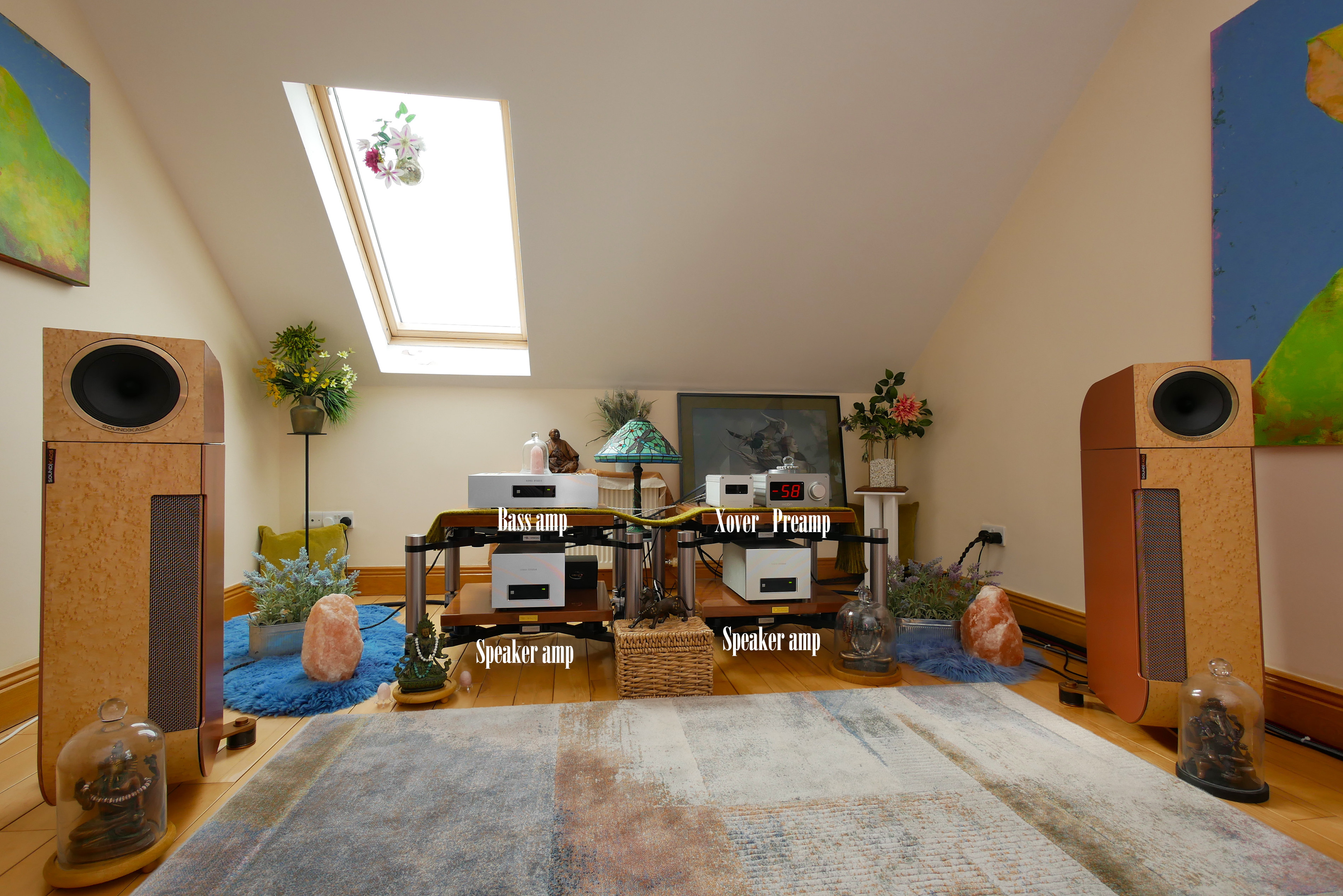
To test dedicated woofer drive on a first round, I still had a review pair of Swiss sound|kaos Vox5 speakers upstairs. This 6" widebander docks atop a folded-dipole twin 12" bass bin and rolls off acoustically at a steep ~120Hz. The sound|kaos XO² dual-mono 200-watt bass amp is based on TI TPA325x chips and twin outboard SMPS. It carries analogue low-pass filter adjustments and bass attenuators. In lieu of it, I had wired up a Lifesaver Audio Gradient Box II active crossover. This was set to a 4th-order 120Hz low pass into a 250wpc Kinki Studio EX-M7 stereo amp as bass driver. That's a DC-coupled 2.5MHz circuit with lateral Exicon Mosfet outputs and classic linear power supply tuned in the spirit of Goldmund/Spectral. Swapping $2.8K EX-M7 and €1.1K NCx500 amps whilst possibly making a small adjustment on the crossover's bass attenuator to account for voltage-gain offset, I had my first bass gala. On paper the nCore amp was the more powerful and probably had still lower output impedance for higher damping and current flow. It also sells for less than half to book attractive savings. That's nothing to sneeze at. But would it be the only difference? Or could class D's rep of bass pep become another decider?





To explore potential wiggle room during my Bass Gala experiments, Grzegorz Rulka offered to send me some of his Supersonic V2 and Hypersonic opamps to try. By owning the same Audiophonic amp, those would come with his personal recommendation. They're these twice- and quad-paralleled jobs with flat aluminium heatsink tops which merely want sufficient lateral clearance to fit. Would they become flashy cufflinks to my black-tie efforts?
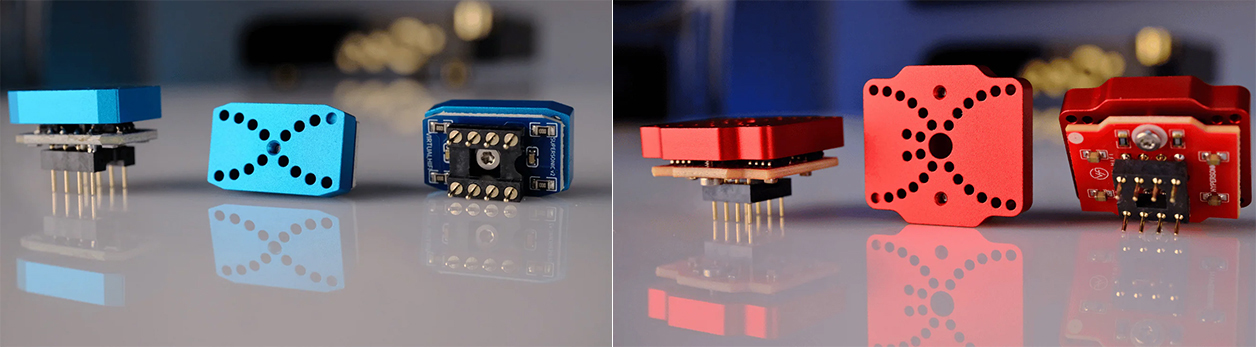
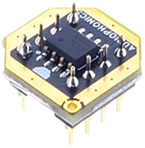 "Recently discrete opamps have become popular. Because they're built from separate components, many believe that they sound better than integrated versions. And it's true that good discrete opamps can sound fantastic. However, there's another way to get incredible performance: connect several of the best modern chip-based opamps in parallel to deliver more power, improve control and lower noise for increased dynamics, substance, bass control, presence and a wider soundstage. In many cases, two top-quality integrated opamps working together can outperform a typical discrete design." On NC500 vs NCx500, Google AI had this: "The Hypex NCx500 platform offers lower distortion, a lower noise floor, better linearity and an optional built-in buffer stage. The original NC500 strictly required a custom external input buffer designed by 3rd-party integrators. The NCx500 includes a high-quality user-selectable onboard buffer though manufacturers can still bypass it to use custom discrete buffers. The NCx control architecture improves load invariance and reduces output Ω for a flatter more consistent frequency response regardless of connected load." From Audiophonics: "We control these modules in phase opposition to cancel power-supply pumping. It alternates the current draw on each rail and increases its capacity. We also employ dual-level voltage regulation and one twin OPA1656 input buffer per channel based on a TI chip [left]."
My first date with the NCx500 was iffy. It's not that the amp turned me off. It turned itself off. I was reasonably certain as to why – DC on the power line. But my quad autoformer passive preamp needs its funky 6V wall wart to power its display and remote control. Ditto the neighbouring active crossover. From previous experiences with my DC-coupled Kinki monos, I knew that if one of those wobbly wall warts didn't seat just so, those amps too could go into protection. I'd learnt how to secure the warts with their looser plugs without further incidents; until now. No matter what, I couldn't get the NCx500 to stay on. Looking for more instant bliss than blind troubleshooting, I moved it downstairs where it replaced its earlier-gen NC500 mono mates in their Nord chassis. Perfection. The Frenchman tightened up their already brilliant control over the 2×15" sub even further whilst being deathly quiet. Until I could track down what made it so unhappy upstairs, it had already found a home in the main system. That hadn't been the plan, exactly—but adapt and overcome isn't just good for marines. Yet my shiny self image smarted in defeat. In rare cases like these I find it useful to remove all cabling then carefully rewire a system step by step whilst paying close attention to cable routing and dressing. So I did. It was 22:00 when I had finished by also relocating my two DC-powered components to the front-end rack next to the chair. Of course if DC leakage from two warts really was the culprit, different wall outlets on a possibly separate spur wouldn't change a thing. And they didn't. Whilst the Kinki Studio EX-M1 stereo amp or twin NC500 monos still had no complaints over playing beasts of bass burden, the French clammed up again. To confirm my trigger hunch, I'd need linear power. If my hunch was off, the NCx500 would stay off. Still, chucking wall warts was welcome either way. It'd be a form of belated audiophile house cleaning. So I ordered an LPS-80 from LHY Audio with custom 6V/3.5A + 6V/3.5A outputs.
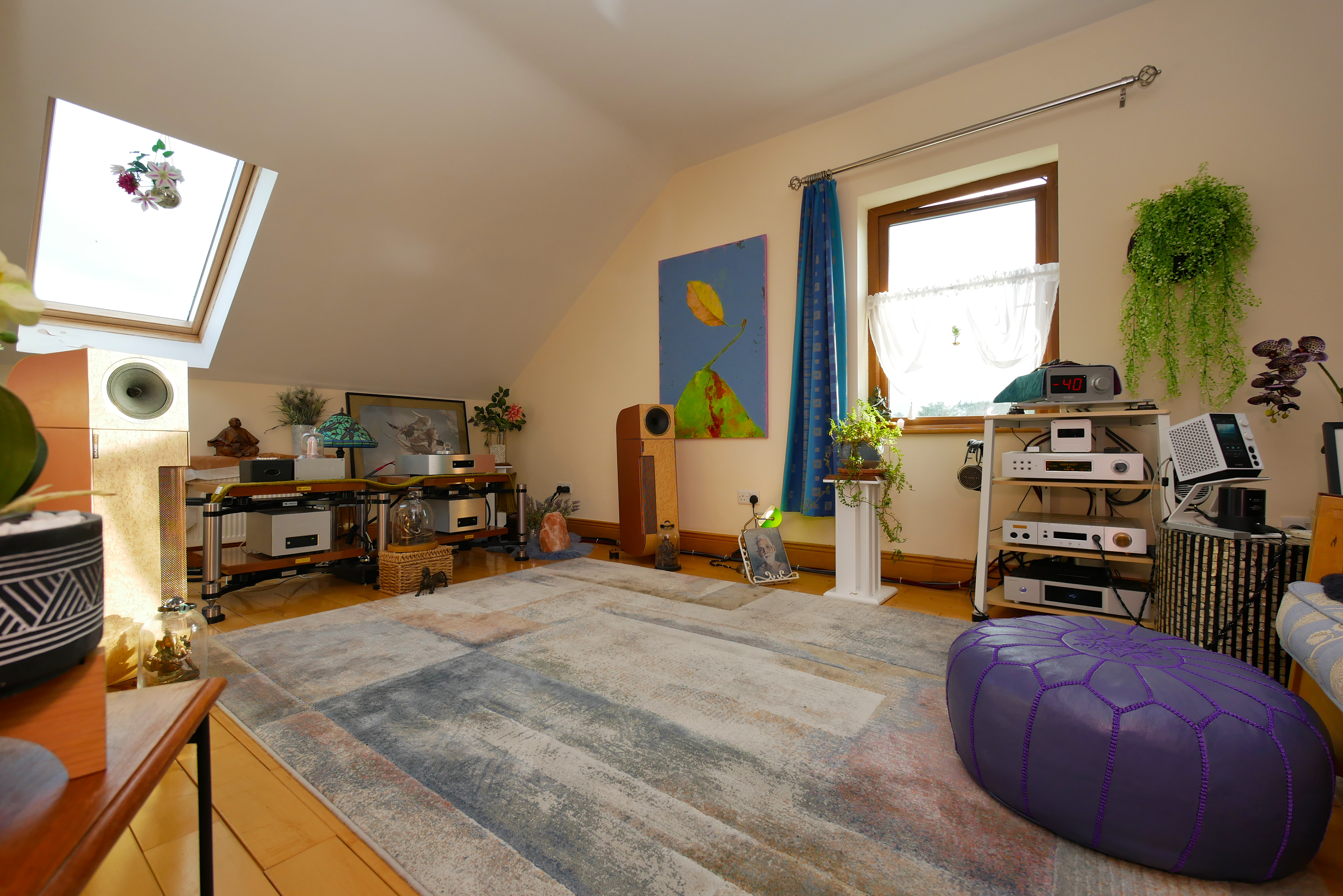
Whilst waiting for its arrival, I thought on what else to try. On a mad lark I swapped crossovers with the other upstairs system; an earlier Lifesaver Gradient Box with minorly different functionality. I felt dumb lucky. Finding that the NCx500 didn't like one crossover but held no complaints about the other; that the 'bad' crossover worked flawlessly in the other system… it reeked of magical thinking where machines think for themselves and indulge petty preferences. Though it solved my problem, it explained absolutely nada. My inner German really doesn't fancy being cast the ignoramus. Sometimes he's just assigned that role then aces it. The world doesn't notice and goes on as it always has; and in this instance, all worked out. Dumb luck indeed. By now the NCx500's boss antics in the main system had simply changed my mind. It's where I do the majority of my work. That deserves my best hardware. The Audiophonics would stay downstairs to drive the twin 15-inch woofers. For upstairs I had a choice of Nord Acoustic class D monos; or Kinki Studio class AB stereo amp. I'd wait until the RiPol sub's arrival to decide. Just then it was time for a full-range test on the desktop.