When Mr. UPS rang the bell at a pitch-black 18'20"—early January's short days are cruel—the initial reaction after unpeeling the first Audalytic from its plain cardboard tomb was, "how cute". It's so not what Dan d'Agostino aims for with his fittingly named Relentless amps; but exactly what my desktop celebrates. The smaller the better; if the sound doesn't dumb down in tandem. Even the silver finish was a virtual stand-in for my Topping monos, something shopping online hadn't realized. My eye-candy needs had their sugar rush. After setting their displays to 'off', the DR70 to NOS mode, only small white glyphs on black remained behind shiny plastic. Or is it glass? I wouldn't know without making a deliberate scratch. Not. At the HP70's max voltage gain, my FiiO FT7 planars worked at ~70/99. So did the speaker amps of low-ish voltage gain. I had plenty of nearfield mayhem left in the tank. Shopping on pure specs, practicalities had zero regrets. How about my grand plan to realsize price and footprints without undue sonic shadows?
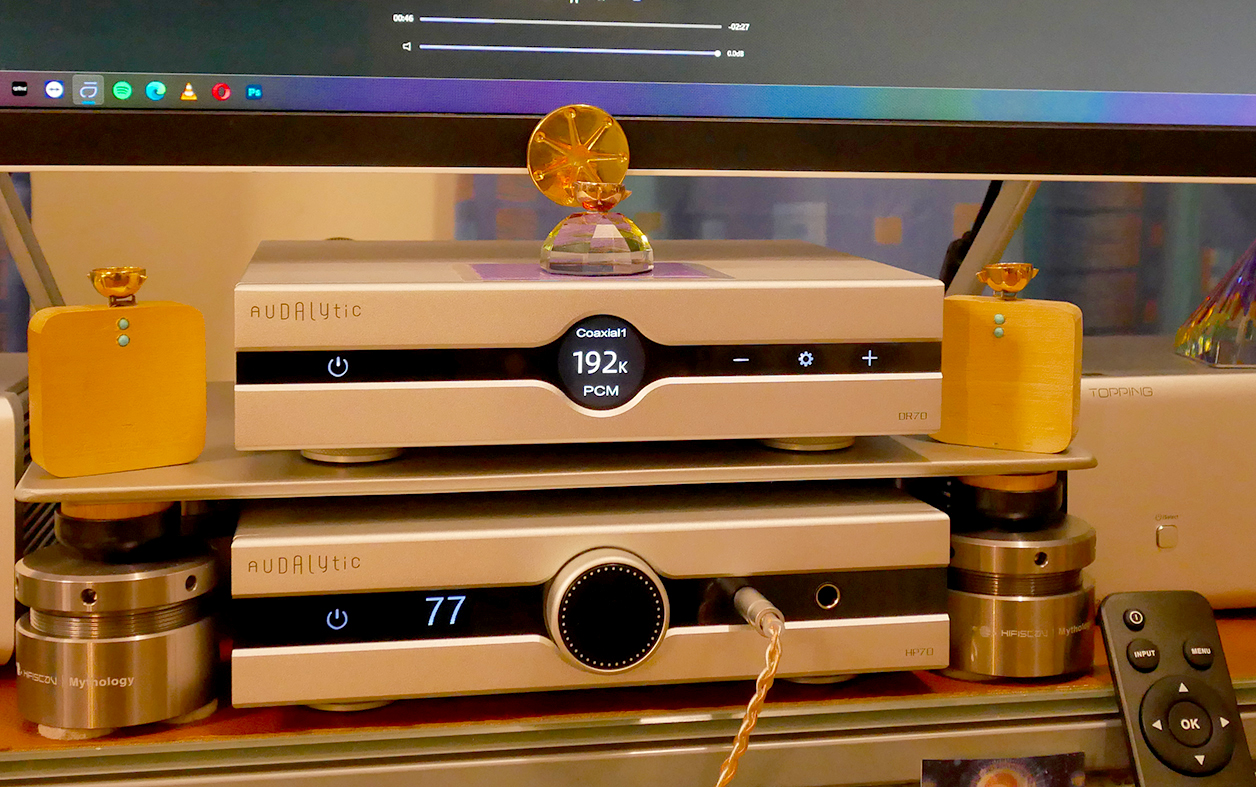 Some footers repurposed from my hifi closet work as risers of just the right height to float my computer monitor above the HP70.
The first order of sonic sleuthing…
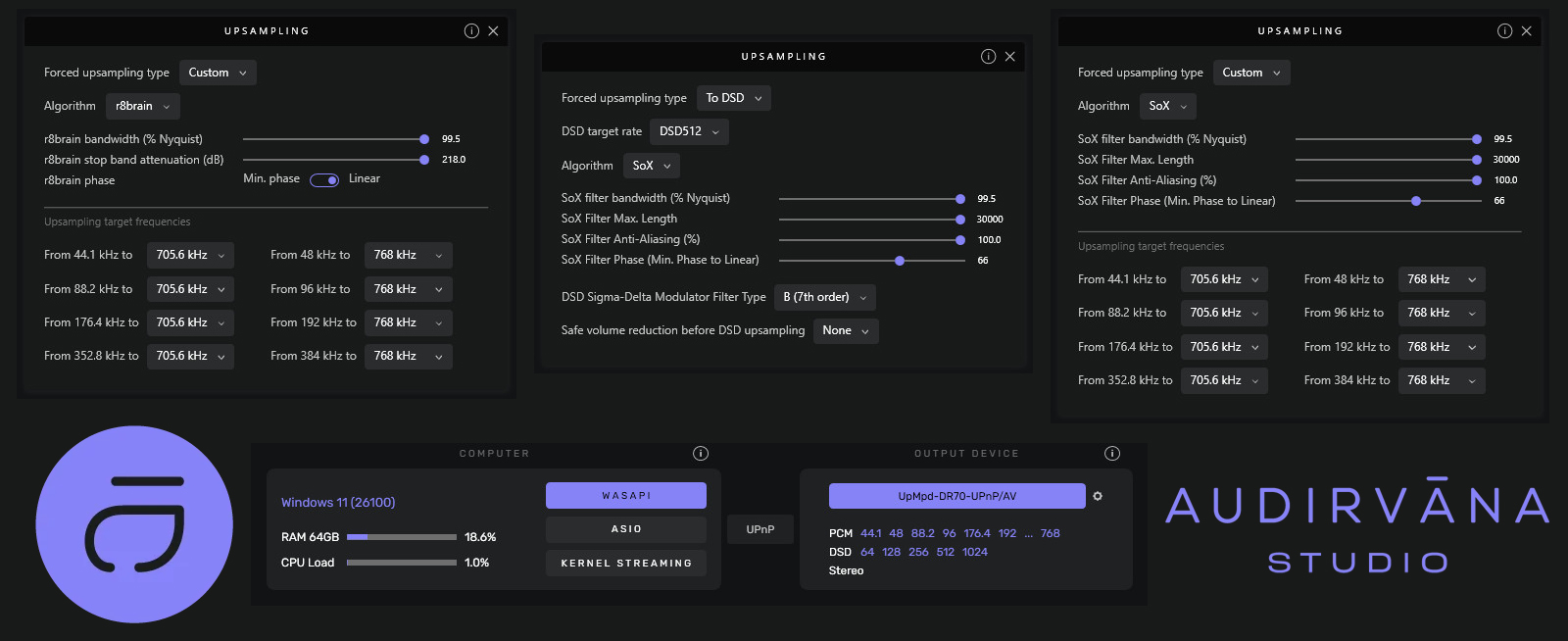










 … had to establish my preferred input; what upsampler engine to set to what target frequency; and whether as hi-rate PCM or DSD. Being UPnP compatible, once the DR70 connected to my LAN, Audirvana located it as UpMdp-DR70. Though shown as DSD1'024 capable, that stuttered. Resampling to DSD512 worked just as advertised. Ditto PCM at 705.6/768kHz.
Then I had a choice of SoX or r8brain algorithm. It took little time to identify a clear preference for hi-rate PCM via r8brain, the DAC itself in NOS mode. This Audirvana setting had the most dynamic contrast and fruitiest tone. DSD felt soft, dark, lazy and vague by contrast¹. I started with the RJ45 copper feed; and to compare, coax through my USB bridge which naturally was limited to 192kHz and DSD64.
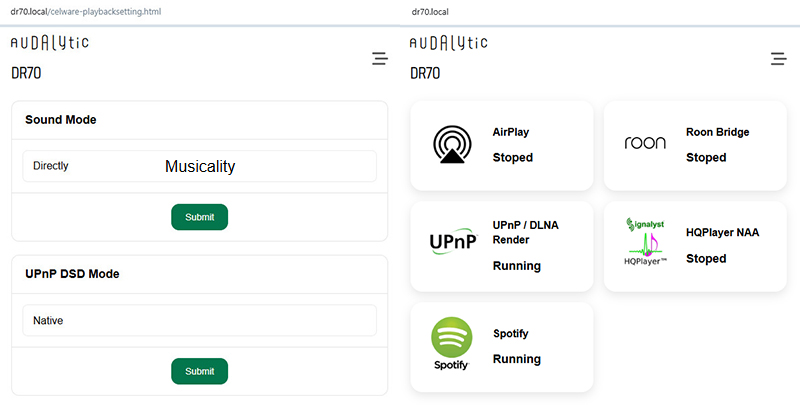
Below is the complete system. My trusty Singxer SU-2 bridge just then was waylaid for a change so out of the signal path. For once I could do without. One less component. Hurray. My realsizing plan was working overtime. At this point I remembered. dr70.local is the browser access for Gustard's basic CelAudio-based streaming module. The interface itself is Flintstonian, even contains blunt typos.
Nevertheless, under playback setting we get a choice of 'directly' and 'musicality' sound modes. We submit our selection and a few seconds later receive confirmation of the change's success. Here my ears were hazy on any difference, my grey cells even foggier. What does this selection do; and how? Off went an email to Chengshi. "This only changes the sound for streaming so only takes effect when using streaming services. Other input ports won't be affected." From John Darko's Ayoshida contact, details were equally fuzzy. "In 'Musicality' mode DSP doesn't alter the frequency response of the analog output. This mode only adjusts the data transmission protocol of the streamer and doesn't affect the FR. All operations on the webpage apply exclusively to the RJ45 input and function independently of the front-panel gear menu settings." Since Audirvana doesn't embed YouTube for its UPnP connection, the DR70 couldn't access it over the network. For that I still had to use the coax input via my USB bridge. Its retirement proved short-lived after all. Or as Audiophonics put it, "does not support standalone network playback—cannot directly access streaming services—and requires the use of a 3rd-party application like BubbleUPnP, Mconnect, Roon or Audirvana for music control and playback." Functionally, Gustard's streaming board is rudimentary. Though the DR70 showed up in my Spotify Premium interface as a device to stream to, it refused to be selectable. Not being a networking wizard, I ran Spotify via USB so turned off the Spotify pane in dr70.local. The best-laid plans. Mice, men 'n' audiofools. Happy days.
______________________
¹ As it turned out, I hadn't yet set the DR70 to DSD Direct mode in its menu. As such I was unwittingly using the default mode which resamples DSD to PCM. I wasn't actually hearing 1-bit processing but a FIR interpolation filter then the standard R2R ladders. Once I made the switch, my assessment completely changed. True DSD with the DR70 is something else altogether and since then I run it at DSD256 via USB.